
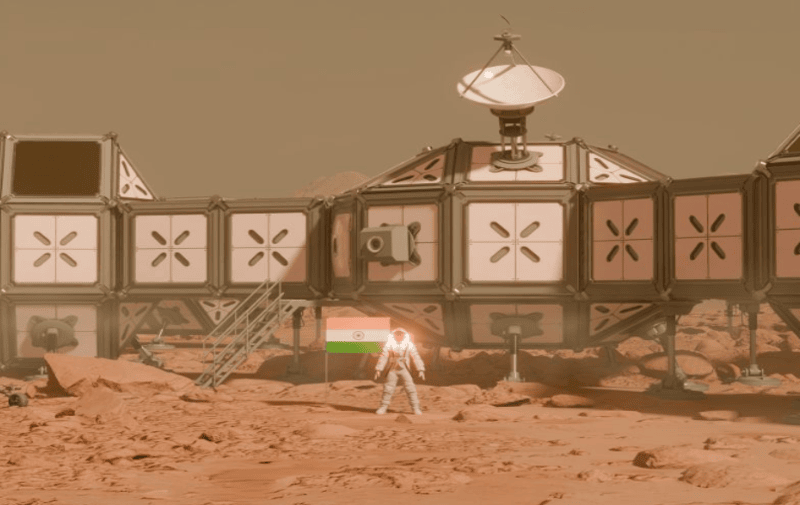
BHEEM: The Made-in-India Space Home That Could One Day House Humans on the Moon or Mars
Getting humans to another world is only half the challenge. The bigger question is: where will they live once they get there?Indian astronaut Shubhanshu Shukla is looking beyond rockets and spacecraft with B.H.E.E.M.—Bharatiya Habitable Expandable Extraterrestrial Habitat, a concept exploring how humans could build homes beyond Earth.The idea emerged from Shukla’s academic research during the Indian phase of his astronaut training and was conceptualised through research at the Aloke Lab at the Indian Institute of Science (IISc), Bengaluru.The research brings together Shukla and IISc researchers Mritunjay Baruah, Amogh Jadhav and Bimalendu Mahapatra.A House That Travels in PiecesBHEEM tackles one of the biggest problems in building homes beyond Earth: how do you transport a large habitat on a rocket with limited space?Instead of launching a massive, pre-built structure, BHEEM proposes transporting smaller structural panels that can be stacked efficiently inside a rocket. Once they reach the Moon or Mars, the panels could be assembled into pressurised living spaces.India Today reports that the concept has been designed around the payload constraints of SpaceX’s Starship, with individual components envisioned to fit inside its payload section before being deployed at their destination.Modular, Expandable and Human-CentredBHEEM is designed to grow with a settlement. Researchers explored different configurations using panels shaped like triangles, squares and pentagons, comparing their structural strength and ability to create usable space.The team first considered what astronauts would actually need to do during long-duration missions. Those activities were then translated into functional living and working spaces. That human-centred approach could allow different BHEEM configurations to be created depending on the mission. As a settlement grows, additional modules could potentially be added.The Work Begins Before the JourneyLiving beyond Earth will involve far more than constructing walls. Future habitats will need protection from radiation and extreme temperatures, along with reliable life-support systems, energy supplies and construction methods suited to unfamiliar environments.BHEEM is still a design concept, not a functioning extraterrestrial habitat. Considerable engineering, testing and development would be needed before such a structure could become reality. But Shukla believes the thinking cannot wait. “If we want humans to live beyond Earth 20 years from now, the work cannot begin 20 years from now. It has to begin today.”And perhaps that is where BHEEM truly begins—not with a rocket launch, but with a question: what will humanity’s first home on another world look like?