
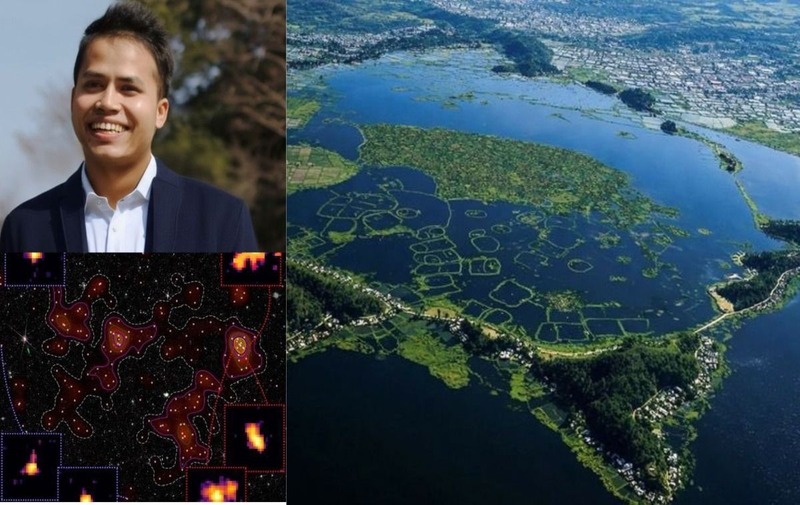
Indian Scientist Names Newly Discovered 12.6-Billion-Year-Old Galaxy Cluster After Manipur Lake
In a discovery that is capturing the imagination of the global scientific community, an Indian scientist has helped uncover one of the earliest known large-scale structures in the universe, a gigantic “city of galaxies” dating back an astonishing 12.6 billion years.Officially named the Loktak Protocluster, the structure was discovered through an international astronomy study led by Dr Ronaldo Laishram, an astrophysicist from Manipur currently working at the National Astronomical Observatory of Japan (NAOJ).Published in The Astrophysical Journal Letters, the groundbreaking study opens a rare window into the infancy of the universe, when galaxies were only beginning to form and gather under the pull of gravity. At the time this newly discovered structure existed, the universe itself was merely 1.2 billion years old, less than 10 percent of its current age. These are crucial because they help explain how today’s massive galaxy clusters evolved over billions of years.Why It Is Called the ‘Loktak Protocluster’What makes the discovery even more special for India is the story behind its name. Dr Laishram chose to name the cosmic structure after his homeland, Manipur’s famous Loktak Lake which is the largest freshwater lake in Northeast India, known for its floating islands called phumdis.The comparison is deeply poetic. Just as the floating islands of Loktak Lake remain interconnected within one vast water body, the newly discovered protocluster contains four distinct concentrations of galaxies connected within one enormous evolving cosmic system.For Dr Laishram, the name is more than scientific terminology, it is a tribute to his roots, culture, and homeland.A Scientific Breakthrough Powered by Advanced TelescopesThe discovery was made using observations from two of the world’s most advanced astronomical instruments, the Subaru Telescope and NASA’s James Webb Space Telescope (JWST). By analysing deep-space data, researchers identified a massive concentration of young galaxies that appeared to be evolving together under gravity.The study also revealed something fascinating about the early universe: galaxies living in crowded cosmic neighbourhoods evolved differently from galaxies in isolated regions. In simple terms, scientists found that where a galaxy exists can influence how it grows and changes over time.The Inspiring Journey of Dr Ronaldo LaishramBehind this extraordinary discovery is an equally inspiring story. Dr Ronaldo Laishram hails from Khangabok in Manipur’s Thoubal district. The youngest among five siblings, he developed a fascination for astronomy at a very young age. At just 18, he discovered a preliminary asteroid and was felicitated by former President Dr A.P.J. Abdul Kalam, a moment that helped shape his scientific journey.He later completed his Master’s degree and PhD in Astronomy from Tohoku University in Japan and is now based in Tokyo, where his research focuses on galaxy formation and evolution in the early universe.Beyond his work in international astronomy, Dr Laishram has also remained committed to science education back home. He is the founding coordinator of the Manipur Astronomical Society (MAS), which promotes astronomy awareness among students and young people in Northeast India.A Proud Moment for Indian ScienceThe discovery of the Loktak Protocluster is being celebrated as a major milestone for Indian science and astronomy. It reflects India’s growing contribution to cutting-edge global research and highlights how scientists from even the most remote corners of the country are helping answer some of humanity’s biggest cosmic questions.