
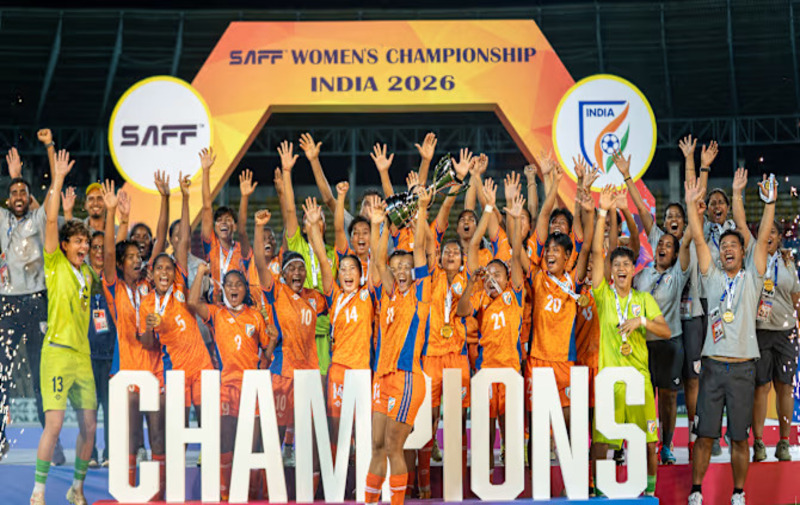
Champions Again! India’s Women's Football Team Lift SAFF Trophy After 7 Years
The queens of South Asian football are back on their throne.In a thrilling finale at the Pandit Jawaharlal Nehru Stadium in Margao, Goa, India defeated defending champions Bangladesh 3-1 to lift the SAFF Women’s Championship 2026 title, ending a seven-year wait and extending their record with a sixth championship crown.The victory marked a triumphant return to the summit for the Blue Tigresses, who produced a dominant campaign and saved their best performance for the biggest stage.A Final Worthy of ChampionsThe much-anticipated clash brought together South Asia’s two strongest women’s football teams. Bangladesh arrived as defending champions and were chasing a historic third consecutive title, while India were determined to reclaim a trophy that had slipped away in the last two editions.From the opening whistle, both sides played with intensity and purpose. India controlled possession and looked more threatening in attack, creating several early opportunities through Manisha Kalyan, Sanfida Nongrum and Astam Oraon. Their persistence finally paid off in the 42nd minute when striker Pyari Xaxa showcased her sharp footwork inside the penalty area before unleashing a shot that took a fortunate deflection and sailed into the net.The Indian supporters erupted in celebration, believing their side had seized control of the contest. But Bangladesh had other ideas.Deep into first-half stoppage time, star forward Ritu Porna Chakma produced a moment of brilliance,and levelled the score at 1-1.Sanfida Sparks India's Second-Half SurgeIf Bangladesh hoped their equaliser would shift momentum, India had a perfect response. Just 40 seconds after the restart, Pyari Xaxa turned creator. Her pinpoint delivery found Sanfida Nongrum, who rose above the defence and powered a header into the net via the post. The goal transformed the match.India grew in confidence, controlling proceedings and repeatedly testing the Bangladesh defence. Every attack carried purpose, while the hosts remained organised and disciplined at the back.As Bangladesh pushed forward in search of an equaliser, gaps began to appear at the back. India capitalised in the 82nd minute when substitute Lynda Kom Serto reacted quickest to a defensive lapse inside the penalty area. Showing remarkable composure, she slotted the ball beyond goalkeeper Mile Akter to make it 3-1.The goal effectively ended the contest and triggered celebrations across the stadium. When the final whistle blew, players, coaching staff and fans erupted in joy as India reclaimed their place atop South Asian women’s football.A Tournament to RememberIndia’s title-winning campaign was nothing short of spectacular. The Blue Tigresses won all four of their matches, scored an impressive 18 goals and conceded only one throughout the tournament. Their attacking flair, defensive solidity and team spirit made them the standout side of the competition.Individual brilliance also shone brightly. Aveka Singh finished as the tournament’s top scorer with four goals, Sanfida Nongrum was named the Most Valuable Player, and goalkeeper Panthoi Chanu Elangbam received the Best Goalkeeper award.Adding an emotional touch to the celebrations was the farewell of veteran Dangmei Grace. The Indian legend, who represented the nation 95 times since her debut in 2013, announced her retirement after helping India secure a third SAFF title in her illustrious career.As fireworks lit up the Goan sky, one message became clear: the Blue Tigresses are back, stronger than ever. After seven long years, India have reclaimed their crown and South Asian football once again belongs to them.