
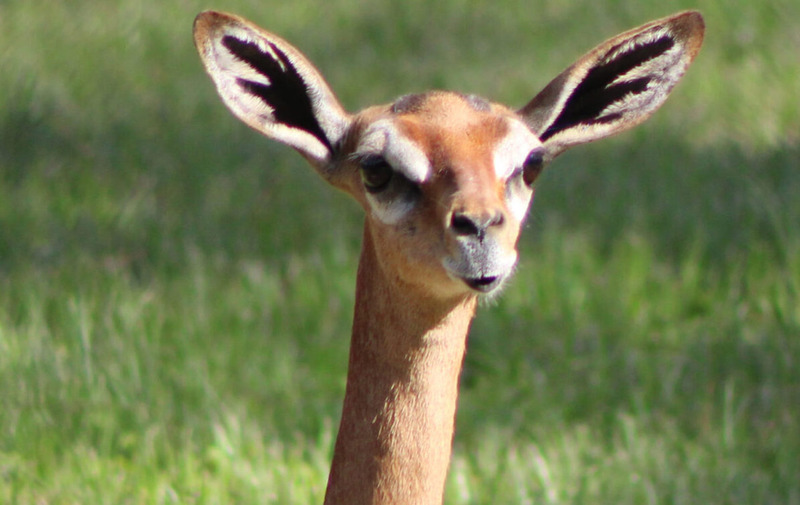
This Animal Can Live Its Entire Life Without Drinking Water! Here’s How the Gerenuk Defies Nature
Imagine surviving your entire life without drinking a single drop of water. Sounds impossible for a mammal, doesn’t it? Yet deep in the dry landscapes of East Africa lives an extraordinary antelope that does exactly that. That's the gerenuk, often called the “giraffe-necked antelope," a strange-looking but brilliantly adapted animal capable of thriving in some of the harshest environments on Earth.Found across Somalia, Kenya, and parts of Djibouti, the gerenuk has evolved a remarkable set of biological tricks that allow it to survive where water is scarce and temperatures soar. And the secret lies not in what it drinks, but in what it eats.Nature’s Ultimate Hydration HackUnlike most animals that depend on lakes, rivers, or watering holes, the gerenuk gets almost all the moisture it needs from its food. Its diet mainly consists of leaves, flowers, fruits, and succulent plants rich in water content. As the animal digests these moisture-filled plants, its body extracts enough hydration to survive even in arid conditions.But that’s only part of the story. The gerenuk also possesses specialised nasal passages that reduce evaporative water loss while breathing. Its body produces extremely concentrated urine, ensuring that very little water is wasted. Together, these adaptations make the gerenuk a master of water conservation, so efficient that it rarely needs to drink at all.Why Does the Gerenuk Look So Strange?At first glance, the gerenuk almost looks like an animal designed by imagination rather than evolution. Its unusually long neck, tiny head, enormous eyes, and oversized ears give it a quirky, almost alien-like appearance. But every feature serves a survival purpose.The long neck helps the animal reach foliage that other antelopes cannot access. Even more impressively, the gerenuk can stand upright on its powerful hind legs, stretching nearly seven feet high to feed on tender shoots and leaves. This ability is made possible by exceptionally strong hind limbs and reinforced lower-back vertebrae.In regions where food is limited near the ground, this adaptation gives the gerenuk a major advantage over competing herbivores. Its long eyelashes and highly sensitive facial hairs also help it navigate thorny bushes without injuring itself while feeding.The Gerenuk (Source: LAZoo)Built for Life in the DrylandsThe gerenuk’s behaviour is just as fascinating as its body. To conserve energy and water, these antelopes are relatively sedentary animals. Apart from short bursts of speed to escape predators, they prefer to remain calm, roam about slowly, and avoid unnecessary movement.They are usually spotted alone or in small groups of two to five, though larger herds can occasionally form in regions where vegetation becomes abundant after rainfall. Interestingly, aerial surveys in East Africa have shown that gerenuks are often found in areas far away from permanent water sources. This strategy helps them avoid competition with animals that depend heavily on drinking water.One of East Africa’s Hidden WondersDespite their extraordinary abilities, gerenuks are often overshadowed by Africa’s more famous wildlife like lions, elephants, and giraffes. Yet conservationists and wildlife rescuers say these elegant antelopes deserve far more attention. The animal is also part of the famous “Northern Five” — a group of rare and iconic northern Kenyan wildlife species that includes the Grevy’s zebra, reticulated giraffe, Somali ostrich, and Beisa oryx.Together, they represent the incredible biodiversity of East Africa’s drylands.A Living Example of Nature’s GeniusThe gerenuk is more than just an unusual antelope. It is a powerful reminder of nature’s ability to adapt, evolve, and survive against the odds. From surviving without water to standing upright like a human to reach food, every aspect of this animal seems almost unbelievable, yet entirely real.In a world increasingly affected by climate change and water scarcity, the gerenuk stands as one of nature’s most astonishing lessons in survival.