
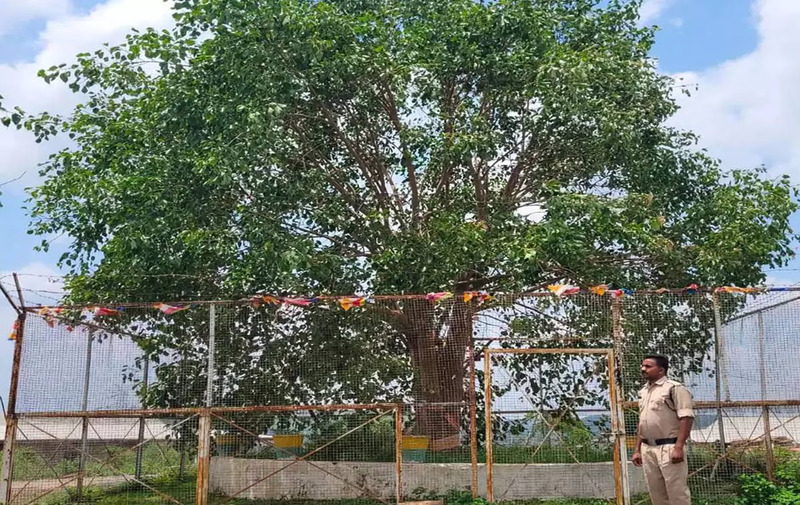
Guarded Day and Night: Why Does This Tree Near Sanchi Have 24x7 Security?
Imagine a single tree protected by armed guards 24 hours a day, enclosed within a towering iron fence, monitored by agricultural experts, and maintained at an annual cost that runs into lakhs. It may sound unbelievable, but this is the reality of the sacred Bodhi tree standing on a hillock near Sanchi in Madhya Pradesh.Located at Salamatpur, around eight kilometres from the UNESCO World Heritage Site of Sanchi Stupa, this Peepal tree is unlike any other in India. Often referred to as the country's first "VVIP tree," every aspect of its care is meticulously planned. Officials ensure that not even a single leaf is left to wither, while dedicated water tankers and expert horticulturists regularly monitor its health.But what makes this tree worthy of such extraordinary protection? The answer lies in a remarkable story that stretches across more than 22 centuries.The Story Begins with Emperor AshokaAccording to various reports online, the sacred journey of this Bodhi tree dates back to the 3rd century BCE during the reign of Emperor Ashoka, one of history's greatest patrons of Buddhism. After embracing Buddhism, Ashoka decided to spread the teachings of Gautama Buddha beyond India's borders. He entrusted his son, Arhat Mahinda, and daughter, Sanghamitta, with carrying a sapling from the original Bodhi tree in Bodh Gaya, the very tree under which Buddha attained enlightenment, to Sri Lanka.Interestingly, historical accounts state that Mahinda and Sanghamitta began this historic mission from Sanchi itself before sailing to Sri Lanka. The sapling was planted at Anuradhapura, in Sri Lanka, where it grew into the revered Jaya Sri Maha Bodhi, one of the world's oldest continuously documented living trees.A Historic Journey Comes Full CircleCenturies passed, and while the original Bodhi tree at Bodh Gaya was damaged and replaced multiple times through history, its ancient lineage remained alive in Sri Lanka. More than 2,200 years after Ashoka's historic gift, the story came full circle.In September 2012, then Sri Lankan President Mahinda Rajapaksa brought a sacred sapling from the Jaya Sri Maha Bodhi back to India. The sapling was planted near Sanchi's Buddhist Vihara, symbolically returning the sacred lineage to the place from where it had once begun its journey across the sea. Why Every Leaf MattersFor millions of Buddhists worldwide, this is far more than a Peepal tree. It represents an unbroken biological and spiritual connection to the original Bodhi tree associated with Buddha's enlightenment. As a direct descendant of that ancient lineage, the tree has become a symbol of peace, faith, and historical continuity.Recognising its immense significance, the Madhya Pradesh government has placed the tree under constant protection. A 15-foot-high iron mesh fence surrounds it, while four security personnel guard it around the clock. Agricultural specialists regularly inspect its condition, ensuring the sacred tree remains healthy for generations to come.Standing Beside Sanchi's Timeless LegacyThe Bodhi tree's presence beautifully complements the nearby Sanchi Stupa, one of India's oldest stone monuments and among the finest surviving examples of Buddhist architecture. Commissioned by Emperor Ashoka in the 3rd century BCE, the Sanchi Stupa houses sacred relics of the Buddha and is renowned for its exquisitely carved stone gateways that narrate stories from Buddhist traditions. Together, the ancient monument and the sacred tree create a powerful reminder of Buddhism's enduring journey through time.In an age where monuments are often built from stone and steel, this living tree stands as perhaps the most remarkable heritage monument of all, its roots preserving a story that has travelled across nations and survived centuries.