
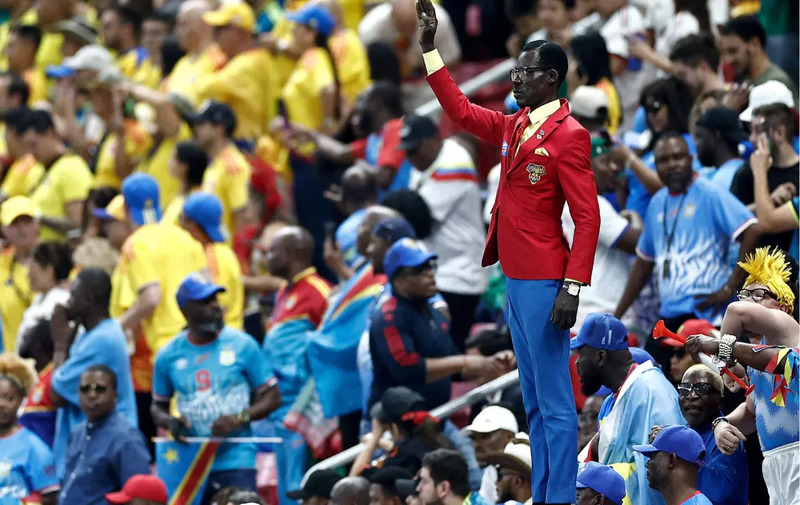
The Fan Who Never Moves: Why a 'Living Statue' Is Captivating the FIFA World Cup
Football stadiums are usually filled with roaring chants, dancing fans and endless waves of emotion. But at the FIFA World Cup, one man has become impossible to ignore, not because he shouts the loudest, but because he doesn't move at all.Dressed in a vibrant suit reflecting the colours of the Democratic Republic of Congo (DRC) flag, Michel Kuka Mboladinga stands motionless throughout the entire match with one arm raised high, resembling a bronze statue. Around him, thousands of fans erupt with joy, but he remains frozen in place.His silent tribute has captured the world's attention. Yet it is far more than an unusual fan ritual. It is a powerful homage to Patrice Émery Lumumba, the DRC's first democratically elected Prime Minister and one of Africa's most enduring symbols of freedom, unity and resistance.A Statue With a Powerful MessageKnown affectionately as "Lumumba Vea" or "Lumumba Lives," Mboladinga first gained international recognition during the Africa Cup of Nations before becoming one of the most recognisable faces of the FIFA World Cup.His resemblance to Lumumba is striking, but it is his unwavering pose that carries the deepest meaning. Mboladinga says he stands as a "living statue" to honour a leader who dreamed of a united, sovereign Congo free from colonial rule and ethnic divisions. Remaining perfectly still is his way of symbolising dignity and unwavering national pride."My job is not just to stand there," he told CNN Sports. "It is to communicate energy, strength and power to the players."Who Was Patrice Lumumba?To understand the symbolism, one must revisit one of Africa's most turbulent chapters. Born in 1925, Patrice Lumumba emerged as a leading voice against Belgian colonial rule. At the time, Congo had endured decades of exploitation that began under Belgian King Leopold II, whose brutal administration resulted in the deaths of millions of Congolese through forced labour, disease and famine.Lumumba co-founded the Mouvement National Congolais (MNC), advocating national unity across Congo's many ethnic communities. When the country gained independence in June 1960, he became its first democratically elected Prime Minister. His vision extended beyond political independence. He wanted genuine sovereignty, equality and an end to foreign control over Congo's immense natural wealth.However, his tenure lasted less than seven months. Amid political turmoil and Cold War tensions, Lumumba was abducted and assassinated in January 1961 by forces backed by Belgian interests. He was only 35 years old.Despite his short time in office, Lumumba became an enduring symbol of African liberation. Civil rights leader Malcolm X once described him as "the greatest Black man who ever walked the African continent."Football Meets National IdentityFor Mboladinga, football offers the perfect platform to keep Lumumba's legacy alive. Standing as a living statue, he reminds the world of a leader whose ideals continue to inspire millions of Congolese people.His tribute comes at a meaningful moment, as the DRC returns to the FIFA World Cup after more than five decades. The team has already impressed by holding Portugal to a 1-1 draw and producing a spirited display against Colombia despite narrowly losing 1-0.Mboladinga's presence has become so significant that Congolese authorities ensured he travelled with the team's official delegation after visa complications threatened his participation.More Than a Football FanWhat fascinates spectators almost as much as his message is his remarkable discipline. Mboladinga trains for days every month to remain motionless for an entire football match, regardless of scorching temperatures or humidity.As the Democratic Republic of Congo continues to face conflict, disease outbreaks and economic challenges, his silent presence has become a powerful symbol of resilience. Sometimes, the loudest message in a packed stadium doesn't come from cheering crowds. Sometimes, it comes from one man who refuses to move—reminding an entire nation and the world that the ideals of Patrice Lumumba still stand tall.