
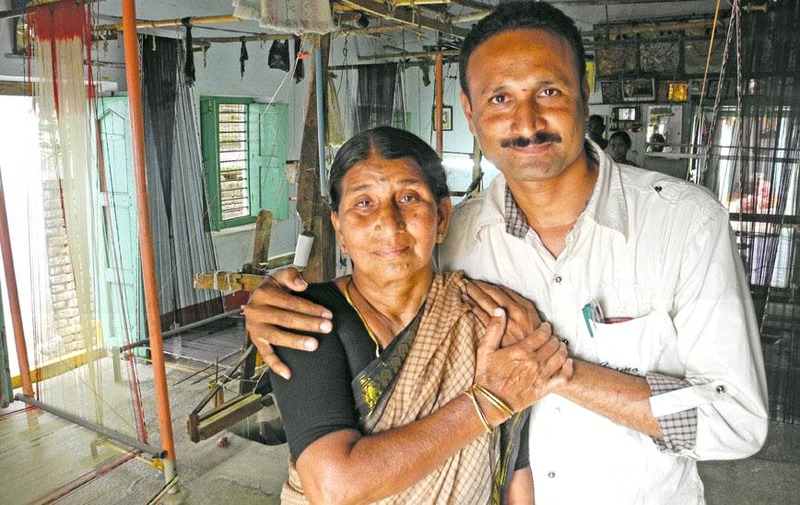
He Built a Machine for His Mother—and Changed the Lives of Thousands of Weavers
Sometimes, the biggest inventions begin with the simplest of wishes: to see someone you love suffer a little less. For Chintakindi Mallesham, that someone was his mother, Laxmi. Growing up in a family of handloom weavers in Sharjipet, Telangana, Mallesham watched his mother perform asu—the painstaking process of winding silk yarn to prepare the intricate patterns of a saree. For every saree, she had to make thousands of repetitive arm movements. The work could take around six hours, leaving her shoulders and elbows aching. At night, she would rub balm on her painful arms and rest.Her son noticed. And he decided something had to change.An Inventor Without an Engineering DegreeMallesham did not have a laboratory, engineering qualification or sophisticated equipment. He had left school early to help his family earn a living. Yet the thought of easing his mother’s burden stayed with him.He began experimenting with a machine that could automate the asu process. Parts were assembled on a wooden frame, ideas were tested and failures followed one after another. Each unsuccessful attempt meant lost time and money—a heavy burden for a family dependent on handloom work.People around him questioned his obsession. Even his family worried about the resources being spent. But Mallesham refused to give up.He travelled to Hyderabad, observed machines in workshops and taught himself by watching how their components moved. Slowly, the pieces of his idea came together. Then came the breakthrough: the Laxmi Asu Machine, named lovingly after his mother.Six Hours Became 90 MinutesThe machine automated the laborious asu process while retaining the precision required for traditional saree-making.A task that once took about six hours could be completed in roughly 90 minutes. Productivity rose dramatically, allowing weavers to prepare several times more patterns than before. But the real impact could not be measured only in numbers.For women who had spent years enduring repetitive physical strain, the machine offered relief. For weaving families, greater productivity meant better earning opportunities. Elderly women and widows could participate in production with less physical hardship, while younger women gained more opportunities to pursue education.From a Village Workshop to the Padma ShriMallesham’s grassroots innovation soon attracted national and international recognition. In 2009, he received the National Innovation Foundation’s award for grassroots innovation, and the Laxmi Asu was recognised internationally. He later secured a patent for the machine and continued receiving accolades for his work.In 2017, the man who had once experimented with machines without formal engineering training received the Padma Shri in Science and Engineering.Yet perhaps his greatest reward was far more personal. It was knowing that the machine bearing his mother’s name had helped ease the very pain that inspired him to invent it.An Invention Born From LoveMallesham’s story is a beautiful reminder that innovation does not always begin in elite laboratories. Sometimes, it begins at home. It begins with a son watching his mother rub balm on aching arms—and deciding he cannot simply stand by.He did not set out to change the handloom industry. He simply wanted to make his mother’s life easier. In doing so, he helped thousands of others live and work with greater comfort and dignity.