
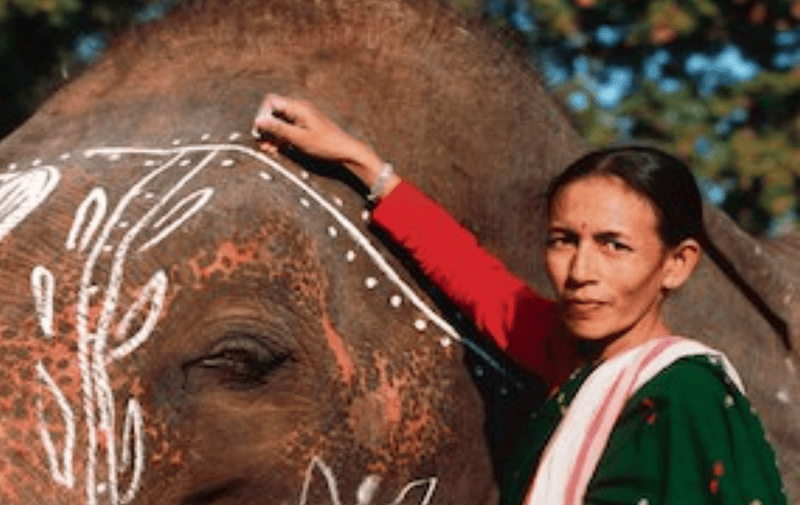
She Chose Elephants Over Dolls—How Parbati Barua Became India's First Female Mahout
From a very young age, Parbati Barua found herself captivated by the forests and the majestic elephants that roamed them. Born on March 14, 1953, into the royal family of Gauripur in Assam, Parbati was one of nine children of the late Prakritish Chandra Barua, the last Rajah of Gauripur. Her father was internationally respected for his deep knowledge of elephants, and it was from him that she inherited an extraordinary bond with the gentle giants.The 14-Year-Old Who Captured Her First ElephantAt an age when most teenagers are discovering their hobbies, Parbati was venturing deep into the forests of Kochugaon in Assam's Kokrajhar district. At just 14 years old, she successfully captured and domesticated her first wild elephant, an achievement few could have imagined, especially for a young girl in a field almost entirely dominated by men.That defining moment earned her the affectionate title 'Hasti Kanya' (Elephant Girl) and marked the beginning of an extraordinary journey. In 1972, Parbati officially became India's first female mahout, breaking barriers that had stood for generations. A Life Dedicated to the Gentle GiantsOver the decades, Parbati Barua has worked with more than 500 elephants, using traditional methods passed down through generations. She became known for employing the age-old Mela Shikar technique to safely capture and rehabilitate wild elephants without relying on tranquiliser guns.But her work extended far beyond elephant taming. She played a vital role in reducing human-elephant conflict across Assam, Kerala, West Bengal, Uttarakhand and Uttar Pradesh. Working closely with forest departments, she trained mahouts, guided wildlife officials and promoted herbal treatments for elephants, helping create safer coexistence between humans and wildlife.For Parbati, elephants have never been merely animals. When asked about her lifelong fascination, she once beautifully summed it up by saying that love cannot be explained.From Assam's Forests to the Global StageParbati's remarkable work soon gained international recognition. She represented India at the International Workshop on the Domesticated Asian Elephant organised by the Food and Agriculture Organization (FAO) in Bangkok in 2001, sharing her expertise with conservationists from around the world.Her inspiring life also became the subject of the acclaimed BBC documentary Queen of the Elephants, introducing global audiences to the woman who fearlessly walked beside some of nature's largest creatures. More recently, the documentary Aparajita 2023 won the "Nature's Warrior" Jury Award at the Kolkata International Wildlife & Environment Film Festival, further celebrating her extraordinary legacy.A Legacy That Continues to InspireParbati Barua's lifelong dedication has earned her some of India's highest honours, including the Padma Shri, conferred by President Droupadi Murmu in 2024 for her outstanding contribution to elephant conservation and social work.She has also received the Asom Gaurav Award, the United Nations Environment Programme's Global 500 Roll of Honour, and was appointed Honorary Chief Elephant Warden of Assam—recognition of decades spent protecting one of India's most iconic species.Today, Parbati Barua stands as far more than India's first female mahout. She is a conservation icon whose courage transformed tradition, whose compassion strengthened wildlife protection, and whose extraordinary journey continues to inspire countless young people.