
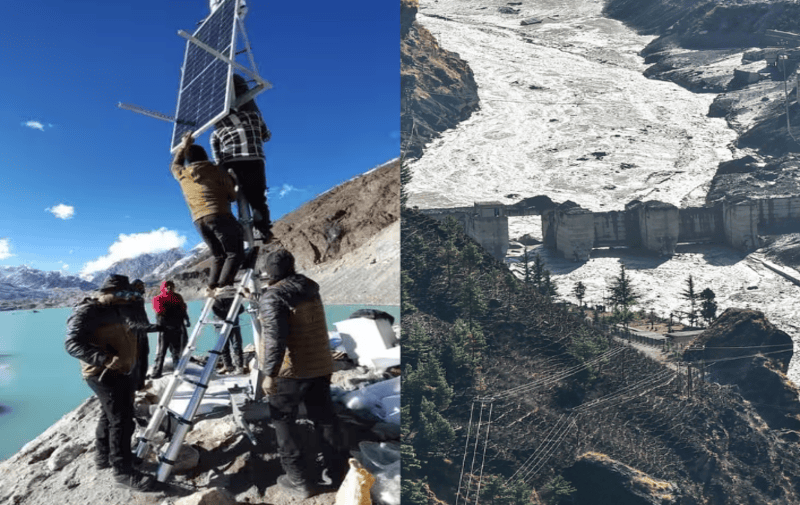
Uttarakhand Installs Its First Glacial Lake Early-Warning System to Detect Flood Risks in the Himalayas
What if scientists could detect warning signs of a dangerous glacial lake flood before it rushes into valleys and communities? Uttarakhand is taking an important step towards making this possible with its first glacial lake early-warning system at Vasundhara Tal in Chamoli district.The initiative comes amid growing concerns over disasters in the Himalayas, including devastating floods in neighbouring Nepal. By moving beyond mapping vulnerable lakes to monitoring them continuously, the state aims to strengthen its ability to identify potential threats and prepare for emergencies.A team of scientists and technical experts from the Central Building Research Institute (CBRI), Roorkee, and the Wadia Institute of Himalayan Geology, Dehradun, has been deployed to install the system with support from disaster response forces and the Indo-Tibetan Border Police.What Will the System Monitor?The technology will keep a close watch on several environmental changes around Vasundhara Tal that could signal rising risks.Water-level sensors will track fluctuations in the lake, while an automatic weather station will record rainfall, temperature, humidity, wind speed, wind direction and atmospheric pressure. Snow-depth and underground temperature sensors will help scientists understand changing snow conditions.The system will also use tilt and accelerometer sensors to detect movement and vibrations at selected locations. A water-flow sensor will monitor changes in the volume of water flowing out of the lake. Together, these readings will help scientists build a clearer picture of conditions around the lake and identify unusual changes that may require attention.Solar Power and Satellites Keep It ConnectedInstalling monitoring equipment in the high Himalayas comes with its own challenges. Remote terrain and the absence of conventional mobile networks make communication difficult.To overcome this, the system will run on solar energy and transmit data through satellite communication. A data logger and monitoring dashboard will record readings and generate alerts when predefined thresholds are crossed.This continuous flow of information can help experts assess developing risks more quickly. However, timely warnings will also depend on interpreting the data correctly and ensuring that alerts reach vulnerable communities.Why Vasundhara Tal MattersThe National Disaster Management Authority has identified 13 high-risk glacial lakes in Uttarakhand, including five in its highest-risk Category A classification. Vasundhara Tal is among these vulnerable lakes.According to government data, 344 glacial lakes were identified across the state in 2023. Scientists have also conducted depth surveys at six lakes to understand their water-holding capacity and assess the potential scale of a glacial lake outburst flood (GLOF). A GLOF occurs when water stored in a glacial lake is suddenly released, potentially sending destructive torrents downstream.Turning Scientific Data into SafetyUttarakhand's new system marks an important move towards science-based disaster preparedness. By combining continuous monitoring, satellite communication and automated alerts, the state hopes to recognise dangerous changes before they escalate.The ultimate goal is to help protect downstream communities, roads, bridges and hydropower projects. In a region where nature can change rapidly, better information and timely warnings could make a crucial difference.