
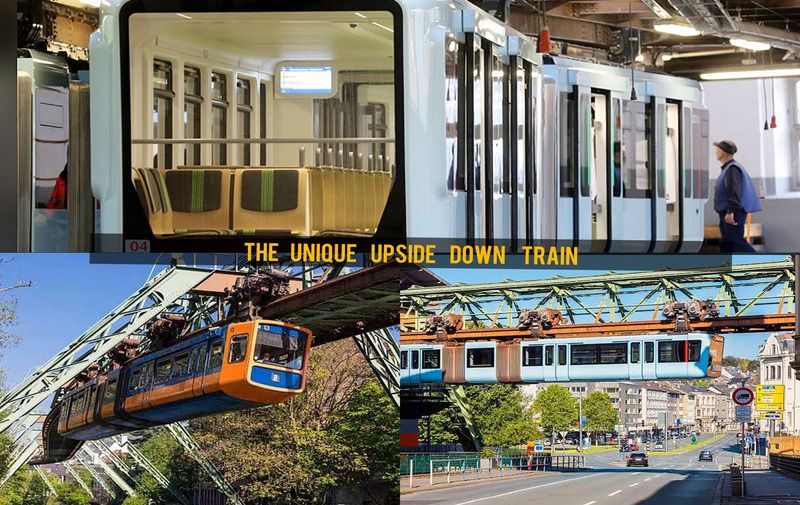
124 Years in the Air: The Story of the Wuppertal Hanging Railway
At first glance, the Wuppertal Schwebebahn looks like something straight out of a futuristic sci-fi film: a sleek blue train hanging from its tracks, gliding gently above a river and weaving through a compact German city. But this marvel is not new at all. It has been operating continuously since 1901, making it the world’s oldest suspension railway. More than a century later, it still carries thousands of daily commuters, while travellers from around the world visit just to experience the easy floating sensation of riding a train that hangs rather than rolls.Hop On the Spectacular Wuppertal SchwebebahnLocated in the lively city of Wuppertal, the Schwebebahn glides along tall iron arches, giving passengers the feeling of flying through the air. As the train passes above roads, neighbourhoods and busy market squares, the scenery slowly opens into stunning views of the Wupper River. For tourists, this bird’s-eye view alone is worth the ride. In some sections, the train is suspended 29 feet above the ground, offering a rare perspective that blends engineering wonder with the calm joy of watching city life from above. It’s a moving window into Wuppertal’s architecture, its people, and its river—all happening beneath your feet.Why Was an Upside-Down Train Needed? The City’s Unique ProblemTo understand this unusual design, we need to go back to the late 1800s. Wuppertal’s textile industry was booming, and the town was rapidly growing. But the entire city lay stretched along a narrow river valley. There simply wasn’t enough space for traditional trams or railways. Building a ground-level or elevated railway along the twisting banks of the Wupper River was nearly impossible. This is where engineer and entrepreneur Eugen Langen stepped in. He had experimented with hanging railways for transporting goods, and he believed the same model could work for Wuppertal’s public transport. His idea seemed strange at the time, but the city embraced the innovation—and in 1901, the world’s first hanging train opened to the public.A Brief History of a Gravity-Defying IconConstruction began in 1898, and after successful test runs, the first section opened in March 1901. The Schwebebahn quickly became the pride of Wuppertal. Over the decades, the system has seen continuous upgrades, with new tracks, modernized stations, and updated carriages replacing the old ones. Yet, one beloved piece of the past still survives: the Kaiserwagen, the very first carriage used in 1901. Named after Kaiser Wilhelm II, who famously rode it, the restored Kaiserwagen can still be hired for private tours today. Riding it feels like gliding through history itself. Through wars, economic changes, and city transformations, the Schwebebahn never stopped running—a testament to the strength of its design and the importance of its role in the city.How the Hanging Train Actually WorksUnlike normal trains, the Schwebebahn doesn’t roll on tracks. It hangs from them. The wheels are on top, hidden above the carriage, while the passenger cabin hangs below the steel rail. This creates a unique floating feeling, especially when the train curves or speeds up. Technically, it is a suspension monorail, designed so that gravity and balance keep it stable. Because it hangs, it is almost impossible for the train to derail during regular operation—another reason why the system has endured for 124 years. A full journey across all 20 stations takes about 35 minutes, offering enough time to enjoy views of the river, neighbourhoods and the life happening under the tracks. Despite its global fame, the Schwebebahn is not just a nostalgic showpiece. It remains a core part of Wuppertal’s public transport, carrying more than 80,000 passengers daily. According to its official website, the hanging train serves both regular commuters and visitors who come simply to experience its unusual charm.Tickets, Costs, and Practical DetailsA standard private tour in the historic Kaiserwagen costs 10 euros (₹905) per person, with additional passengers paying 4.40 euros (₹452) each. Children under six travel free. Regular commuter tickets are much cheaper, similar to local public transport rates. For the people of Wuppertal, the Schwebebahn is not merely a mode of transport; it is a companion in their city’s story, a symbol that has stayed strong through 124 years of change.