
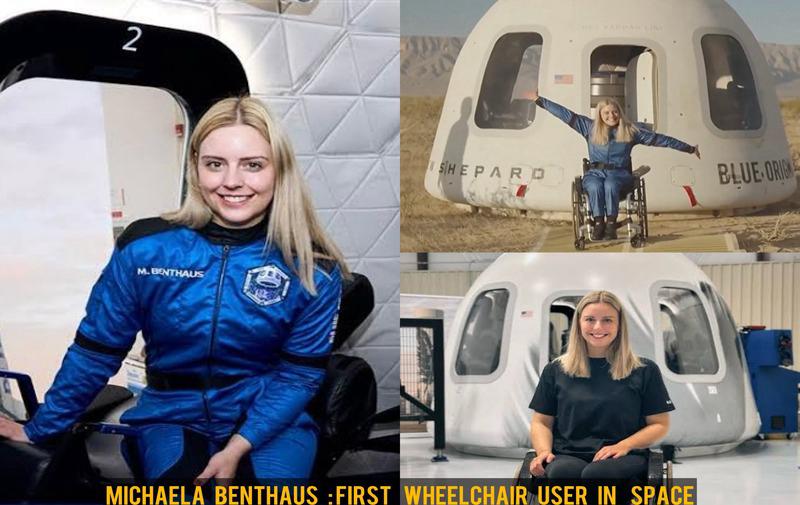
Wheelchair to the Stars : Michaela Benthaus Becomes The First Wheelchair User in Space
German engineer Michaela Benthaus made her name in history by becoming the first person with paraplegia to travel to space. Her journey aboard US billionaire Jeff Bezos’ space tourism company Blue Origin marked a milestone for accessibility and representation in the aerospace world. The brief suborbital flight lasted around 11 minutes but carried a profound message: space is for everyone. Benthaus’ achievement was possible not only due to personal determination but also because of the collaborative efforts of a team committed to making space accessible to people with disabilities.The Journey to SpaceBenthaus’ historic flight took off aboard Blue Origin’s New Shepard NS-37 at 8:15 a.m. local time from a launch site in West Texas. The suborbital vehicle reached an altitude of approximately 100 kilometers, providing passengers with a fleeting but unforgettable experience of weightlessness and breathtaking views of Earth. Alongside Benthaus were former space engineer Hans Königsmann from Germany and four American entrepreneurs. Each stage of the journey, from launch to microgravity and descent, showcased the seamless integration of technology and human courage.A Remarkable Engineer with an Inspiring StoryAt 33 years old, Michaela Benthaus works at the European Space Agency (ESA). Her life took a dramatic turn at 26 when a mountain biking accident left her with a spinal injury, requiring her to use a wheelchair. Instead of limiting her ambitions, this challenge fueled her determination to pursue her dreams. “It was the coolest experience ever, honestly,” she said after returning to Earth. Benthaus’ journey illustrates the power of resilience, showing that physical limitations do not define one’s potential to achieve extraordinary goals.Benthaus used her flight to highlight the importance of accessibility for people with disabilities. She emphasized how her accident revealed the barriers still present in everyday life and urged society to create more inclusive environments. During the flight, she independently transferred from her wheelchair into the capsule using a bench designed for accessibility, demonstrating both her skill and the critical role of adaptive technology. Her message resonates globally: inclusivity is not a privilege but a fundamental requirement for a society that values equal opportunity.Collaboration and SupportThe success of Benthaus’ flight was made possible by meticulous planning and collaboration. Hans Königsmann, a retired SpaceX manager, was present to assist if needed, and Blue Origin adapted ground support equipment to facilitate her entry and exit from the capsule. Benthaus recalls asking Königsmann if someone like her could become an astronaut. “I met Hans the first time online,” she said. “I just asked him, ‘Do you think that people like me can be astronauts?” His encouragement, coupled with her determination, ensured the mission’s smooth execution and set an example of teamwork and mentorship in space exploration.By sharing her experience publicly, she has become a role model for individuals with disabilities and advocates for a more inclusive world, encouraging them to pursue careers in STEM, aviation, and beyond.The Flight and Its Technical SignificanceBlue Origin’s New Shepard NS-37 provided a safe and controlled environment for the historic flight. The reusable suborbital launch vehicle reached the Kármán line at 100 kilometers above Earth, giving passengers a brief moment of microgravity and stunning views. The 16th crewed mission for Blue Origin demonstrates the company’s growing role in space tourism, highlighting technological innovation while opening doors for diverse participants. Benthaus’ inclusion emphasizes that space exploration is expanding beyond traditional astronaut profiles to include people with unique challenges and perspectives.Space for EveryoneMichaela Benthaus’ journey is more than a spaceflight; it is a symbol of inclusivity and human potential. By becoming the first wheelchair user to travel to space, she has not only achieved a personal dream but has also redefined what is possible for people with disabilities. Her story emphasizes that technological advancement must go hand in hand with social progress. As space tourism expands, Benthaus’ historic flight will remain a beacon of inspiration, reminding the world that courage and determination know no physical boundaries.