
From Classroom to National Stage: Tushar Shaw’s AI Glasses Are Changing Lives!
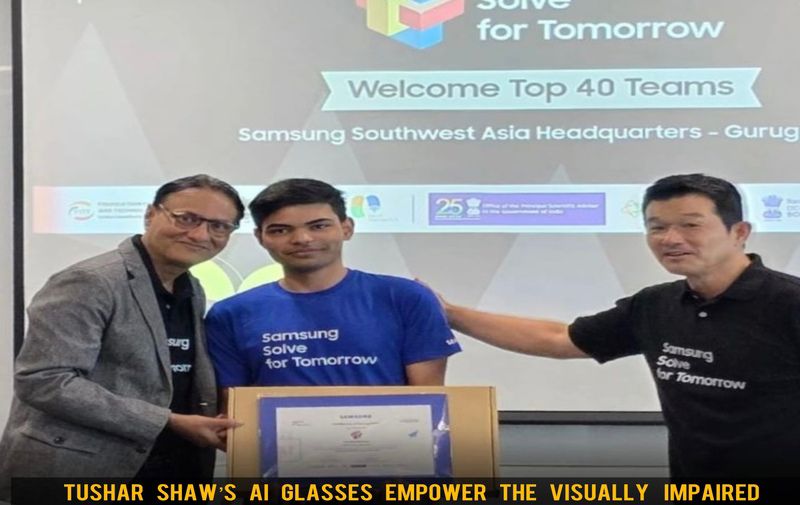
At just 19 years of age, Tushar Shaw, a second-year engineering student at the Scaler School of Technology (SST) in Bengaluru, has achieved what many innovators spend years striving for. His invention, an AI-powered smart glasses device named Percevia, has earned national attention for its potential to transform the lives of people with complete blindness. More than a technological breakthrough, Percevia is a deeply human innovation born out of empathy, curiosity and a desire to solve a real-world problem. Tushar’s journey reflects the power of young minds when given the freedom to build, experiment and fail. What began as a classroom assignment has now evolved into one of India’s most promising student-led assistive technologies.From Midterm Project to National RecognitionPercevia did not start as a startup idea or a competition entry. It began as a midterm project at SST, where students are encouraged to think beyond grades and focus on real impact. Guided by faculty mentors and shaped by direct feedback from visually impaired users, Tushar gradually refined his concept from a prototype into a field-tested solution. His dedication paid off when Percevia advanced through the highly competitive Samsung Solve for Tomorrow 2025 challenge. Tushar moved from the Top 20 to the Top 10 and eventually emerged as one of the four national winners, securing the top prize of ₹25 lakh. Reflecting on the experience, he described it as finding “a tribe of builders,” where collaboration and shared ambition pushed everyone beyond their perceived limits.What Is Percevia, and Why It MattersPercevia is an AI-powered smart glasses device designed to assist people with complete blindness in navigating their surroundings safely and independently. Unlike many assistive tools that offer limited functionality, Percevia acts as a real-time sensory companion, translating visual information into sound and vibration cues. At its core, the device uses Google Gemini 2.0 Flash to process visual input captured through the glasses. This allows Percevia to recognize objects, faces, text and spatial layouts instantly. For a blind user, this means understanding what lies ahead, who is nearby and what obstacles need to be avoided—all without relying on constant external assistance.Engineering Meets EmpathyWhat impressed judges and mentors alike was not just the technology behind Percevia but its human-centered design. Samsung praised the project for its engineering clarity, thoughtful design choices and purpose-driven innovation. Scaler School of Technology highlighted it as a powerful example of how deep-tech, when guided by empathy, can create meaningful social impact. The device offers real-time object awareness, distance and depth sensing to avoid collisions, and face recognition that helps users identify known people. It can read and summarize text, provide voice guidance and deliver vibration-based safety alerts. All processing is powered through a smartphone, keeping the glasses lightweight, comfortable and practical for everyday use. One of Percevia’s strongest foundations lies in its iterative design process. Tushar actively involved visually impaired users in testing and feedback sessions, refining the device based on their real experiences. Comfort, usability and clarity of cues were given as much importance as technical accuracy.The Road Ahead: From Prototype to ProductWith the prize money and national recognition, Tushar is now focused on developing a production-ready version of Percevia. The next phase involves rigorous pilot testing in blind schools across India. These trials will help improve usability, enhance comfort and fine-tune AI performance across diverse environments. Affordability remains a key priority. Tushar aims to price Percevia around ₹29,999, making it accessible to a wider section of users. He also hopes to collaborate with NGOs and accessibility-focused organizations to ensure the device reaches those who need it most, not just those who can afford it.A New Chapter in Assistive TechnologyPercevia stands as one of the most impactful student-led assistive technologies to emerge from India in recent years. It reflects the growing power of AI when guided by empathy and responsibility. As Tushar Shaw continues to refine and scale his invention, his journey sends a powerful message to young innovators across the country. Meaningful change often begins with a simple question: how can I help? At 19, Tushar is not just building technology. He is building a future where innovation sees everyone.