
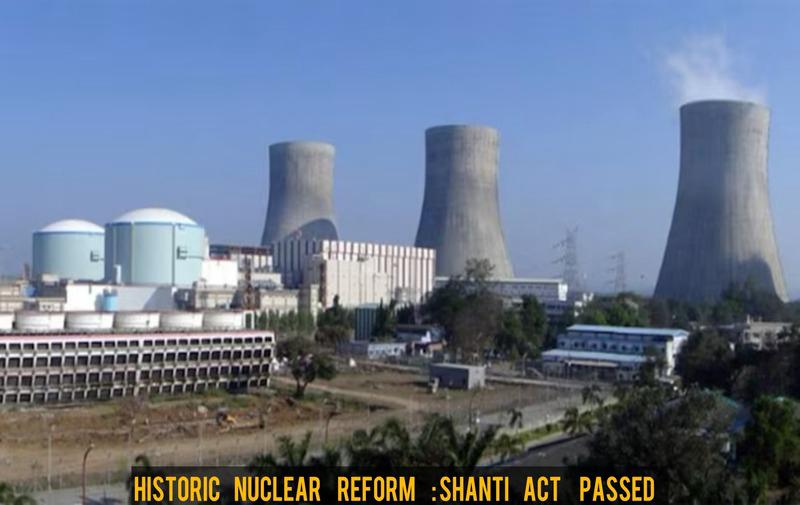
Historic Shift in Energy Policy : India Opens Nuclear Power Sector to Private Firms as SHANTI Act Becomes Law
India’s civil nuclear sector has entered a new era with the President of India, Droupadi Murmu, granting assent to the Sustainable Harnessing and Advancement of Nuclear Energy for Transforming India (SHANTI) Bill, 2025. With this assent, the Bill has officially become an Act, ending decades of exclusive state control over civil nuclear power generation. For the first time since independence, private companies and joint ventures are legally permitted to participate in building and operating nuclear power plants in India, under a government licensing framework. This landmark reform is being described as one of the most significant energy policy decisions in recent decades. It reflects India’s urgent need to balance energy security, climate commitments, and rapid economic growth in an increasingly power-hungry nation.What the SHANTI Act Really ChangesAt its core, the SHANTI Act opens the door for private sector participation in the civil nuclear energy space. Private firms and joint ventures can now build, own, operate, and even decommission nuclear power plants, provided they receive licenses from the central government. Until now, nuclear power in India was the exclusive domain of government entities such as the Nuclear Power Corporation of India Limited (NPCIL). However, the Act is careful to draw a clear boundary between commercial power generation and strategic nuclear activities. Sensitive areas such as uranium and thorium mining, fuel enrichment, isotopic separation, reprocessing of spent nuclear fuel, high-level radioactive waste management, and heavy water production will remain strictly under the control of the central government or government-owned entities. This ensures that national security and non-proliferation commitments remain intact.Repealing Old Laws to Unlock GrowthOne of the most consequential aspects of the SHANTI Act is the repeal of two older laws: the Atomic Energy Act of 1962 and the Civil Liability for Nuclear Damage Act, 2010. While these laws were created with safety and sovereignty in mind, over time they became major roadblocks to investment and expansion in the civil nuclear sector. The liability law in particular had discouraged both domestic and foreign players due to its stringent and unclear provisions. By updating the regulatory and liability framework, the SHANTI Act seeks to create a more balanced system—one that prioritizes safety while also making nuclear energy financially and legally viable for investors.Why India Needs This Reform NowIndia’s energy demand is growing at an unprecedented pace. As cities expand, industries scale up, and millions aspire to a better quality of life, the demand for reliable electricity continues to surge. At the same time, India has made global commitments to reduce carbon emissions and increase the share of clean energy in its power mix. Nuclear energy offers a unique solution to this challenge. It provides large-scale, round-the-clock power with minimal carbon emissions. Unlike solar and wind energy, nuclear power is not dependent on weather conditions. By allowing private participation, India can accelerate the construction of nuclear plants, bring in advanced technologies, and reduce the financial burden on the government.Balancing Safety, Sovereignty, and InvestmentA common concern surrounding nuclear power is safety. The SHANTI Act addresses this by strengthening the regulatory framework and reinforcing government oversight. All private participation will operate under strict licensing, inspection, and compliance norms set by the central authorities. By retaining state control over the nuclear fuel cycle, India ensures that its strategic interests are protected. This balance between openness and control is central to the Act’s design. It signals that India is ready to modernize its nuclear sector without compromising on safety or sovereignty. In regions where power shortages still disrupt daily life, the expansion of nuclear energy promises stability. For young engineers, scientists, and technicians, the opening of the nuclear sector creates new career pathways in high-skill, future-ready industries. It also positions India as a global leader in clean and advanced energy technologies.A Step Towards Energy Independence and Climate GoalsThe SHANTI Act aligns closely with India’s long-term vision of energy independence and sustainable development. By diversifying energy sources and reducing dependence on fossil fuels, India strengthens its resilience against global energy shocks and price fluctuations. From a climate perspective, nuclear energy will play a crucial role in meeting India’s net-zero ambitions. As the country transitions away from coal, nuclear power can act as a stable backbone supporting renewable energy expansion. The enactment of the SHANTI Act, 2025, is not merely a legislative reform; it is a statement of intent. India is signaling to the world that it is ready to embrace innovation, private participation, and global best practices in its pursuit of clean and reliable energy. By opening the civil nuclear sector while safeguarding strategic interests, the government has attempted a careful balancing act. If implemented effectively, the SHANTI Act could redefine India’s energy landscape, powering not just cities and industries but also the aspirations of a nation on the rise.