
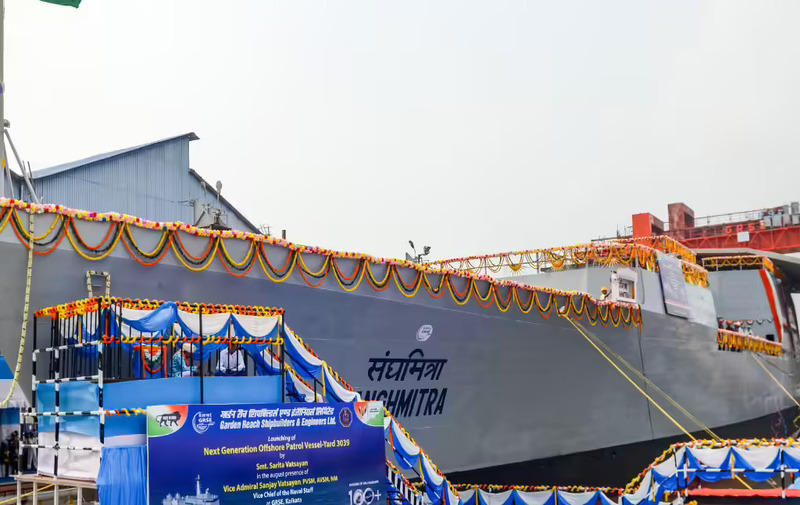
‘Sanghamitra’ Sets Sail: India Launches First Next-Generation Naval Patrol Vessel
India’s march towards self-reliance in defence manufacturing reached another major milestone as Garden Reach Shipbuilders and Engineers launched ‘Sanghamitra’, the first of four Next-Generation Offshore Patrol Vessels (NGOPVs) being built for the Indian Navy.The launch ceremony took place at the GRSE facility in Kolkata amid traditional rituals and Vedic chants. The vessel was ceremonially launched by Sarita Vatsayan, wife of Vice Admiral Sanjay Vatsayan, the Vice Chief of Naval Staff.As India steadily expands its indigenous naval fleet, the launch of Sanghamitra marks a proud moment not only for the Navy but also for the country’s growing shipbuilding ecosystem.Built for Modern Maritime ChallengesThe Next-Generation Offshore Patrol Vessel is far more advanced than conventional patrol ships currently in service. Stretching around 113 metres in length and 14.6 metres in width, Sanghamitra displaces nearly 3,000 tonnes and has been designed for endurance, versatility, and operational readiness.According to officials, the vessel can travel up to 8,500 nautical miles at a cruising speed of 14 knots while reaching a top speed of 23 knots. Despite its size, the ship requires a draught of only four metres, enabling it to operate efficiently in shallow coastal waters.The ship is expected to play a critical role in protecting offshore assets, carrying out maritime surveillance, anti-piracy operations, search and rescue missions, convoy protection, and humanitarian assistance during disasters. Its operational profile also includes mine warfare support, special operations assistance, and Visit, Board, Search and Seizure (VBSS) missions, which are key requirements in modern maritime security operations.Indian Navy’s Expanding Maritime VisionSpeaking at the launch ceremony, Vice Admiral Sanjay Vatsayan highlighted the evolving role of the Indian Navy in maintaining peace and stability across the maritime domain. He noted that today’s Navy is not focused solely on combat preparedness but is also committed to maritime cooperation, regional stability, operational presence, and humanitarian readiness.Against this backdrop, he described the NGOPV project as strategically significant for India’s future naval capabilities. The Vice Admiral also praised GRSE for delivering eight ships to the Indian Navy in the previous financial year, calling it a reflection of India’s rapidly improving defence production capacity.A Symbol Rooted in India’s HeritageThe vessel’s name, Sanghamitra, carries historical and cultural significance. It is inspired by Sanghamitra, the daughter of Emperor Ashoka, remembered for spreading Buddhism beyond India’s borders. The ship’s crest further reflects India’s maritime symbolism through the Ursa Major constellation and a striking red-and-white lighthouse.The naming reflects a larger effort by the Indian Navy to connect modern defence platforms with India’s civilisational identity and legacy.Boosting India’s Indigenous Shipbuilding PushSanghamitra is one of 11 NGOPVs ordered for the Indian Navy under the government’s Buy (Indian-IDDM) initiative aimed at strengthening domestic defence manufacturing. While four ships are being constructed by GRSE, the remaining seven are being built by Goa Shipyard Limited. Contracts for the vessels were signed in March 2023, and deliveries are expected to begin from September 2026.GRSE has already demonstrated its growing capabilities through projects such as the export of the offshore patrol vessel MCGS Barracuda to Mauritius — a significant achievement frequently cited as evidence of India’s expanding maritime manufacturing expertise.Sailing Towards a Self-Reliant FutureFor the Indian Navy, Sanghamitra represents more than just another patrol vessel. It adds a highly capable and versatile platform designed for peacetime surveillance, maritime policing, and strategic presence across the Indian Ocean region.As Sanghamitra touched water for the first time in Kolkata, it carried with it not only advanced technology and firepower but also the aspirations of a nation steadily building its own path towards maritime strength and self-reliance.