A Gateway with a Human Touch: Navi Mumbai International Airport Opens
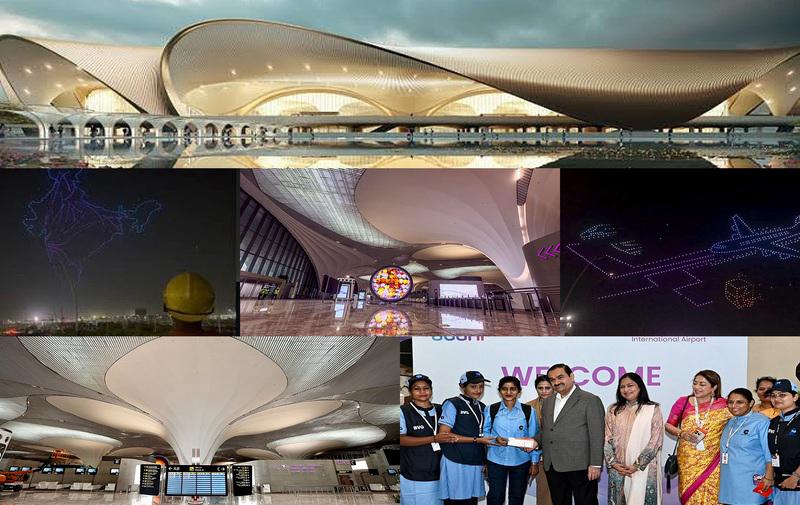
The long-awaited Navi Mumbai International Airport (NMIA) officially entered India’s commercial aviation map on Thursday, promising to reshape air travel for the Mumbai Metropolitan Region (MMR). Developed and operated by Adani Airports Holdings Limited (AAHL), NMIA is among India’s largest greenfield airport projects and is designed to handle 90 million passengers and 3.2 million tonnes of cargo annually at full build-out. On its inaugural day, the airport welcomed 48 flights connecting nine domestic destinations, serving over 4,000 passengers, with peak traffic recorded between 5 pm and 7 pm. The first arrival, IndiGo flight 6E460 from Bengaluru, touched down at 8 am and was greeted with a ceremonial water cannon salute. The first departure followed at 8:40 am, with an IndiGo flight to Hyderabad. Chairperson Gautam Adani personally welcomed passengers and took part in a ceremonial walk through the departure terminal alongside employees, community representatives, and beneficiaries of the Adani Foundation.Technology-Driven Passenger ExperienceNMIA promises a next-generation travel experience powered by artificial intelligence. From entry to boarding, passengers can enjoy Digi Yatra-enabled entry, which facilitates smooth access through airport gates. The AI systems also allow fast-track immigration when international operations begin in March 2026 and feature real-time passenger flow tracking, offering live updates on waiting times at entry points, security, and immigration counters. The emphasis on technology aims to make the airport more efficient than Mumbai’s T1 and T2 terminals, reducing congestion while enhancing passenger convenience. By integrating these innovations, NMIA sets a new benchmark for airports across India, blending modernity with operational intelligence.State-of-the-Art InfrastructureNMIA’s Terminal 1 spans 3 lakh square meters and is designed to handle 20 million passengers per year, with a cargo capacity of 0.8 million tonnes annually. The airport is expected to reach saturation around mid-2026, highlighting the foresight in its planning. Two parallel runways, with lengths of 3.7 kilometers and rapid exit taxiways, ensure smooth aircraft movement and operational efficiency. The airport features 42 aircraft slots, 29 aerobridges, 13 remote bays, 70 general aviation stands, and 17 GA hangars. Such infrastructure positions NMIA as a key hub for both domestic and international aviation in the MMR, alleviating pressure on the existing Mumbai International Airport and opening new avenues for cargo and passenger traffic.Cultural Integration and Community EngagementBeyond technology and infrastructure, NMIA reflects the cultural identity of the region. Inspired by India’s national flower, the lotus, the terminal architecture integrates contemporary design with sustainability features, creating a visually striking and environmentally conscious space. On its inauguration, cultural performances featuring Maharashtrian lezim, dhol, and tutari added a local flavor, connecting passengers and visitors with the heritage of the region. The airport also prioritized inclusivity, with underprivileged families and first-time flyers enjoying special aerial tours over Mumbai. This human touch emphasized the airport’s commitment to community engagement, making the launch not just a technical achievement but a social milestone.Spectacular Drone Show Celebrates InaugurationOn the eve of its operational launch, NMIA hosted a spectacular drone show featuring 1,515 drones. The display included 3D lotus formations, the airport logo, a plane flying over Mumbai, and thematic visuals showcasing India’s rise on the global stage. The audience included differently-abled individuals, the workers who worked their hearts out for this, and NMIA employees, celebrating both innovation and the collective effort behind the airport’s construction. The show also extended to construction workers who contributed to building the airport, reflecting a rare acknowledgment of the human labor behind such monumental projects.A Vision Years in the MakingThe concept of NMIA dates back to 1997, when Maharashtra’s City and Industrial Development Corporation (CIDCO) first proposed it. The foundation stone was laid by Prime Minister Narendra Modi in 2018, marking the beginning of a complex development journey. Since 2021, Adani Airports Holdings Limited has accelerated construction and prepared the airport for phased commercial operations, overcoming challenges including the global pandemic, which delayed progress by two years. After nearly eight years of planning, construction, and testing, NMIA is now ready for operations, combining architectural elegance, sustainability, and technological sophistication. Its debut promises to redefine air travel for Mumbai while setting new standards for future greenfield airport projects across India.Looking AheadWith its advanced technology, world-class infrastructure, and emphasis on passenger experience, NMIA is poised to become a defining feature of Mumbai’s aviation landscape. International operations set to commence in 2026 will further elevate its role in global connectivity. Beyond its immediate operational benefits, the airport symbolizes a broader narrative of innovation, resilience, and community impact, setting an inspiring precedent for India’s future transport projects. It is not just a gateway to the skies but also a celebration of collective vision, effort, and the transformative power of modern infrastructure in enhancing lives and connecting communities.