
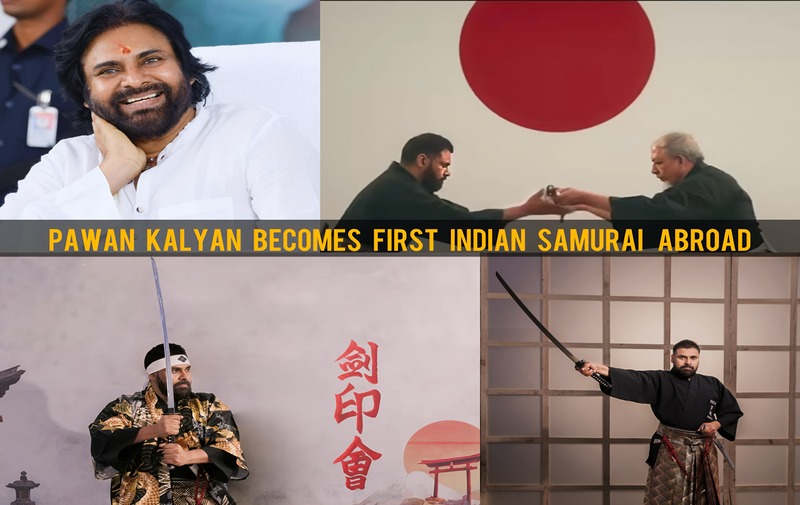
Beyond Cinema and Politics: Pawan Kalyan Becomes First Indian Honoured as a Samurai
In a world where political power is often measured by numbers and noise, Andhra Pradesh Deputy Chief Minister and Jana Sena Party president K. Pawan Kalyan has earned recognition through an entirely different path—one built on discipline, silence, and decades of personal commitment. In December 2025, he achieved rare international recognition in Japanese martial arts, becoming the first person from India to be honoured as a “Samurai.” The achievement, officially confirmed through a Jana Sena Party press release, places him in a global cultural lineage that few non-Japanese practitioners ever enter.An Honour Beyond BordersPawan Kalyan was awarded the prestigious Fifth Dan (5th Dan) by the Sogo Budo Kanri Kai, one of the world’s most respected governing bodies of traditional Japanese martial arts. This is not a ceremonial title but a recognition granted only after years of rigorous training, evaluation, and philosophical understanding. Adding to the distinction, he became the first Telugu-speaking individual to be inducted into the historic Takeda Shingen Clan under the lineage of Soke Muramatsu Sensei, an honour rarely extended outside Japan. The Golden Dragons organisation further recognised his lifelong dedication by conferring on him the title “Tiger of Martial Arts,” acknowledging not just skill but commitment to the values of Budo.From Chennai Dojos to Samurai PhilosophyThe roots of this achievement trace back to Pawan Kalyan’s childhood in Chennai, far removed from political stages or film sets. It was here that he began training in karate, developing an early relationship with discipline and physical endurance. Over time, this interest deepened into a lifelong pursuit of martial knowledge. What began as physical training gradually evolved into an intellectual and philosophical journey as he immersed himself in Samurai traditions and the deeper principles of Japanese martial culture. For Pawan, martial arts were never about display; they were about self-control, respect, and inner balance.Walking the Path of KenjutsuA defining phase of his journey came with his induction into Kenjutsu, the ancient Japanese art of swordsmanship. Kenjutsu, meaning “the art of the sword,” is one of the four central martial disciplines of pre-modern Japan, rooted in the Samurai era. It focuses on combat with a drawn sword, teaching precise strikes, parries, footwork, timing, and battlefield strategy. By the 1500s, Kenjutsu had evolved beyond warfare into a disciplined system of one-on-one combat and defense against multiple weapons. Mastering it requires not just physical strength but also mental clarity and ethical grounding, qualities central to Samurai philosophy. Pawan Kalyan’s advanced training was shaped under the guidance of Hanshi Professor Dr Siddiq Mahmoodi, a globally respected authority in Budo. Under his mentorship, Pawan gained high-level proficiency in both Kenjutsu and Kendo, the modern form of Japanese sword fighting. This phase of training refined his technique while deepening his understanding of Budo as a way of life. The Samurai code emphasises discipline, mental focus, humility, and responsibility—values that resonate deeply with his personal and public life.Thirty Years of Silent DisciplineThe honours conferred upon him are the result of more than 30 years of continuous practice, study, and refinement. His journey is not one of sudden achievement but of patience and persistence. From earning karate belts to mastering the katana, Pawan Kalyan’s path reflects the Samurai belief that true strength is built quietly over time. This long commitment humanises the achievement, showing that even those in the public eye must return repeatedly to the basics to grow.When Cinema Reflected the Warrior WithinPawan Kalyan’s martial grounding has also found expression in his cinematic career. Unlike choreographed action detached from reality, he brought authentic martial techniques to the screen in films such as Thammudu and Khushi. These performances resonated with audiences because they carried an underlying truth of movement and intent. Even in his upcoming film OG, this commitment to realism continues. For fans, these moments are more than entertainment; they are glimpses into a discipline he lives, not just portrays.A Leader Shaped by DisciplineToday, at 54, Pawan Kalyan serves as the 11th Deputy Chief Minister of Andhra Pradesh, holding key portfolios including Panchayat Raj, Rural Development, Rural Water Supply, Environment, Forest, Science, and Technology. As an MLA from Pithapuram and founder-president of the Jana Sena Party, his responsibilities are immense. Yet, the Samurai philosophy he follows offers insight into his approach to leadership: calm under pressure, guided by ethics, and rooted in service rather than spectacle. Being honoured as a Samurai in the modern world is not about wielding a sword; it is about embodying a way of life. For many of his admirers, Pawan Kalyan’s recognition carries emotional weight. It proves that dedication to self-improvement can coexist with cinema, politics, and public responsibility. His journey reminds us that true mastery, whether in governance or personal life, begins with discipline within.