
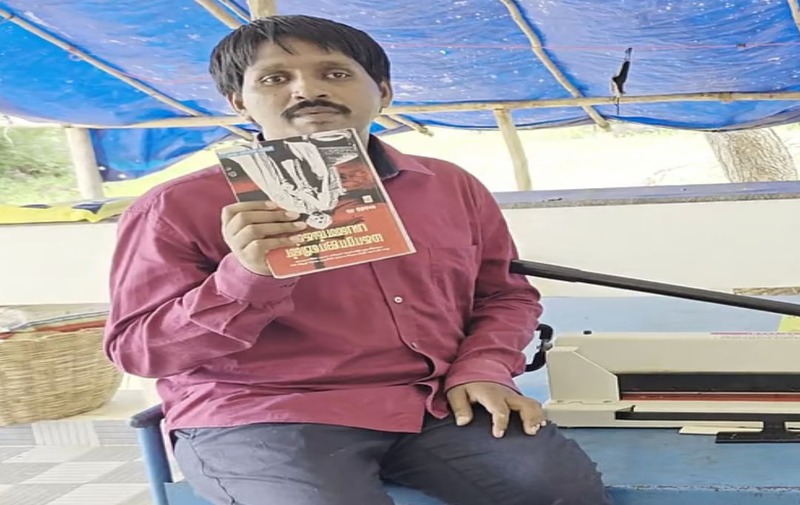
Visually Impaired Teacher Opens the World of Books for Thousands of Blind Students
For the past several years, in Tamil Nadu’s Pudukkottai district, Pon Sakthivel, a 34-year-old visually impaired Tamil teacher from Pudukkottai, has been on a mission that is changing the lives of countless readers across the state. Armed with determination, technology, and an unshaking belief in equal access to education, he has digitised more than 2,000 printed books into accessible formats for visually impaired students and readers.What makes his work extraordinary is not just the scale of the effort but the deeply personal journey behind it.Turning Struggle Into PurposeBorn with visual impairment, Sakthivel understands the barriers faced by visually impaired students better than most. Growing up, accessing textbooks and academic materials was a constant struggle. Reading often depended on others — classmates, volunteers, or family members — leaving visually impaired students with limited independence and confidence.But Sakthivel refused to let those challenges define him. He completed his undergraduate studies at The American College before pursuing an MPhil focused on technology for visually impaired users. Later, he enrolled for a PhD at Gandhigram Rural Institute, researching journals designed for visually impaired readers.When he began teaching Tamil at the Government Higher Secondary School in Silattur near Aranthangi in 2019, he decided to solve the very problem that had shaped his own academic life.Bringing Books to Life Through TechnologyUsing a professional duplex scanner purchased through a central government research grant, Sakthivel started converting printed books into accessible digital formats. The process is both technical and time-consuming.Each page is scanned individually before Optical Character Recognition (OCR) software converts the images into editable text. The text is then made compatible with assistive technologies such as screen readers, text-to-speech software, enlarged font formats, and Braille display systems.The result? Visually impaired readers can finally access books independently.Over the years, Sakthivel has digitised several important Tamil literary and academic works that were previously inaccessible to blind readers. These include the 12-volume Anandarangam’s Diaries and Nenjukku Neethi, the six-volume autobiography of former Tamil Nadu Chief Minister M. Karunanidhi. He has also converted books published by Sahitya Akademi, including Sirpi’s Ilakkiya Varalaru.For many readers, these works were once beyond reach. Now, they are only a click away.As requests for accessible books increased, Sakthivel began travelling across Tamil Nadu to major book fairs in Chennai, Madurai, Coimbatore, Erode, and Tiruchy. Readers, students, and teachers send him wishlists, pool money to purchase books, and Sakthivel personally buys and digitises them free of cost.“The money is collected only for buying the books. Digitisation is always done without charge,” he explains.Building a Community of Accessible LearningIn 2023, Sakthivel launched a WhatsApp-based initiative called Viral Mozhiyin Nool Thirattu, which roughly translates to “Accessible Language Book Collection.”Members contribute a small fee and submit book requests. The group collectively purchases titles, which Sakthivel later converts into accessible formats and distributes among members. His work has become especially valuable for students preparing for competitive examinations, many of whom depend entirely on audio and digital study material.Sakthivel also runs a YouTube channel where he reviews Tamil books entirely from memory in a single take, helping visually impaired readers discover new titles and literary works.A Mission Bigger Than One ManDespite his remarkable achievements, Sakthivel believes lasting change requires systemic support.He urges publishers to release books simultaneously in accessible digital formats, as required under the Rights of Persons with Disabilities Act. He also believes universities and libraries must invest in assistive technologies and digitisation centres so accessibility does not depend solely on individuals and volunteers.In a world where millions still struggle to access knowledge equally, Pon Sakthivel’s work is proving that true empowerment begins with access — and sometimes, all it takes to transform lives is the ability to read independently.