
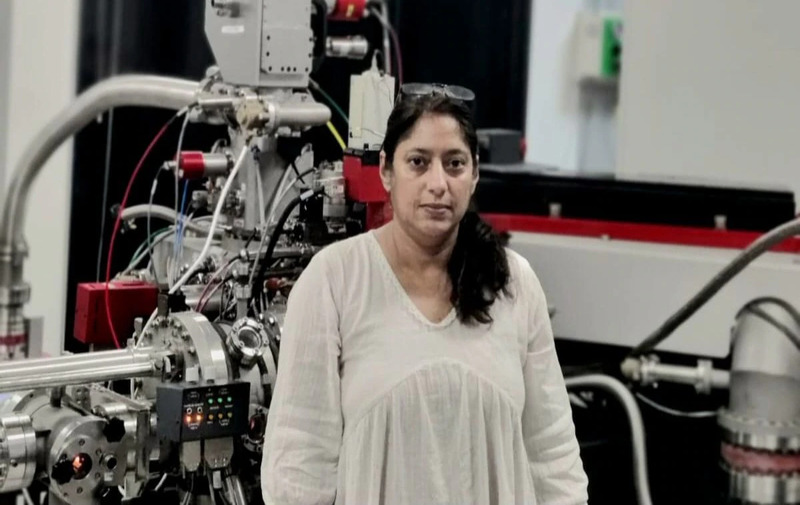
From Meteorites to Milestones: Kuljeet Kaur Marhas Becomes First Indian Woman Fellow of The Meteoritical Society
For nearly a century, some of the world’s brightest minds in planetary science and meteoritics have been recognised by The Meteoritical Society. Yet, in its 93-year history, no Indian woman had ever entered that distinguished circle—until now.Prof. Kuljeet Kaur Marhas has become the first Indian woman to be elected Fellow of the prestigious society for 2026, creating a landmark moment not only for Indian science but also for women in space research. A professor in the Planetary Science Division at Physical Research Laboratory in Ahmedabad, Marhas joins an elite league of globally celebrated scientists whose work has transformed humanity’s understanding of the Solar System.The achievement becomes even more remarkable considering that she is only the third Indian scientist ever to receive the honour, after renowned scientists Devendra Lal and JN Goswami.Decoding the Solar System’s Oldest SecretsWhat makes Prof. Marhas’s work so groundbreaking is her ability to study some of the oldest known materials in existence—fragments of meteorites and extraterrestrial samples that date back billions of years. Her research focuses on short-lived radionuclides and stable isotopes present in extraterrestrial materials. Through these microscopic clues, scientists can reconstruct how the Solar System was born, evolved and transformed over time.From pre-solar grains and Calcium-Aluminum-rich Inclusions (CAIs) to chondrules and ancient organic matter trapped inside meteorites, Marhas has spent years decoding cosmic evidence left behind from the dawn of planetary formation.Her work extends far beyond Earth-bound laboratories. She has analysed samples collected through some of humanity’s most iconic space missions, including Stardust, Hayabusa and the legendary Apollo program. Each sample carries a story older than Earth itself — and Marhas has helped scientists read those stories with extraordinary precision.Science at the Smallest Scale, Impact at the LargestOne of the defining aspects of Prof. Marhas’s research is her use of highly sophisticated technologies such as Secondary Ion Mass Spectrometry (SIMS) and nanoSIMS. These advanced analytical techniques allow researchers to study isotopic signatures hidden within microscopic particles from space rocks and planetary materials. Through this, Marhas has revealed vital insights into the chemical and physical processes that shaped the early Solar System billions of years ago.Her discoveries have significantly strengthened the field of cosmochemistry—the science that studies the chemical composition of the universe and its evolution. More importantly, her work has helped place India firmly on the global map of planetary science research at a time when the country is rapidly expanding its ambitions in space exploration.A Proud Moment for Indian Space ScienceReacting to the honour, Prof. Marhas described the recognition as a reflection of India’s growing scientific ecosystem. Her recognition arrives at a significant moment for India’s space sector, with growing international attention on the country’s planetary missions and scientific capabilities.Already a Fellow of the American Geophysical Union, Prof. Marhas is also a recipient of the prestigious Devendra Lal Memorial Medal.Today, her journey stands as more than a personal achievement. It represents a breakthrough for Indian women in advanced space sciences and an inspiration for young researchers who dream of exploring the mysteries of the cosmos.Keywords: Kuljeet Kaur Marhas, Meteoritical Society, ISRO scientist, Indian woman scientist, planetary science, cosmochemistry, meteorites, Physical Research Laboratory Ahmedabad, Solar System research, space science India, extraterrestrial materials, meteoritics, cosmochemistry research, Indian space achievements