
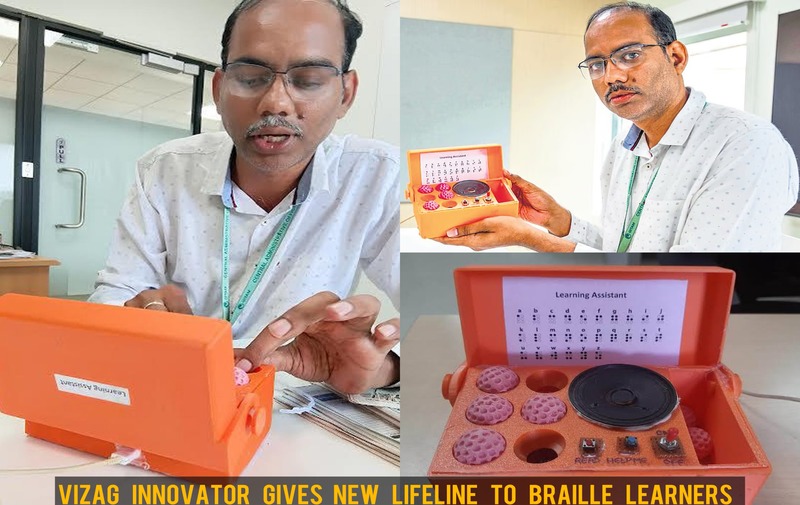
Vizag Professor Designs Breakthrough Device Bringing Independence to Visually Impaired Children
For many visually impaired children, the path to literacy begins with the gentle tap of a fingertip on a raised dot. That simple touch opens the door to language, knowledge and independence. But learning Braille is far from simple. It demands immense patience, constant practice and repeated guidance from trained teachers. In many schools, one instructor handles dozens of students, making personalised learning impossible. In rural and remote areas, children often do not even have access to specialised schools, leaving them dependent on family members who may not understand Braille. Into this gap steps an innovation from Visakhapatnam that may change how thousands of children learn to read.A GITAM Professor’s Vision for Accessible LearningMohammed Khwaja Muinuddin Chisti, Assistant Professor in the Department of EECE at GITAM Deemed to be University, has developed an embedded device called the Braille Learning Assistant Embedded Kit (LAEK). Designed to be simple, intuitive and child-friendly, this device allows visually impaired students to learn Braille independently, whether they are at school or at home. Chisti’s idea stemmed from a desire to reduce the burden on teachers and give children the confidence to learn at their own pace. His solution uses technology not as a replacement for teachers, but as a supportive companion that ensures no child feels embarrassed, hesitant, or left behind.How the Device WorksThe LAEK is built around a 3 × 2 hollow hemispherical Braille cell fitted with sensors. When a child places the dot pattern inside the cell, the sensors detect the combination and the device instantly decodes it. Through an audio output system, it announces the corresponding letter, number or instruction. This real-time feedback means a student no longer needs to wait for a teacher to verify every attempt. They can practise, revise and even self-correct, which drastically increases the speed of learning. The device includes a Help Me button that alerts the teacher whenever a child needs intervention, improving classroom management in schools where one teacher may be handling 30 or 40 visually impaired students.Designed with Children in MindChisti also worked on the small details that matter in a child’s daily use. The balls used to form patterns are designed in a way that makes them easy to retrieve even if dropped. The device is rechargeable, removing the dependence on batteries which are expensive and difficult to replace frequently. Every part of the design focuses on comfort, ease of learning and long-term accessibility. For children in remote regions who cannot travel daily to blind schools, the device becomes even more meaningful. Parents can participate in the learning process at home, following the same pattern-based method used in classrooms. Depending on the child’s learning pace, Chisti says that all basic Braille alphabets can be learnt within a few weeks.Inspired by Real Challenges in Blind SchoolsThis innovation did not emerge from a laboratory alone. Chisti’s earlier project, the Walking Assistant device, exposed him to the daily struggles of visually impaired students. That wearable tool alerts users about obstacles using sound and vibrations. While donating that device to blind schools, he spent time with teachers and students, listening to the challenges of classroom learning. He saw how much pressure teachers face, how slowly the early lessons progress and how overwhelmed some children feel when they cannot keep up. Many hesitate to ask the same doubt repeatedly, fearing they will slow down the class or burden the teacher. These interactions sparked the idea for an educational tool that would empower students and ease the workload on schools.Learning with Dignity and ConfidenceThe emotional heart of this invention lies in the independence it brings to visually impaired children. For a child who has always needed someone to check every single dot they press, the ability to learn alone is transformative. It builds dignity, ownership and confidence. It turns learning into a joyful discovery rather than a stressful task. For teachers, the device becomes a supportive partner that helps them focus their time on students who truly need guidance. For parents who live far away from special schools, it provides hope that their child can still learn effectively without relocation or financial strain. Chisti’s device is not just a tool. It is a bridge between technology and human need, carrying the warmth of empathy and the promise of equal opportunity. As Chisti continues to refine and expand his innovation, he brings us closer to a future where every visually impaired learner can touch a Braille cell not with hesitation, but with confidence and hope.