
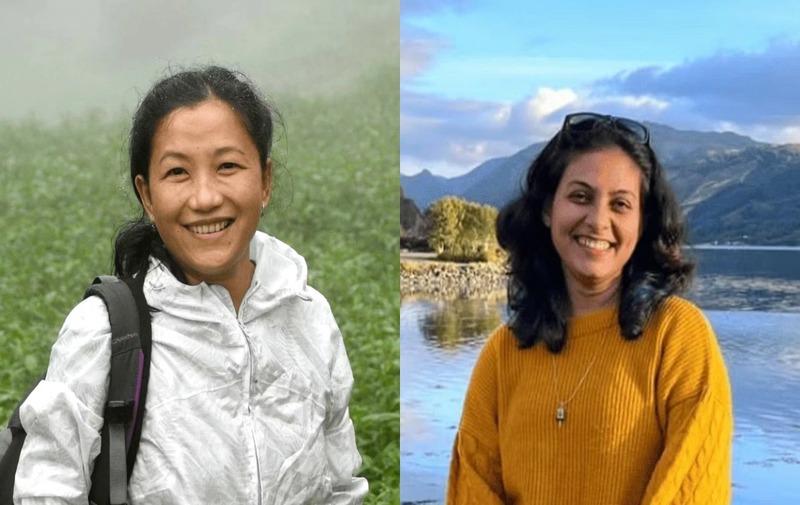
Two Indian Women Conservationists Win Prestigious International ‘Green Oscar’ for Saving Rare Species
Far away from celebrity culture and social media fame, two Indian women have quietly achieved something extraordinary.Parveen Shaikh and Barkha Subba are among the six winners of the 2026 Whitley Awards, internationally celebrated as the “Green Oscars," for their groundbreaking work in wildlife conservation. Presented by the UK-based Whitley Fund for Nature, the award recognises grassroots environmental leaders from across the globe. Along with international recognition, winners receive funding, mentorship and global support to expand their conservation work.But while the spotlight briefly shifted to London for the award ceremony, the real stories are unfolding thousands of kilometres away, on the sandbanks of the Chambal river and in the mist-covered wetlands of the Darjeeling hills.Together, these two women are proving that conservation is not just about saving animals. It is about saving entire ecosystems, communities and futures.The Woman Protecting India’s Rare River BirdFor years, Parveen Shaikh has dedicated herself to protecting one of India’s most endangered birds—the Indian skimmer.The striking black-and-white river bird is famous for its unusual hunting style. Flying low over the water, it skims the surface with its uniquely shaped beak to catch fish. But despite its beauty, the species is now dangerously close to disappearing. Habitat destruction, pollution, river development projects and illegal sand mining have devastated nesting areas across South Asia. Today, more than 90 percent of the bird’s global population survives in India.Shaikh decided to fight back, not alone, but with the help of local communities. Along the Chambal river, she created a network of “nest guardians”, local residents who monitor breeding sites, protect eggs and prevent disturbances near nesting grounds.The results have been remarkable. Nest survival rates have nearly doubled, and the local skimmer population has seen a significant rise. Perhaps even more importantly, local people have begun calling them “our birds”—a simple phrase that reflects a powerful shift in responsibility and emotional connection.Saving a ‘Living Fossil’ in the HimalayasWhile Shaikh works beside rivers, Barkha Subba’s battle is unfolding in the fragile wetlands of the eastern Himalayas.Her mission centres around the Himalayan salamander, a rare amphibian often described as a “living fossil” because of its ancient evolutionary history. The species has survived for millions of years. But now, modern human activity may push it toward extinction.Rapid tourism, construction and changing land-use patterns are shrinking wetlands across the Darjeeling hills. Out of dozens of breeding habitats once spread across the region, only around 30 remain today. Subba’s work combines science, restoration and community action.She and her team are restoring damaged wetlands, removing invasive plant species and working closely with tea garden workers, villagers and local authorities to protect remaining breeding sites. Her project also monitors deadly fungal diseases that have wiped out amphibian populations in several parts of the world.But perhaps the most powerful aspect of her work is inclusion. More than 200 local residents are being trained in conservation efforts, creating a model where protecting biodiversity also strengthens local livelihoods and awareness.Why Their Victory Matters Beyond the AwardsAt a time when climate change, habitat destruction and biodiversity loss dominate global headlines, the success of Shaikh and Subba carries a deeper message.Environmental conservation does not always begin in laboratories or government offices.Sometimes, it begins with ordinary people protecting the rivers, forests and species they see every day. The Whitley Award brings £50,000 in funding to each winner, giving these projects a major boost. But the recognition also places India’s grassroots conservation efforts on the global map.