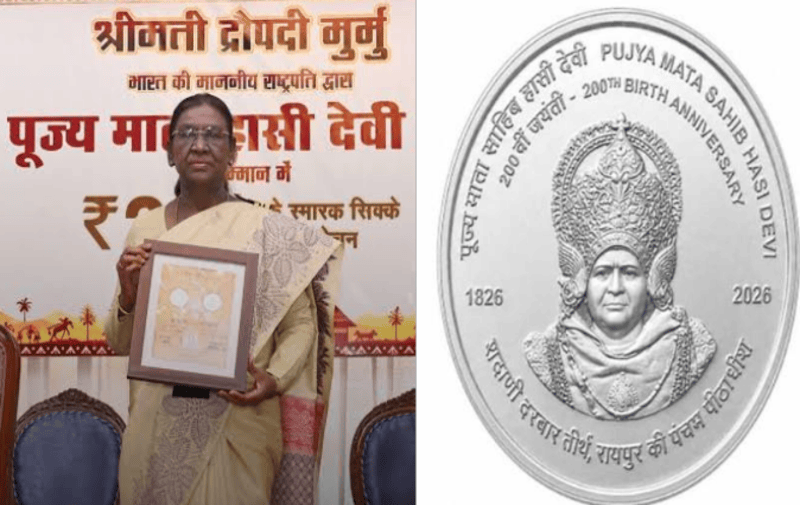
President Murmu Unveils ₹200 Coin Honouring Sindhi Spiritual Leader Mata Sahib Hasi Devi
A revered spiritual leader whose life inspired generations has been honoured with a special commemorative coin. President Droupadi Murmu unveiled a ₹200 coin marking the 200th birth anniversary of Mata Sahib Hasi Devi, the fifth head of Shadani Darbar in Raipur, Chhattisgarh.The ceremony was held at Chhattisgarh Mandapam in Lok Bhawan, in the presence of Governor Ramen Deka and Chief Minister Vishnu Deo Sai. Issued by the Union Ministry of Finance, the coin celebrates her enduring contribution to spirituality, social welfare and the cultural heritage of the Sindhi community.A Coin That Preserves a Spiritual LegacyThe commemorative coin features an embossed portrait of Mata Sahib Hasi Devi on one side. The reverse carries the Lion Capital of the Ashoka Pillar alongside the denomination of ₹200.The coin seeks to preserve her memory and introduce future generations to her teachings and contributions. Following its unveiling, devotees and coin collectors are expected to be able to book the commemorative issue through various branches and units of Shadani Darbar.Sant Yudhishthir Lal, the present head of Pujya Shadani Darbar, delivered the welcome address at the ceremony. The occasion was particularly significant for the Sindhi community in India and abroad, which continues to cherish her legacy.A Woman Who Led with CompassionBorn in 1826 in Khanpur Mahar, in present-day Pakistan, Mata Sahib Hasi Devi assumed the spiritual leadership of Shadani Darbar in 1852, at the age of 26. She went on to guide the institution for 57 years, focusing on spiritual growth, community welfare and the preservation of cultural traditions.One of the most enduring stories associated with her life is her service during a devastating famine in Sindh. According to the historical account preserved by Shadani Darbar, she responded to the suffering of hungry people through Anna Sewa, the practice of serving food to those in need.The account describes how Mata Sahib Hasi Devi prayed for divine mercy and placed a single bag of wheat into a large iron storage vessel. She then instructed her sewadars, or volunteers, to keep distributing grain to the starving population without opening the vessel or looking inside it. According to the tradition, the grain continued to feed thousands of people for six months.The story of Anna Sewa remains a powerful part of her legacy, reflecting her deep concern for the suffering and her belief in serving humanity. For her, spirituality was not limited to prayer and religious teachings; it was also expressed through practical acts of kindness and care for those facing hardship.She also encouraged communal harmony, education, music and cultural values. Her teachings of peace, love and tolerance earned her respect across communities.An Enduring Message for Future GenerationsThe commemorative coin honours more than a historical milestone. It celebrates a life devoted to faith, humility and helping others.By recognising Mata Sahib Hasi Devi on her 200th birth anniversary, the coin brings renewed attention to a spiritual legacy that continues to inspire devotees and the wider Sindhi community.