"Dream, Dream, Dream! Conduct these dreams into thoughts, and then transform them into action."
- Dr. A. P. J. Abdul Kalam
"Dream, Dream, Dream! Conduct these dreams into thoughts, and then transform them into action."
- Dr. A. P. J. Abdul Kalam
18 Mar 2026
Artificial Intelligence (AI) is rapidly transforming industries across the world. From healthcare and transportation to finance and education, AI is shaping how businesses operate and how people live. However, despite the growing importance of AI, reports often show that only one in five Indian engineers is truly AI-ready, highlighting a significant gap between traditional education and industry needs. To bridge this gap, the Scaler School of Technology has introduced an innovative approach to learning through its AI + Business Programme. Instead of focusing only on theory, the programme allows students to learn AI while building startups during their college years. This unique model combines technology education with entrepreneurship, helping students understand not only how AI works but also how it can solve real-world problems.
Traditional engineering programmes often teach technical subjects separately from business or entrepreneurship. However, the AI + Business programme at the Scaler School of Technology integrates both fields into a single learning experience. Students are encouraged to build tools, create prototypes, and test startup ideas while studying. This hands-on approach ensures that students do not just learn coding or algorithms but also understand how technology can be transformed into real products and businesses. By combining technical knowledge with entrepreneurial thinking, the curriculum prepares students for a future where innovation and business skills are equally important. Instead of waiting until graduation to explore startups, students start experimenting with ideas early in their academic journey.
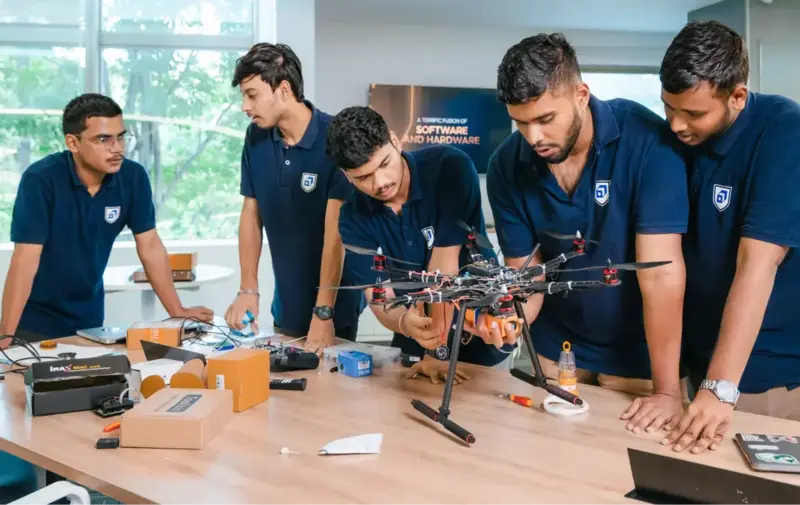
Much of the practical work happens inside the Scaler Innovation Lab, a specialized environment designed for technological experimentation and collaboration. The lab focuses on emerging fields such as Artificial intelligence , Robotics , Autonomous systems , Digital infrastructure In this space, students work alongside startup founders, engineers, and innovators. They contribute to the development of real products and learn how early-stage startups operate. This exposure helps students understand the fast-paced and creative nature of startup culture, where experimentation, problem-solving, and teamwork play a major role. The lab also allows students to see their ideas turn into working solutions, giving them confidence and valuable experience before they even graduate.
Several startups are already growing within this innovation ecosystem. One such startup is Percevia, which is developing AI-powered smart glasses designed for visually impaired people. These glasses use artificial intelligence to help users understand their surroundings and navigate spaces more easily. The startup has already gained recognition and received ₹25 lakh in support from Samsung, showing the potential of student-led innovation.
Another startup, XSpecies, is working on building advanced robotics technologies that could play a role in industries such as automation and intelligent machines. Meanwhile, GahanAI is focusing on road safety technology, using AI systems to analyze traffic situations and improve safety for drivers and pedestrians. These startups demonstrate how students can transform classroom learning into real-world solutions that address important social and technological challenges.
One of the key strengths of the programme is its emphasis on problem-solving and real-world impact. Students do not simply work on hypothetical projects or academic assignments. Instead, they collaborate with entrepreneurs and engineers to develop products that may eventually enter the market. Through this process, students learn how to Identify real problems in society, build technology-driven solutions and test ideas in practical environments.
India is one of the fastest-growing technology hubs in the world, and the demand for AI talent continues to rise. However, the gap between academic education and industry skills remains a challenge. Initiatives like the AI + Business Programme at the Scaler School of Technology aim to close that gap by giving students early exposure to real-world technology development. By learning directly from founders and building products in innovation labs, students gain experience that many professionals only acquire years after graduation.
The model adopted by the Scaler School of Technology reflects a broader shift in higher education. Universities and institutes around the world are beginning to move beyond traditional lectures and exams. Instead, they are focusing on hands-on learning, innovation, and entrepreneurship. For students passionate about artificial intelligence, programmes like this offer an exciting opportunity: the chance to build the technologies of the future while still sitting in a college classroom. In a world increasingly shaped by AI, such learning experiences could help create the next generation of innovators who will transform industries and perhaps even change the world.

Romanticizing life and shaping stories from everything I see through my journalistic lens. Also, I love sports on the side.