"Dream, Dream, Dream! Conduct these dreams into thoughts, and then transform them into action."
- Dr. A. P. J. Abdul Kalam
"Dream, Dream, Dream! Conduct these dreams into thoughts, and then transform them into action."
- Dr. A. P. J. Abdul Kalam
3 Mar 2026
Imagine walking into a centuries-old temple. You fold your hands in prayer, admire the carvings glowing under the South Indian sun, and gently brush your fingers against a stone pillar. Suddenly, a clear musical note rings out like a bell struck in perfect rhythm. Surreal, isn’t it? Yet this is not fantasy. It happens at the Vijaya Vithala Temple in Hampi, where stone pillars have been known to produce sounds resembling classical Indian musical instruments. In a world driven by modern technology, the idea that granite carved 500 years ago can sing still leaves visitors speechless.

The temple stands in Hampi, a UNESCO World Heritage Site on the banks of the Tungabhadra River in Karnataka. Often described as an open-air museum, Hampi is known for two striking features: its dramatic landscape of massive granite boulders in shades of grey, ochre and pink, and the sprawling ruins of temples and palaces that once formed the capital of the powerful Vijayanagara Empire. Between the 14th and 16th centuries, the Vijayanagara rulers transformed this rocky terrain into a thriving centre of art, religion and commerce. They invested heavily in culture, building grand temples adorned with intricate carvings and massive gateways. Among these architectural wonders, the Vijaya Vithala Temple remains the crown jewel.
The Architectural Masterpiece of Vijayanagara
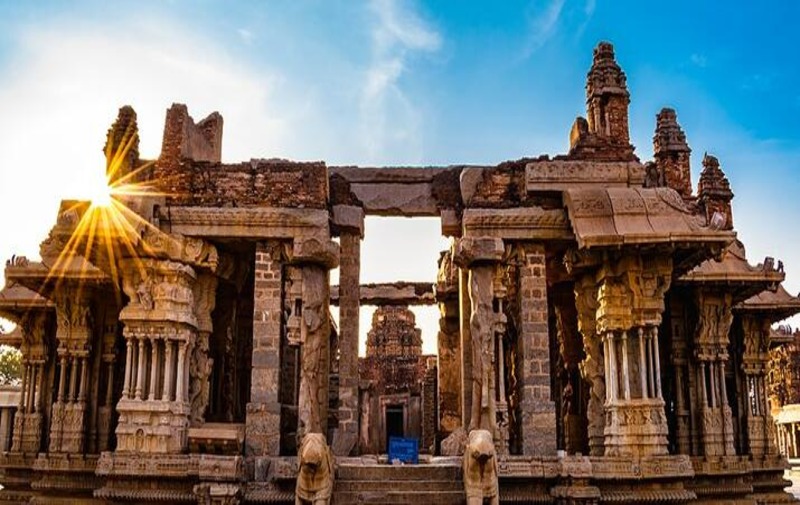
The Vijaya Vithala Temple, built in the 15th century and dedicated to Lord Vishnu, represents the zenith of Vijayanagara architecture. Constructed from locally sourced porphyritic granite, the temple complex features ornate gateways, sculpted pavilions and the famous stone chariot that has become a symbol of Hampi. At its heart lies the Mahamandapa, or Great Hall, once a grand stage for royal ceremonies and classical performances. The hall stands on a raised platform carved with horses, floral motifs and mythological scenes. Massive stone elephants guard the entrance, leading into a forest of towering pillars. But these are no ordinary pillars.
Inside the Mahamandapa are 56 slender stone columns often referred to as the “musical pillars” or “sa-re-ga-ma pillars,” named after the notes of the Indian classical scale. Hewn from single blocks of granite, these composite pillars consist of a thick central column surrounded by clusters of thinner colonettes. When gently tapped once traditionally with sandalwood sticks or even fingers, the slender shafts produced tones resembling bells, strings and percussion instruments such as the veena or tabla. It is said that musicians once “played” these pillars, filling the hall with melody during performances for royalty and deities alike. The phenomenon continues to puzzle historians and scientists. While the pillars function as lithophones, resonant stones that produce sound when struck, their artistic and acoustic sophistication sets them apart from similar examples found elsewhere in the world. Scholars note that nowhere else do we see such an extraordinary blend of musical engineering and sculptural beauty carved into hard granite. Whether the sound-producing quality was an intentional acoustic design or a remarkable coincidence remains debated. What is clear, however, is that the Vijayanagara artisans possessed a deep understanding of stone, structure and resonance.

Each pillar is carefully shaped into different geometrical forms: circular, hexagonal, square or octagonal, possibly influencing tonal variations. The composite design, with load-bearing central columns and surrounding slender shafts, may have allowed the thinner sections to vibrate more freely. The hard granite of the region makes the craftsmanship even more astonishing. Unlike softer stones that are easier to carve and resonate differently, granite demands precision and immense labour. The ability to extract sound from such material reflects not only artistic brilliance but also advanced knowledge of acoustics and structural dynamics. Today, visitors are no longer allowed to touch the pillars. In the past, repeated tapping by tourists led to gradual degradation. The Mahamandapa is now cordoned off, preserving these fragile relics for future generations. Tourists must admire them visually, a silent tribute to a once musical space.
Five centuries ago, the Great Hall would have been alive with movement. Dancers in vibrant silk costumes performing intricate steps. Musicians playing veena, drums and wind instruments. Royal patrons watching from carved platforms. Devotees offering prayers to Lord Vishnu. The pillars were not just architectural elements; they were part of a larger cultural ecosystem where art, spirituality and science blended seamlessly. Even today, standing beneath the towering columns, one can almost imagine the rhythmic beats and melodic strains that once filled the air.
In an era where technology creates artificial soundscapes at the touch of a button, the idea that stone can sing feels magical. Yet it is also grounding. It reminds us that human curiosity and creativity are timeless. The Vijaya Vithala Temple is not merely a monument of the past; it is a bridge between generations. Visitors who stand before the musical pillars often feel a sense of awe not just at the craftsmanship but at the continuity of human expression. Music, after all, is universal. Whether produced by strings, drums or stone, it speaks to the same emotions. As the sun sets over Hampi’s boulder-strewn landscape, the temple glows in warm hues of gold and pink. The pillars stand quietly, no longer struck, yet still resonant in memory. Even in silence, they seem to hum with history. And perhaps that is the greatest marvel of all, that after 500 years, these stones continue to sing, not just through sound but through the stories they tell.

Writing about what truly matters, good news and stories to remind the world - it is brighter than we think.