"Dream, Dream, Dream! Conduct these dreams into thoughts, and then transform them into action."
- Dr. A. P. J. Abdul Kalam
"Dream, Dream, Dream! Conduct these dreams into thoughts, and then transform them into action."
- Dr. A. P. J. Abdul Kalam
10 Mar 2026
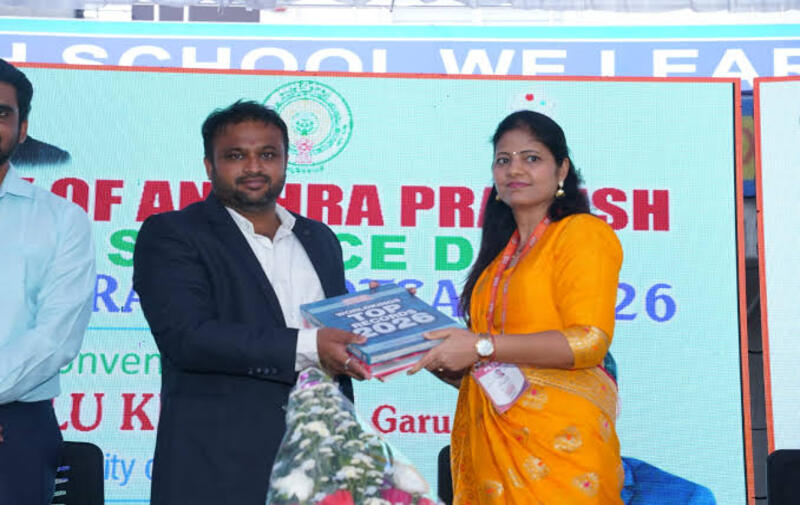
In an era where technology and scientific knowledge are shaping the future, Andhra Pradesh has taken a remarkable step to nurture young scientific minds. AP Science City, through its ambitious initiatives, is transforming the way students experience science education. Its flagship programme, “Science Samagra Mahotsav 2K26,” has gained national and international attention after securing a place in both the India Book of Records and the Asian Book of Records.
The recognition highlights the programme’s scale, impact, and commitment to encouraging scientific curiosity among school students. With participation from over 30,000 students across 4,118 schools, the initiative has emerged as one of the largest science outreach programmes in the region. For educators, parents, and students alike, the achievement represents more than just a record; it reflects a growing movement to make science accessible, engaging, and meaningful for young learners.
The Science Samagra Mahotsav 2K26 was designed to promote scientific thinking among students studying in Classes 6 to 9. The programme invited students from both government and private schools to present innovative science projects that addressed real-world challenges. Rather than limiting participation to a small group of elite institutions, the initiative ensured that students from villages, towns, and cities across the state had equal opportunities to showcase their ideas.
Participants presented projects ranging from environmental conservation and renewable energy to practical solutions for everyday problems. These projects demonstrated how young students, when given the right platform, can develop creative solutions using basic scientific principles. The programme not only encouraged innovation but also helped students understand the importance of teamwork, experimentation, and problem-solving.
One of the reasons behind the programme’s credibility and recognition was its four-stage selection process, which ensured fairness and quality. The evaluation began at the village level, where local schools presented their best projects. The selected ideas then moved to the mandal level, followed by the district level, where expert panels reviewed the entries. Finally, the most promising projects reached the state-level competition, where they were assessed by a jury of educationists, scientists, and subject experts. Projects were judged on several criteria, including innovation and originality , scientific clarity, practical applicability, and environmental sustainability. After the rigorous process, one project from each of the 26 districts was selected as a finalist, showcasing the best young scientific talent in the state.
The success of AP Science City’s initiatives has been closely linked to the leadership of CEO Kesineni Venkateswarlu, who has focused on creating programmes that go beyond traditional classroom learning. Under his guidance, the institution has been encouraging students to experience science through experimentation and innovation rather than simply memorizing concepts from textbooks. Education experts believe that such initiatives are essential in today’s world, where scientific literacy and technological awareness are becoming increasingly important. A former university vice-chancellor praised the initiative, noting that encouraging young students to focus on science and technology can help them develop critical thinking skills and prepare them for future careers in research and innovation.
The Science Samagra Mahotsav is not the only initiative that has brought attention to AP Science City. Earlier, the organisation organised a Rocketry Challenge, which attracted engineering students from across the country. The event allowed participants to design and launch experimental rockets, giving them practical exposure to aeronautics and engineering concepts. Such programmes are helping the state build a strong ecosystem for science education and technological innovation, while also encouraging students to dream bigger. Experts believe that hands-on learning experiences like these are crucial for shaping the future workforce in science, technology, engineering, and mathematics (STEM).
AP Science City currently operates under the Infrastructure and Investment Department, but several academicians believe that bringing the institution closer to the education ecosystem could further strengthen its impact. Some experts have suggested that integrating the science city more closely with the state’s education reforms led by HRD Minister Nara Lokesh could help expand its programmes and reach more students.
The broader vision aligns with the educational goals of Chief Minister N. Chandrababu Naidu, who has emphasized the importance of creating a generation of globally competitive learners equipped with scientific skills and innovative thinking. By connecting schools with scientific institutions, laboratories, and innovation challenges, Andhra Pradesh is attempting to build a future-ready education system.
The success of Science Samagra Mahotsav 2K26 demonstrates how science education can be transformed when students are given the chance to experiment, question, and innovate. Instead of viewing science as a difficult subject confined to textbooks, students are learning to see it as a tool to understand and improve the world around them. With record-breaking participation and growing recognition, AP Science City is gradually creating a vibrant culture of scientific inquiry in Andhra Pradesh. If such initiatives continue to expand, the state may soon become a major hub for nurturing young scientists, innovators, and researchers who will contribute to India’s technological future.

Romanticizing life and shaping stories from everything I see through my journalistic lens. Also, I love sports on the side.