"Dream, Dream, Dream! Conduct these dreams into thoughts, and then transform them into action."
- Dr. A. P. J. Abdul Kalam
"Dream, Dream, Dream! Conduct these dreams into thoughts, and then transform them into action."
- Dr. A. P. J. Abdul Kalam
2 Feb 2026
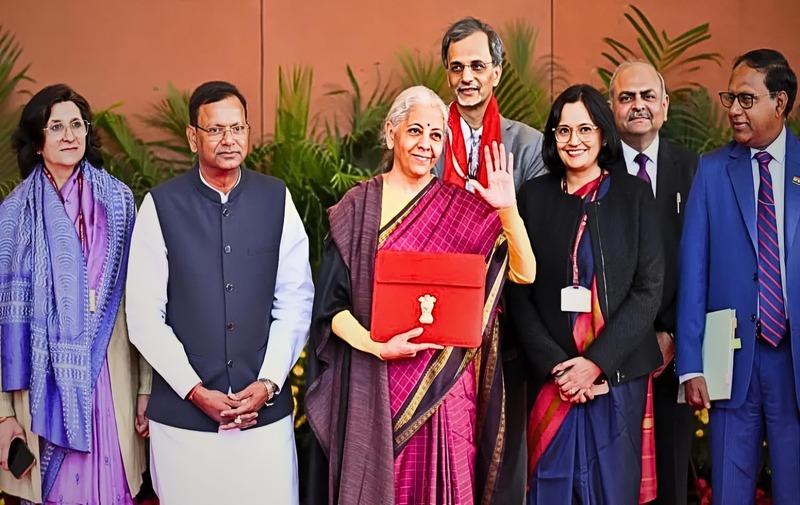
Finance Minister Nirmala Sitharaman’s presentation of the Union Budget 2026–27 was more than a routine financial exercise; it was a statement of intent. Delivered in the Lok Sabha on 1 February in an 85-minute address, her ninth consecutive Budget reflected continuity, confidence and clarity. Coming at a time when the global economy is uncertain and supply chains are under stress, the Budget chose optimism backed by reform, discipline and ambition. Anchored in the vision of Viksit Bharat, the Budget seeks to guide India into its next phase of transformation—one that is growth-driven, inclusive and future-ready.
The optimism of the Budget is reinforced by the Economic Survey 2026, presented on 29 January, which projects India’s GDP growth at 7.4% in FY26 and 6.8–7.2% in FY27. These numbers are not just statistical projections; they reflect India’s robust macroeconomic fundamentals, regulatory reforms and renewed private sector confidence. At a time when many economies are slowing down, India continues to stand out as the world’s fastest-growing major economy. The Budget builds on this momentum by balancing fiscal prudence with growth-oriented spending, especially in capital expenditure and strategic sectors.
In a deeply symbolic beginning, the Finance Minister said this was the first Budget prepared in Kartavya Bhawan and is inspired by three kartavya (duties). The first is to accelerate and sustain economic growth by improving productivity, competitiveness and resilience. The second is to fulfil people’s aspirations by building their capacity and making them partners in progress. The third is to ensure Sabka Sath, Sabka Vikas, so that every region, community and sector can participate meaningfully in India’s growth story. This framing gives the Budget a human connection—it is not only about numbers but also about people, dignity and opportunity.
Union Budget 2026–27 places a strong emphasis on scaling up manufacturing across seven strategic and frontier sectors, while also rejuvenating legacy industries. MSMEs, recognised as the backbone of the economy, receive a major boost through a ₹10,000 crore SME Growth Fund, aimed at creating future “Champion MSMEs”. Public capital expenditure continues to be a growth driver. From just ₹2 lakh crore in 2014–15, capex has risen to ₹11.2 lakh crore in 2025–26, and the Budget proposes increasing it further to ₹12.2 lakh crore in 2026–27. This sustained investment in infrastructure generates jobs, boosts demand and strengthens long-term productivity.
One of the most aspirational announcements is the development of seven high-speed rail corridors, including Mumbai–Pune, Delhi–Varanasi and Chennai–Bengaluru. These corridors are envisioned as “growth connectors” that reduce travel time, enhance mobility and integrate regional economies. Alongside this, the Mumbai–Ahmedabad bullet train project continues to progress, promising to cut travel time to under two hours. Dedicated Freight Corridors, new National Waterways and expanded port connectivity underline the government’s commitment to sustainable and efficient logistics.
In a world facing geopolitical disruptions and chip shortages, India’s push towards self-reliance in technology stands out. The Semiconductor Mission 2.0, with an outlay of ₹8,000 crore, aims to deepen India’s chip manufacturing ecosystem. Rare earth corridors in mineral-rich states and incentives for biopharma manufacturing further strengthen India’s position in critical global supply chains. The Biopharma SHAKTI initiative, with ₹10,000 crore over five years, aims to make India a global hub for biologics and biosimilars, while also strengthening clinical trials and regulatory capacity.
Calling it a Yuva Shakti-driven Budget, the Finance Minister highlighted India’s demographic strength. From setting up girls’ hostels in every district to upgrading hospitality education and launching AVGC Content Creator Labs in schools and colleges, the Budget invests deeply in human capital. The launch of the Khelo India Mission reflects a long-term vision to transform sports into a structured, professional and aspirational sector nurturing talent, creating infrastructure and integrating sports science.
Healthcare and mental well-being also receive attention, with the proposal for NIMHANS-2, regional mental health institutes, and five Regional Medical Hubs to promote medical tourism and employment. The third kartavya of inclusion is visible in initiatives for farmers, women, Divyangjan, and underdeveloped regions. Bharat-VISTAAR, a multilingual AI-powered agricultural advisory tool, promises to empower farmers with customised, real-time guidance. Programs like SHE Marts build on the success of Lakhpati Didi, strengthening women-led entrepreneurship.
Prime Minister Narendra Modi described the Budget as historic, reform-driven and human-centric a catalyst for long-term growth. Union Budget 2026–27 reflects that belief: belief in India’s youth, in its entrepreneurs, in its farmers and workers, and in its ability to rise higher on the global economic ladder. More than figures and policies, this Budget carries a message—India is not just aiming to grow faster but to grow better, fairer and stronger on its journey towards Viksit Bharat.
| Area | What the Budget Says | Why It Matters |
|---|---|---|
| Overall Vision | Budget guided by Viksit Bharat and three kartavya (growth, people’s capacity, inclusion) | Shows the Budget is not just about money, but about people and long-term development |
| Economic Growth | GDP growth projected at 7.4% in FY26 and up to 7.2% in FY27 | Confirms India remains one of the fastest-growing economies |
| Fiscal Discipline | Fiscal deficit at 4.3% of GDP; debt ratio declining | Growth without losing control over government finances |
| Capital Expenditure | Capex increased to ₹12.2 lakh crore | More roads, railways, jobs and economic activity |
| Manufacturing Push | Focus on 7 strategic and frontier sectors | Strengthens “Make in India” and reduces dependence on imports |
| MSME Support | ₹10,000 crore SME Growth Fund | Helps small businesses grow into big, job-creating companies |
| Semiconductor Mission 2.0 | ₹8,000 crore allocation | Builds India’s own chip-making ecosystem |
| Rare Earth Minerals | New rare earth corridors in key states | Secures critical minerals for future technologies |
| Biopharma SHAKTI | ₹10,000 crore to boost biologics and biosimilars | Makes India a global biopharma manufacturing hub |
| Textile Sector | National Fibre Scheme, Samarth 2.0, cluster modernisation | Boosts jobs in labour-intensive textile industry |
| Infrastructure – Rail | 7 new high-speed rail corridors announced | Faster travel, stronger regional economies |
| Bullet Train | Mumbai–Ahmedabad bullet train nearing completion | India enters the global high-speed rail league |
| Freight & Waterways | New freight corridors and 20 national waterways | Cheaper, greener transport of goods |
| City Economic Regions | ₹5,000 crore per CER over 5 years | Turns cities into powerful growth engines |
| Energy Security | Focus on renewables, batteries, nuclear and logistics | Stable energy for long-term growth |
| Medical Tourism | 5 Regional Medical Hubs planned | Creates jobs and brings global patients to India |
| Veterinary Education | Support to add 20,000+ professionals | Strengthens rural economy and animal healthcare |
| AVGC Sector | Labs in 15,000 schools and 500 colleges | Prepares youth for gaming, animation and digital jobs |
| Girls’ Education | One girls’ hostel in every district | Supports higher education for girl students |
| Hospitality & Tourism | National Institute of Hospitality, guide training | Improves tourism quality and employment |
| Sports Development | Launch of Khelo India Mission | Systematic support for sports talent and infrastructure |
| Farmers | Bharat-VISTAAR AI agri tool | Smart, customised advice for farmers |
| Women Empowerment | SHE Marts under Lakhpati Didi | Strengthens women-led businesses |
| Mental Health | NIMHANS-2 and regional institutes | Better mental health care access |
| North-East & Purvodaya | Industrial corridor, tourism, e-buses | Balanced regional development |
| Buddhist Circuits | New tourism scheme in North-East | Boosts culture, tourism and local jobs |
| Defence Budget | ₹7.9 lakh crore (21% rise) | Stronger national security and defence manufacturing |
| IT Sector | Unified IT services category, higher safe harbour | Makes India more attractive for global IT business |
| Global Investment | Tax holidays for data centres till 2047 | Positions India as a global digital hub |
| Ease of Doing Business | Simplified customs, single digital window | Faster trade, less paperwork |
| Tax Reforms | Simpler Income Tax Act from April 2026 | Easier compliance for common taxpayers |
| Relief to Taxpayers | Reduced TCS, extended return revision timelines | Less pressure and more flexibility |
| Support to NRIs & Youth | One-time foreign asset disclosure window | Encourages honesty without fear |
| Cooperatives | More tax benefits and exemptions | Strengthens farmer and cooperative economy |
Romanticizing life and shaping stories from everything I see through my journalistic lens. Also, I love sports on the side.