"Dream, Dream, Dream! Conduct these dreams into thoughts, and then transform them into action."
- Dr. A. P. J. Abdul Kalam
"Dream, Dream, Dream! Conduct these dreams into thoughts, and then transform them into action."
- Dr. A. P. J. Abdul Kalam
1 Apr 2026
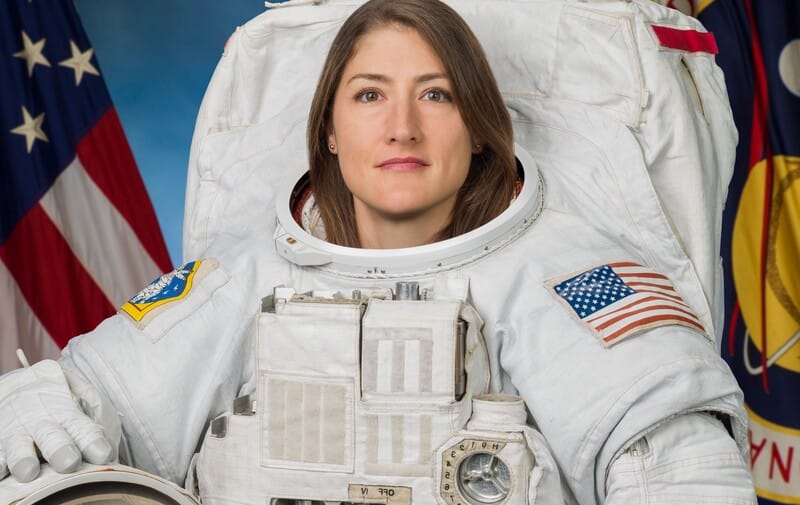
For more than half a century, journeys to the Moon have been defined by a single narrative, one where only men ventured beyond Earth’s orbit. But history is about to change. On April 1, NASA astronaut Christina Koch is set to become the first woman to travel beyond low-Earth orbit and circle the Moon as part of the Artemis II mission. This 10-day journey around the Moon will test the Orion spacecraft’s systems, paving the way for future lunar landings. But beyond the technical achievements, this mission carries a deeper meaning—it represents progress, inclusion, and a future where space belongs to everyone.
Christina Koch is no stranger to making history. Long before Artemis II, she had already carved her name into the record books. She holds the record for the longest single spaceflight by a woman: 328 days aboard the International Space Station. During her time in orbit, she contributed to critical scientific research, from growing protein crystals for medical advancements to testing 3D biological printing in microgravity. In 2019, she was also part of the first all-female spacewalk, a milestone that inspired millions across the globe. Each achievement wasn’t just personal—it was symbolic, breaking stereotypes in a field where nearly 90% of astronauts have historically been men.
The Artemis II mission is part of NASA’s broader Artemis program, which aims to return humans to the Moon and eventually take them to Mars. While this mission will not land on the lunar surface, its importance cannot be overstated. It is a test flight, a critical step in ensuring that spacecraft systems, navigation, and life-support technologies are ready for future missions. Koch, serving as Mission Specialist, will play a key role in ensuring everything functions perfectly. For the first time in over 50 years, humans will travel near the Moon again. And this time, the journey carries a powerful message of change.
Behind every historic moment is a story of perseverance. Koch’s journey began far from the spotlight—in Grand Rapids, Michigan, and later in Jacksonville, North Carolina. She often credits her childhood experiences, especially summers spent working on her family’s farm, for shaping her resilience. Those early days taught her the value of hard work, patience, and pushing beyond limits. Her academic journey led her to North Carolina State University, where she pursued electrical engineering and physics. But what truly set her apart was her willingness to step outside comfort zones. From working in Antarctica’s extreme conditions to contributing to cutting-edge space missions, Koch built a career defined by courage and curiosity.
Before becoming an astronaut, Koch’s career was as adventurous as it was impressive. She worked as an electrical engineer at NASA’s Goddard Space Flight Center and later joined the United States Antarctic Program. Spending a year in Antarctica, including a winter at the South Pole, she faced some of the harshest conditions on Earth. She also served on firefighting and search-and-rescue teams, showcasing her ability to handle high-pressure situations. Her work with organizations like the National Oceanic and Atmospheric Administration and the Johns Hopkins Applied Physics Laboratory further strengthened her expertise, preparing her for the challenges of space.
Koch’s journey represents a shift in how we view space exploration. It is no longer a domain limited by gender or background. It is becoming a space where diversity drives innovation and progress. Her presence on Artemis II is not just about representation; it is about redefining leadership and inspiring future generations. It shows us that inclusion leads to greater achievements, both on Earth and beyond.
As humanity prepares to return to the Moon, Christina Koch’s journey ensures that this new chapter is written with equality, courage, and hope. As she circles the Moon, she carries with her the dreams of millions. Dreams of exploration, equality, and a future where everyone has a place among the stars. Because sometimes, one journey can change everything and this is one of those journeys.
Romanticizing life and shaping stories from everything I see through my journalistic lens. Also, I love sports on the side.