"Dream, Dream, Dream! Conduct these dreams into thoughts, and then transform them into action."
- Dr. A. P. J. Abdul Kalam
"Dream, Dream, Dream! Conduct these dreams into thoughts, and then transform them into action."
- Dr. A. P. J. Abdul Kalam
13 Jan 2026
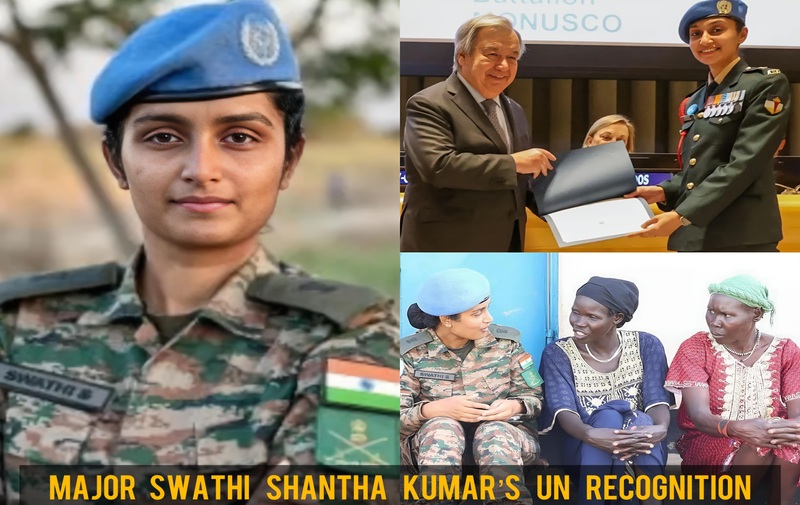
In a moment of pride for India and the global peacekeeping community, Major Swathi Shantha Kumar of the Indian Army has been awarded the prestigious United Nations Secretary-General’s Award 2025 for her outstanding contribution to gender-inclusive peacekeeping. Currently serving with the United Nations Mission in South Sudan (UNMISS), the Bengaluru-born officer emerged as a global winner in the Gender Category, selected from nominations across all UN peacekeeping missions and UN agencies worldwide. The recognition places her work among the most impactful peace initiatives undertaken by UN personnel in recent years.
The award was officially announced by UN Secretary-General António Guterres, who praised Major Swathi’s project titled “Equal Partners, Lasting Peace.” The initiative strengthened UNMISS’s gender-inclusive framework, aligning closely with the United Nations’ mandate to promote gender parity and gender-responsive peacekeeping. What makes this honour particularly significant is the process itself: the project secured the highest number of votes among four global finalists through a UN-wide voting system involving personnel from across the world. In a mission-driven organisation like the UN, such peer recognition carries immense weight.
At the heart of Major Swathi’s work lies a simple yet powerful idea that peace is stronger when women are not just protected but actively included. Her leadership focused on effectively deploying and integrating the Indian Engagement Team, ensuring that women were central to peacebuilding efforts rather than positioned at the margins. This approach transformed how grassroots engagement was conducted across UNMISS’s area of responsibility, especially in conflict-affected and remote regions of South Sudan. Through her initiative, peacekeeping moved beyond static protection to active community participation. Women were encouraged to engage, speak, and lead, laying the groundwork for trust in regions where fear and instability had long defined daily life.
South Sudan presents one of the most challenging environments for peacekeeping operations, marked by fragile security, difficult terrain, and limited infrastructure. Under Major Swathi’s command, the Indian Engagement Team carried out short- and long-distance patrols, integrated riverine patrols, and dynamic air patrols to far-flung counties. These operations were not merely logistical achievements; they were vital lifelines connecting isolated communities to the promise of safety and dialogue. Her leadership helped create a secure and supportive environment for over 5,000 women, enabling them to participate meaningfully in community activities. In regions where women often bear the brunt of conflict, this shift represented dignity, agency, and renewed confidence at the grassroots level.
One of the most lasting impacts of Major Swathi’s work has been the trust built between peacekeepers and local communities. The United Nations noted that her team’s consistent commitment improved outreach and confidence-building efforts, especially in areas long affected by violence and displacement. By integrating women into peacekeeping outreach, the mission was able to listen more closely to local concerns, respond more sensitively, and foster cooperation that traditional security measures alone could not achieve. Her work stands as a living example of how gender-inclusive leadership is not a symbolic gesture but a practical strategy for achieving lasting peace and stability.
Beyond the uniform and medals lies a deeply human story. The eldest of three daughters, Major Swathi Shantha Kumar grew up in Bengaluru with a clear sense of purpose. Her father, R. Shantha Kumar, recalls her determination from a young age to serve the nation in uniform. She completed her schooling in the city and later graduated from New Horizon College of Engineering before being commissioned into the Indian Army’s Corps of Electronics and Mechanical Engineers (EME).
For her family, pride walks hand in hand with concern. Serving in harsh terrains and volatile conditions is never easy, and her father openly admits the worries that come with watching a daughter serve far from home. Yet, the UN honour has brought reassurance that her discipline, courage, and commitment are making a difference far beyond borders.
Today, Major Swathi stands as an inspiration for children across society, especially young girls who dream of careers in uniformed services. Her journey proves that leadership is not confined by gender and that compassion and strength can coexist on the battlefield of peacekeeping. In an era where representation matters deeply, her recognition sends a powerful message: Indian women are shaping global peace narratives, not just participating in them.
After nearly 15 months in South Sudan, Major Swathi is expected to return to India early next month, following which she will be posted in Secunderabad. While her deployment may end, the legacy of her work in UNMISS will continue to guide future missions. The United Nations has highlighted her initiative as a benchmark, showing how inclusive leadership can strengthen peacekeeping operations in fragile regions.
Romanticizing life and shaping stories from everything I see through my journalistic lens. Also, I love sports on the side.