"Dream, Dream, Dream! Conduct these dreams into thoughts, and then transform them into action."
- Dr. A. P. J. Abdul Kalam
"Dream, Dream, Dream! Conduct these dreams into thoughts, and then transform them into action."
- Dr. A. P. J. Abdul Kalam
10 Jul 2026
Deep beneath the lush landscapes of Vietnam's Phong Nha-Ke Bang National Park, an extraordinary underground discovery has left scientists and cave explorers in awe. A newly found cavern, now named Thang Cave or Victory Cave, is not just another limestone wonder, it is home to an exceptionally large concentration of rare cave pearls, a geological phenomenon that even seasoned explorers say is incredibly uncommon.
The discovery has sparked excitement among researchers, who believe the cave could unlock valuable insights into Earth's geological history while opening new opportunities for eco-tourism in one of Southeast Asia's most spectacular natural landscapes.
Thang Cave was first spotted by a local resident in the Ma Da Valley, nestled between Elephant Cave and Ma Da Lake. Soon after, the park authorities launched a six-day scientific expedition to explore the hidden chamber. But reaching it was no easy task.
Researchers had to descend nearly 20 metres using mountaineering equipment before entering the mysterious underground world. Once inside, they discovered that the cave stretches for nearly 3 kilometres, averaging around 70 metres in width, with some sections expanding beyond 100 metres. The cave also features two entrances, one spacious enough for easy access and another so narrow that only a single adult can squeeze through.
As the explorers ventured deeper, they encountered an astonishing landscape sculpted over hundreds of thousands of years. Towering stalactite columns rise as high as 50 metres, while gigantic stalagmites, shimmering stone curtains and massive karst formations create a surreal underground panorama. Every chamber reveals intricate limestone formations shaped patiently by water and time, transforming the cave into what researchers describe as a natural geological museum.
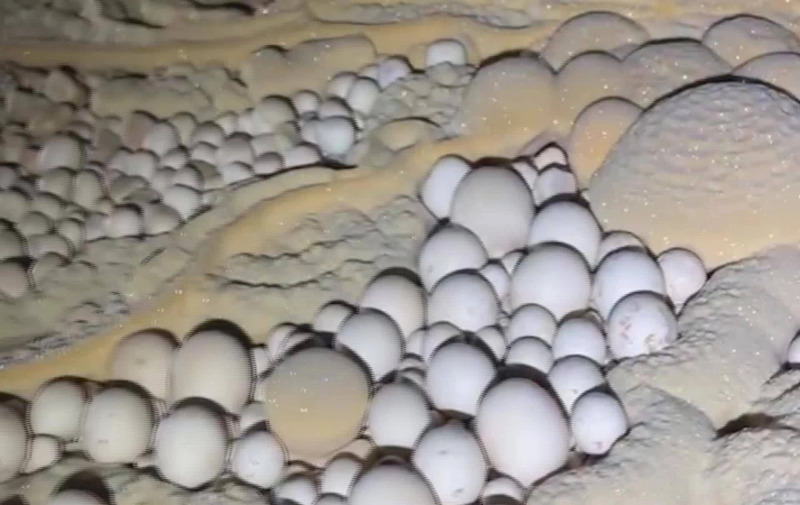
What truly captured scientists' attention was the discovery of countless cave pearls—small, smooth, almost perfectly round white mineral formations resting inside natural rock basins.
Unlike precious pearls found in oysters, cave pearls are created entirely by geology. Over thousands of years, mineral-rich water continuously drips onto tiny particles such as grains of sand or rock fragments. Each droplet deposits an incredibly thin layer of calcium carbonate, gradually building perfectly rounded spheres. While cave pearls are known to occur in limestone caves around the world, finding them in such remarkable abundance is exceptionally rare.
Experienced cave researchers involved in the expedition admitted they had never witnessed deposits of this scale before, making Thang Cave one of the most significant cave pearl discoveries in recent years.
Beyond their beauty, the cave pearls tell an important scientific story. Their formation requires highly stable geological and hydrological conditions over thousands of years. Their abundance suggests that Thang Cave has remained remarkably undisturbed for an incredibly long period, preserving clues about climate, groundwater movement and the evolution of karst landscapes.
Researchers believe the cave will become an important site for geological studies, helping scientists better understand how underground ecosystems evolve over time.
Located within the UNESCO World Heritage-listed Phong Nha-Ke Bang National Park, the newly discovered cavern has the potential to become another jewel in Vietnam's growing reputation as one of the world's greatest cave destinations.
For now, however, Thang Cave remains a place of wonder, a hidden underground kingdom where nature quietly spent thousands of years crafting tiny stone pearls, waiting patiently for humanity to discover one of its best-kept secrets.
.jpeg)
I have a Masters in Literature and a knack for spotting the silver lining! When I’m not chasing good news, you’ll find me nurturing my farm or lost in a good book.