"Dream, Dream, Dream! Conduct these dreams into thoughts, and then transform them into action."
- Dr. A. P. J. Abdul Kalam
"Dream, Dream, Dream! Conduct these dreams into thoughts, and then transform them into action."
- Dr. A. P. J. Abdul Kalam
28 Feb 2026
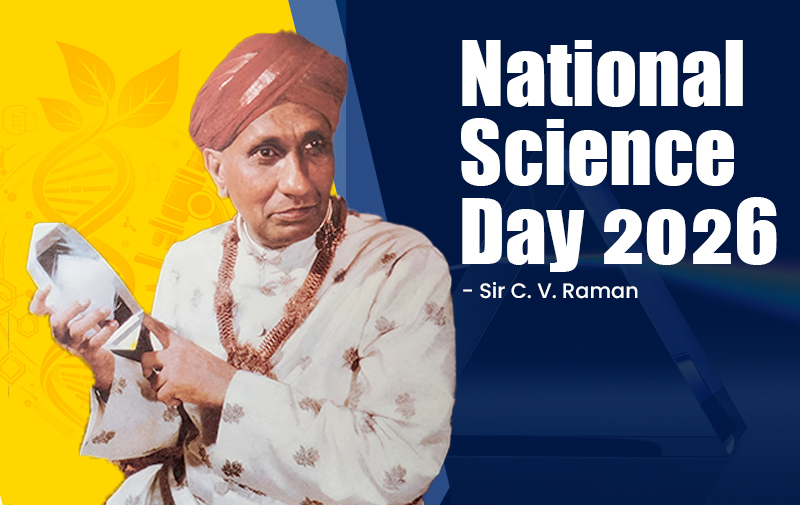
On February 28, 1928, a quiet but revolutionary announcement was made by Indian physicist C. V. Raman. His discovery, later known as the Raman Effect, explained how light changes direction and energy when it passes through a substance. What may sound like a complex physics concept today was, at that time, a bold scientific breakthrough achieved under limited resources during colonial rule. Two years later, Raman received the Nobel Prize in Physics, becoming the first Asian to win a Nobel in science. His achievement was not just personal success; it was a moment of national pride. It proved that India could contribute original research to the world. To honour this historic milestone, the Government of India declared February 28 as National Science Day in 1987. But in 2026, this day feels more urgent and meaningful than ever before.

India stands at a turning point in 2026. The country has set its vision on becoming a “Viksit Bharat” or developed nation by 2047, marking 100 years of independence. This transformation cannot happen without science and technology. Whether it is digital payments reaching villages, space missions placing India among global leaders, or biotech research saving lives, science is shaping everyday reality. National Science Day in 2026 is no longer just about celebrating a past discovery. It is about recognising that research laboratories, universities, startups, and classrooms are building the India of tomorrow. The day reminds policymakers and citizens alike that innovation drives economic strength, global competitiveness, and social progress.
One of the strongest reasons National Science Day matters more in 2026 is its theme: “Women in Science: Catalysing Viksit Bharat.” For decades, women have contributed immensely to Indian science, yet their representation in leadership positions remains limited. This year’s focus highlights female researchers, space scientists, engineers, and innovators who are quietly transforming sectors like artificial intelligence, healthcare, renewable energy, and space exploration. From young girls participating in robotics competitions to senior scientists leading national missions, women are increasingly visible in laboratories and innovation hubs. Celebrating women in science is not symbolic. It is strategic. India cannot afford to leave half of its talent behind while aiming for global leadership. When young girls see women scientists being recognised, they begin to imagine themselves in those roles. National Science Day 2026 therefore becomes a bridge between aspiration and opportunity.

The world today is flooded with information. Social media spreads news within seconds, but not all of it is accurate. In such an environment, scientific temper becomes a necessity rather than a luxury. Scientific temper means questioning, verifying facts, and relying on evidence. It protects society from myths, fake cures, climate denial, and technological fear. National Science Day serves as a reminder that science is not confined to laboratories; it is a way of thinking. In 2026, when artificial intelligence can generate realistic content and misinformation can influence public opinion, strengthening scientific awareness becomes critical for democracy and public health. The day encourages students and citizens to think logically and responsibly.
India faces pressing challenges such as climate change, rising temperatures, water scarcity, health threats, and growing energy demands. These issues cannot be solved through opinion or guesswork. They require research, experimentation, and innovation. Indian scientists are working on renewable energy solutions, advanced vaccines, sustainable agriculture, and smart infrastructure. National Science Day 2026 highlights how science directly improves lives. From affordable medicines reaching rural areas to clean energy projects powering homes, science touches common citizens in visible and invisible ways. The celebration becomes meaningful when people realise that scientific progress is not abstract. It affects the water they drink, the crops they grow, the transport they use, and the jobs they seek.
Walk into any Indian school on February 28, and you will see children building volcano models, demonstrating robotics, or presenting science projects with excitement in their eyes. For many students, this day is their first real exposure to experimentation and curiosity beyond textbooks. National Science Day creates a spark. It encourages a child from a small town to dream of becoming a researcher. It reminds parents that science is not just about marks but about problem-solving and creativity. It tells teachers that nurturing curiosity can shape the nation’s future. As the country moves toward its centenary year of independence, February 28 stands as a reminder that development without science is incomplete. National Science Day 2026 matters more than ever because it connects history to ambition, celebration to responsibility, and curiosity to national growth. Science built India’s pride once. In 2026, it is building India’s future.


Writing about what truly matters, good news and stories to remind the world - it is brighter than we think.