"Dream, Dream, Dream! Conduct these dreams into thoughts, and then transform them into action."
- Dr. A. P. J. Abdul Kalam
"Dream, Dream, Dream! Conduct these dreams into thoughts, and then transform them into action."
- Dr. A. P. J. Abdul Kalam
28 Jun 2026
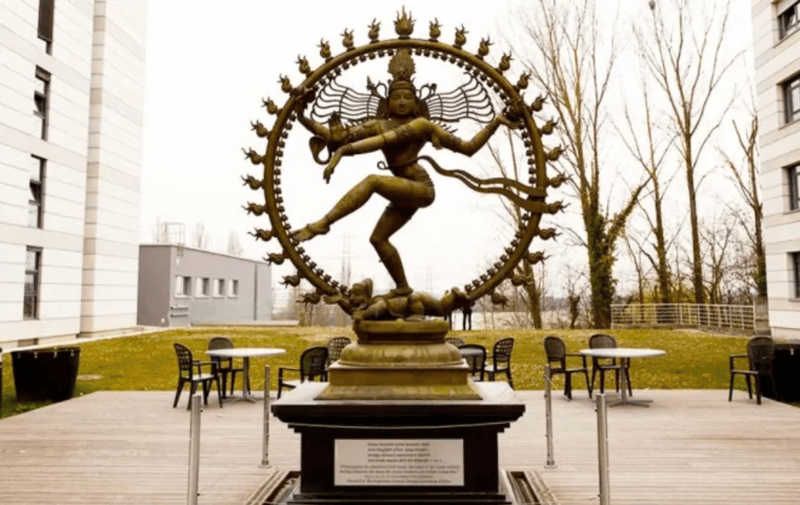
Imagine visiting the world's largest particle physics laboratory, expecting to see only cutting-edge technology and giant scientific instruments, only to be greeted by a magnificent bronze statue of Lord Shiva performing the cosmic Tandava.
For many first-time visitors to CERN in Switzerland, the sight is unexpected. Why would a Hindu deity stand at the entrance of one of the world's most advanced scientific institutions? The answer lies not in religion, but in an extraordinary meeting point of science, philosophy and art.
Far from being out of place, the Nataraja statue represents one of the most compelling metaphors for the universe ever created, a metaphor that resonates deeply with the discoveries of modern physics.
The nearly two-metre-tall bronze statue of Lord Shiva in his Nataraja form was gifted to CERN by the Government of India and unveiled on June 18, 2004.
In Hindu philosophy, Nataraja, the Lord of Dance, performs the Tandava, a dance that symbolises the eternal cycle of creation, preservation and destruction. The universe is not static but constantly transforming, with worlds emerging, evolving and dissolving before beginning anew. Remarkably, this idea echoes what physicists observe at the smallest scales of existence.
Inside CERN's Large Hadron Collider (LHC), particles are accelerated to astonishing speeds before colliding, creating new particles while others disappear in fractions of a second. Matter continually transforms into energy and back again, revealing a universe in perpetual motion. In many ways, the subatomic world is engaged in its own cosmic dance.
Quantum physics has challenged humanity's understanding of reality for over a century. How can light behave both as a wave and a particle? Why does certainty give way to probabilities at the quantum level? These paradoxes have fascinated generations of scientists.
Several pioneering physicists found surprising philosophical parallels in Eastern thought. J. Robert Oppenheimer and Erwin Schrödinger explored Vedanta and other Indian philosophical traditions, drawn by their acceptance of unity, interconnectedness and apparent contradictions that are difficult to express through conventional binary thinking.
Rather than viewing reality as fixed and separate, these traditions often describe existence as dynamic, interconnected and constantly changing.
The symbolism of Shiva's dance gained worldwide attention through physicist and author Fritjof Capra, whose influential book The Tao of Physics explored striking similarities between modern physics and Eastern philosophy.
A plaque beside the Nataraja statue at CERN features one of Capra's most celebrated observations:
"Hundreds of years ago, Indian artists created visual images of dancing Shivas... In our time, physicists have used the most advanced technology to portray the patterns of the cosmic dance."
For Capra, the interactions of elementary particles resembled an endless dance of energy—constantly appearing, disappearing and transforming.
The Large Hadron Collider recreates conditions that existed moments after the birth of the universe, allowing scientists to investigate the fundamental building blocks of reality. Just a few steps away, Lord Shiva's cosmic dance reminds visitors that change is the essence of existence.
Separated by thousands of years, ancient Indian philosophy and modern particle physics arrive at remarkably similar imagery—a universe that is alive with movement, transformation and rhythm. Perhaps that is why the bronze Nataraja continues to stand at CERN.
.jpeg)
I have a Masters in Literature and a knack for spotting the silver lining! When I’m not chasing good news, you’ll find me nurturing my farm or lost in a good book.