"Dream, Dream, Dream! Conduct these dreams into thoughts, and then transform them into action."
- Dr. A. P. J. Abdul Kalam
"Dream, Dream, Dream! Conduct these dreams into thoughts, and then transform them into action."
- Dr. A. P. J. Abdul Kalam
4 May 2026
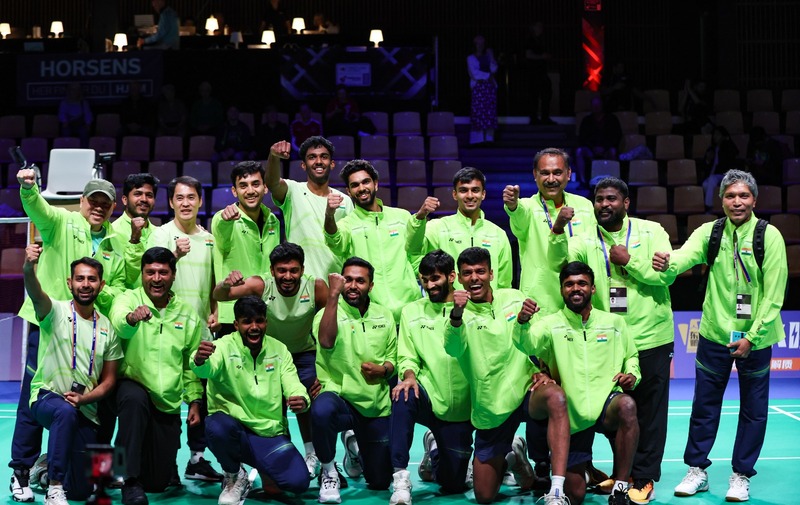
Under the bright lights of Horsens in Denmark, the 2026 edition of the Thomas Cup unfolded with intensity, emotion, and moments that defined careers. For India, it was a journey filled with promise, resilience, and ultimately, a podium finish that brought both pride and perspective. Ending their campaign with a bronze medal, the Indian men’s badminton team once again proved they belong among the world’s elite but also highlighted the gaps that need to be bridged.
Every tournament begins with hope, but it is consistency that defines success. India entered the competition with a strong core, many of whom were part of the historic 2022 gold-winning team. The hunger to reclaim dominance was evident from the very start. Despite a close group-stage loss to a formidable China side, India showed resilience. Matches like these often serve as a benchmark, and even in defeat, there were positives to take forward. The team’s ability to compete against traditional powerhouses signaled their continued growth on the global stage.
If there was a moment that truly defined India’s campaign, it came in the quarterfinal clash against Chinese Taipei. It was here that the team displayed character, composure, and class. Lakshya Sen once again proved why he is considered the backbone of India’s singles lineup, delivering under pressure with remarkable versatility. Alongside him, the dynamic doubles pair of Satwiksairaj Rankireddy and Chirag Shetty showcased their chemistry and dominance, playing with precision and confidence.
Perhaps the most exciting revelation was Ayush Shetty, a debutant who displayed maturity beyond his years. His fearless approach and composure against experienced opponents offered a glimpse into the future of Indian badminton. That victory wasn’t just about reaching the semifinals it was about belief. It reminded fans and players alike that India could still challenge the very best.
However, sport often tests resilience in the harshest ways. In the semifinal against France, India faced a tough reality. Missing Lakshya Sen due to injury, the team struggled to find momentum. Ayush Shetty, Kidambi Srikanth, and HS Prannoy fought hard but were unable to secure a single match. The French players, including Christo Popov, Alex Lanier, and Toma Popov, were clinical, wrapping up the tie 3-0 in straight games. It was a difficult loss, not just because of the scoreline but because it highlighted the thin margin between victory and defeat at the highest level. In tournaments like the Thomas Cup, depth matters, and on that day, India felt the absence of it.
Despite the semifinal defeat, the bronze medal remains a significant achievement. It marks India’s second-ever medal in the history of the Thomas Cup and their first since the golden triumph of 2022.
In a sport dominated by nations with deep talent pools and long-standing systems, finishing among the top four is no small feat. It reflects years of hard work, evolving strategies, and the determination of players who continue to push boundaries. For fans, it was a campaign filled with moments of joy powerful smashes, nerve-wracking rallies, and victories that kept hopes alive. For the players, it was a reminder that they are still contenders on the global stage.
Yet, every medal tells a deeper story. While India’s top players delivered when it mattered, the tournament also exposed a recurring concern: bench strength. The absence of a key player like Lakshya Sen significantly impacted the team’s balance. Countries like China and South Korea, which went on to win the Thomas and Uber Cup titles, respectively, have a pipeline of players ready to step in at any moment.
For India to consistently challenge at the highest level, building that depth is essential. The encouraging sign, however, is the emergence of young talents like Ayush Shetty. With the right support, training, and exposure, the next generation can strengthen India’s position in global badminton. As the curtains fall on the 2026 Thomas Cup, Indian badminton stands at an important crossroads. The foundation is strong, the talent is evident, and the belief is alive. What remains is the effort to build a deeper, more resilient system that can sustain success. The bronze medal in Denmark is not just an end it is a beginning. A reminder that while India has come far, there is still a long way to go.
Romanticizing life and shaping stories from everything I see through my journalistic lens. Also, I love sports on the side.