"Dream, Dream, Dream! Conduct these dreams into thoughts, and then transform them into action."
- Dr. A. P. J. Abdul Kalam
"Dream, Dream, Dream! Conduct these dreams into thoughts, and then transform them into action."
- Dr. A. P. J. Abdul Kalam
18 Jun 2026
Imagine being born before Queen Victoria became the monarch of Britain, before Mahatma Gandhi entered the world, and more than a century before India gained independence.
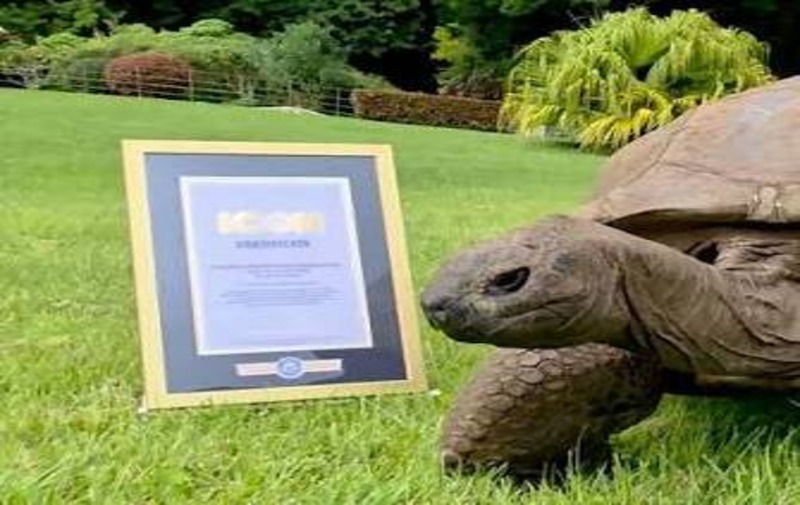
That is the incredible story of Jonathan, the Seychelles giant tortoise who is believed to have hatched around 1832. Nearly 200 years later, Jonathan is still alive, making him the oldest known living land animal on Earth. His remarkable journey has now earned him recognition as a Guinness World Records ICON, turning the gentle reptile into a global celebrity and a symbol of longevity.
Today, Jonathan resides on the remote South Atlantic island of Saint Helena, where visitors flock to catch a glimpse of the living legend.
When Jonathan was born, steam engines were transforming the world, India was under British rule, and photography was still in its infancy.
By the time he arrived on Saint Helena in the 1880s, he was already fully grown. Since then, Jonathan has lived through two World Wars, the rise and fall of empires, the invention of airplanes and the internet, and the independence of dozens of nations. Few creatures on Earth have witnessed such an extraordinary span of history.
Jonathan belongs to the Seychelles giant tortoise species, famous for its enormous size and incredible lifespan. These herbivorous reptiles can weigh over 250 kilograms and grow more than a metre long. Native to islands in the Indian Ocean, they evolved in environments with few predators, allowing them to adopt a slower and more energy-efficient lifestyle.
Unlike many animals that prioritize rapid growth and reproduction, giant tortoises take life at a leisurely pace, growing slowly and reproducing over many decades. Their average lifespan is around 150 years, already extraordinary by animal standards, but Jonathan has surpassed even that.
Scientists believe several factors contribute to the astonishing longevity of giant tortoises. One major reason is their slow metabolism. Because they burn energy gradually, their cells accumulate less damage over time, slowing the ageing process. Researchers have also discovered genetic adaptations linked to DNA repair, stronger immune systems, and resistance to cancer. These mechanisms help maintain cellular health and protect against age-related diseases.
Their large body size and low exposure to predators have also enabled evolution to favour traits that promote longer lifespans.
Perhaps the most fascinating aspect of giant tortoises is that they exhibit what scientists call "negligible senescence"—a phenomenon in which ageing occurs extremely slowly. Even at 194, Jonathan remains surprisingly active. Though partially blind due to cataracts and unable to smell, he still enjoys eating, exploring, and socializing with fellow tortoises.
For researchers studying ageing, Jonathan represents more than a world record. He is a living laboratory. As scientists seek ways to extend healthy human life, some answers may lie in the slow, steady existence of a tortoise that has quietly outlived generations, empires, and revolutions.
.jpeg)
I have a Masters in Literature and a knack for spotting the silver lining! When I’m not chasing good news, you’ll find me nurturing my farm or lost in a good book.