"Dream, Dream, Dream! Conduct these dreams into thoughts, and then transform them into action."
- Dr. A. P. J. Abdul Kalam
"Dream, Dream, Dream! Conduct these dreams into thoughts, and then transform them into action."
- Dr. A. P. J. Abdul Kalam
8 Jul 2026
Urban pollution has long been one of India's toughest environmental challenges. Crowded roads, concrete landscapes, and shrinking green spaces leave little room for nature to do its job. But what if the answer wasn't planting another tree—rather, carrying one wherever it's needed?
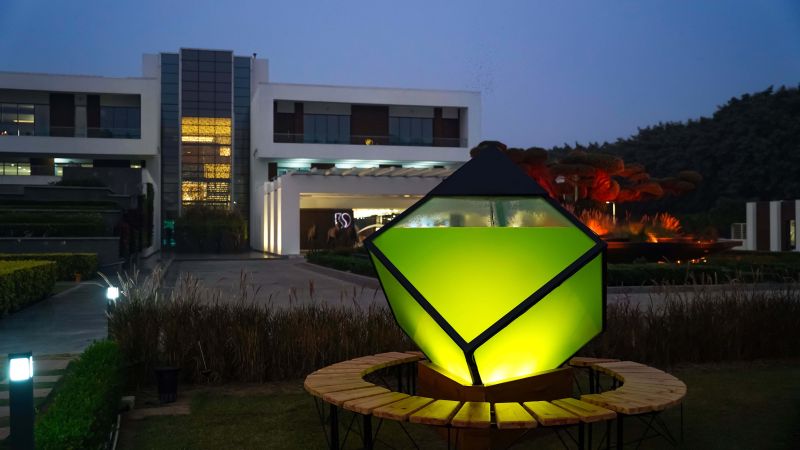
Scientists at the Council of Scientific and Industrial Research – Central Institute of Mining and Fuel Research (CSIR-CIMFR) have developed an innovative air-purification system called the Smart Algal Liquid Tree (SALT)—a compact, mobile "liquid tree" that harnesses the power of microscopic algae to clean polluted air.
Already installed at the CSIR-CIMFR campus in Dhanbad, this futuristic invention could transform how cities combat pollution in space-starved urban environments.
Unlike conventional trees rooted in soil, SALT is essentially a transparent container filled with water and millions of microscopic algae known as microalgae.
These tiny organisms may be invisible to the naked eye, but they perform one of nature's most remarkable processes—photosynthesis. Just like plants, microalgae absorb carbon dioxide from the surrounding air using sunlight and release oxygen as a by-product. In fact, scientists estimate that microalgae produce nearly half of the world's oxygen, making them one of Earth's most powerful natural oxygen generators.
By recreating this biological process inside a compact unit, SALT functions like a miniature ecosystem that can fit where traditional trees simply cannot.
The science behind SALT is surprisingly simple yet incredibly effective. Air containing carbon dioxide enters the algae-filled chamber, where the microalgae absorb the greenhouse gas during photosynthesis. In return, they release fresh oxygen into the atmosphere.
As polluted air passes through the liquid medium, certain airborne pollutants and dust particles are also trapped or biologically processed, improving overall air quality.
One of SALT's biggest advantages is that it doesn't rely solely on sunlight. The system can continue functioning under artificial lighting and can be powered using either solar energy or electricity, making it suitable for round-the-clock operation.
According to project leader and senior principal scientist Vetrivel Anguselvi, the primary objective is to improve air quality in densely populated urban areas where there is little or no space to plant large trees. Unlike earlier liquid tree concepts that remained stationary, SALT has been designed to be mobile. It can be relocated easily and deployed wherever pollution levels are highest.
Potential locations include transport hubs, industrial zones, shopping malls, educational institutions, parks, and other busy public spaces where clean air is urgently needed.
The answer is a clear no. Natural trees remain irreplaceable. They provide shade, cool cities, support biodiversity, conserve water, and create habitats for countless living organisms. SALT is not intended to compete with nature but to complement it.
Its real strength lies in places where planting trees is nearly impossible. Since the system requires no soil, minimal maintenance, and is less vulnerable to pests and harsh urban conditions, it offers a practical solution for heavily built-up areas.
Researchers are now exploring commercial production and hope to make the technology affordable enough for residential neighbourhoods and pollution hotspots across the country.
As cities continue to expand, innovative solutions like SALT could become an important part of India's clean-air strategy. While it may never replace the countless benefits of a real tree, this algae-powered invention proves that science can help nature reach places where roots simply cannot.
.jpeg)
I have a Masters in Literature and a knack for spotting the silver lining! When I’m not chasing good news, you’ll find me nurturing my farm or lost in a good book.