"Dream, Dream, Dream! Conduct these dreams into thoughts, and then transform them into action."
- Dr. A. P. J. Abdul Kalam
"Dream, Dream, Dream! Conduct these dreams into thoughts, and then transform them into action."
- Dr. A. P. J. Abdul Kalam
15 Feb 2026
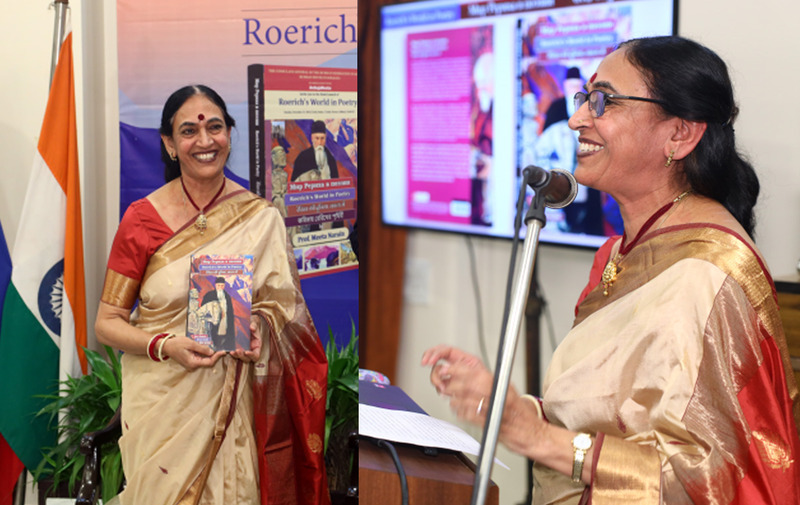
Moscow witnessed a rare and resonant celebration of cross-cultural scholarship on 12 February 2026, as Professor Meeta Narayan became the first Indian to receive the prestigious Helena Roerich International Medal. Conferred by the Helena Roerich Charitable Foundation. The honour recognises exceptional contributions to culture, art, science, and humanitarian thought—a space where Professor Narayan’s work has long flourished.
The grand ceremony at the Moscow House of Public Organisations brought together an eclectic gathering of diplomats, academics, artists, students, and literary enthusiasts. Among the distinguished attendees were senior officials and representatives from the Embassy of India in Moscow, underlining the diplomatic and cultural significance of the occasion. The event was a symbolic reaffirmation of the intellectual bridges connecting India and Russia.
The Helena Roerich International Medal commemorates the towering legacy of Helena Roerich (1879–1955), the celebrated Russian philosopher, writer, and cultural thinker whose ideas transcended borders and disciplines. Instituted to honour individuals advancing humanistic and cultural ideals, the medal has historically been associated with globally respected figures. Past recipients include prominent Russian personalities such as Anatoly Karpov, the legendary World Chess Champion.
By joining this distinguished lineage, Professor Narayan’s recognition carries profound weight. It signals not only personal achievement but also the global relevance of Indian scholarship within the domain of international cultural discourse.
Observers and scholars alike have widely acknowledged Professor Narayan’s pioneering role in promoting the artistic, literary, and philosophical heritage of the Roerich family across India and Russia. Her decades-long engagement with Roerich’s work has helped illuminate the deep philosophical and aesthetic affinities between the two civilizations.
Central to this contribution is her acclaimed trilingual volume, Roerich’s World in Poetry. The work presents Roerich’s poetic cycles in Russian, Hindi, and English—a rare literary feat that expands accessibility while preserving linguistic and cultural nuance. Beyond translation, the book reveals the richness of Indian culture, philosophy, and spirituality through the lens of a Russian painter-poet, offering readers a multidimensional cultural dialogue.
Scholars have described the publication as a significant cultural document of Indo-Russian friendship, one that transforms poetry into a shared intellectual space rather than a mere artistic artifact.
Professor Narayan’s intellectual pursuits extend beyond Roerich studies. Her work, East-West, emphasises the indispensable role of culture in fostering international harmony and mutual understanding. At a time when geopolitical narratives often overshadow cultural conversations, her writings reaffirm the idea that literature and philosophy remain powerful instruments of global connection.
Professor Narayan’s recognition in Moscow is built upon more than forty years of distinguished academic engagement. A former professor at Jawaharlal Nehru University, she commands exceptional expertise in Russian language studies, specialising in Russian philology and translation studies. Her publications have earned international academic recognition, with universities across multiple countries incorporating her work into their curricula.
Her career has been punctuated by notable accolades. She received the Pushkin Medal in 2019 for her contribution to Russian language and culture, followed by the Dostoevsky Star Award in 2025. Earlier honours include the Modernites Award for Excellence (2019) and the Dr Radhakrishnan Millennium National Teacher Award (2010), reflecting both scholarly distinction and pedagogical impact.
Professor Meeta Narayan’s historic achievement represents far more than an individual triumph. It marks a milestone in cultural diplomacy, highlighting the enduring vitality of India-Russia intellectual relations. In an era defined by rapid technological change and shifting global priorities, such recognitions underscore the timeless influence of literature, philosophy, and artistic dialogue.
.jpeg)
I have a Masters in Literature and a knack for spotting the silver lining! When I’m not chasing good news, you’ll find me nurturing my farm or lost in a good book.