"Dream, Dream, Dream! Conduct these dreams into thoughts, and then transform them into action."
- Dr. A. P. J. Abdul Kalam
"Dream, Dream, Dream! Conduct these dreams into thoughts, and then transform them into action."
- Dr. A. P. J. Abdul Kalam
30 Dec 2025
As the world grapples with climate change and energy insecurity, India has delivered a powerful statement in 2025. The country has achieved 50% non-fossil installed electricity capacity—five years ahead of its Nationally Determined Contribution (NDC) target for 2030. This milestone is not just a statistic; it marks a defining moment in India’s journey towards a greener, more self-reliant energy future.
According to the latest figures, India had set a target of 500 GW of non-fossil capacity by 2030. Remarkably, by 2025, the combined installed and pipeline non-fossil capacity had already touched around 507 GW. This early achievement underscores the scale, speed, and ambition of India’s energy transition.
India’s non-fossil installed capacity has grown from 81 GW to 263 GW over the years—an impressive increase of nearly 225%. This growth reflects sustained policy support, large-scale project execution, and increasing participation from both public and private players.
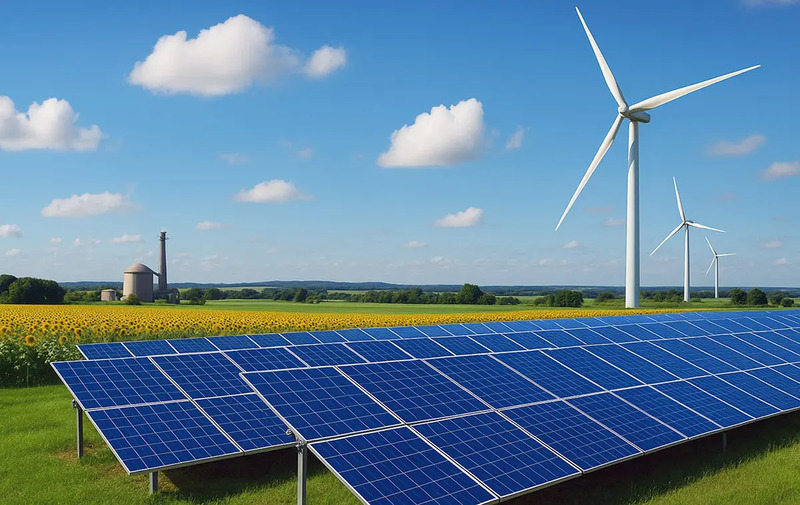
At the heart of this transformation lies renewable energy, particularly solar and wind power. Together, they have reshaped India’s electricity landscape and reduced its dependence on conventional fossil fuels.
Solar energy has emerged as the undisputed driver of India’s clean energy push. Installed solar capacity has surged from just 2.8 GW in 2014 to an astounding 133 GW in 2025—an increase of over 4,500%.
This boom has been fuelled by utility-scale solar parks, rapid rooftop solar adoption, and innovative hybrid renewable tenders. Government initiatives such as the PM Surya Ghar: Muft Bijli Yojana, aimed at providing rooftop solar connections to one crore households, have further accelerated adoption at the grassroots level.
Between 2022 and 2024 alone, India added around 46 GW of solar power, making it the third-largest contributor to global solar capacity additions during this period.
Wind energy has continued its steady climb, with installed capacity rising from about 21 GW to 54 GW since 2014—a growth of 155%. Biopower, driven by agricultural residue and organic waste, has also expanded from 8.1 GW to 12 GW, registering a 42% increase.
Together, these sources have helped diversify India’s renewable energy mix, making the grid more resilient and regionally balanced.
2025 has also been a breakthrough year for renewable energy manufacturing in India. Domestic solar module manufacturing capacity has increased from 2 GW to 123 GW—an increase of more than 6,000%. Solar cell manufacturing, virtually absent before 2014, now stands at 27 GW, while wafer manufacturing capacity has reached 2.2 GW.
India has also established 3.2 GW of fully integrated manufacturing facilities, covering the entire solar value chain. This shift has strengthened supply chains, reduced import dependence, and aligned with the vision of Atmanirbhar Bharat.
India’s clean energy progress has earned strong international recognition. In 2023, the country overtook Japan to become the world’s third-largest solar power generator, producing 1,08,494 GWh of solar electricity.
According to the International Renewable Energy Agency (IRENA), India’s energy transition has saved nearly ₹4 lakh crore (about $46 billion) in fossil fuel and pollution-related costs. Fossil fuel savings alone account for approximately $14.9 billion—a significant economic dividend of going green.
Union Minister for New and Renewable Energy Pralhad Joshi has called the early achievement of the 50% target a moment of national pride, crediting Prime Minister Narendra Modi’s leadership for steering India’s green transformation.
In 2025, energy storage moved from concept to cornerstone. Battery Energy Storage Systems received strong policy backing, including viability gap funding for grid-scale projects. Pumped storage projects also gained momentum, with multiple proposals advancing across states.
These developments are crucial for integrating large volumes of renewable energy while ensuring grid stability.
As India looks beyond 2025, the message is clear: the clean energy transition is no longer aspirational—it is operational. By achieving its targets early, India has not only strengthened its energy security but also positioned itself as a global climate leader, ready to power growth sustainably in the decades ahead.
.jpeg)
I have a Masters in Literature and a knack for spotting the silver lining! When I’m not chasing good news, you’ll find me nurturing my farm or lost in a good book.