"Dream, Dream, Dream! Conduct these dreams into thoughts, and then transform them into action."
- Dr. A. P. J. Abdul Kalam
"Dream, Dream, Dream! Conduct these dreams into thoughts, and then transform them into action."
- Dr. A. P. J. Abdul Kalam
30 Oct 2026
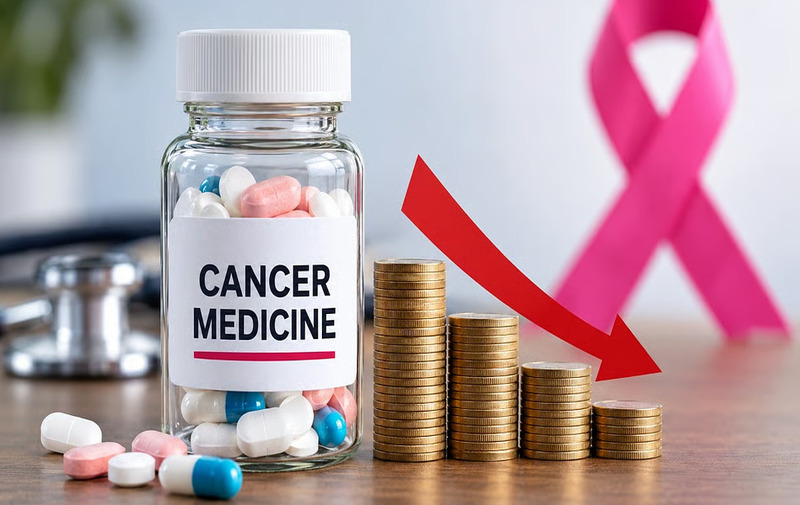
For many cancer patients, the battle is not just against the disease but also against the staggering cost of treatment. In a significant step towards making healthcare more affordable, the Indian government has announced price reductions for 137 cancer medicines, bringing relief to patients who often struggle to afford life-saving drugs.
Behind this important decision is the determination of Sarojam Radhakrishnan, a retired bank employee from Kerala, whose personal struggle eventually reached the Supreme Court.
Diagnosed with breast cancer in 2021, Radhakrishnan was prescribed medicines that cost more than ₹63,000 a month. Unable to bear the financial burden, she realised that countless other families were facing similar difficulties. In 2022, she approached the Kerala High Court, seeking government intervention to make cancer medicines more affordable. She passed away in the same year at the age of 69.
The Kerala High Court continued with the proceedings that eventually brought the issue before the Supreme Court, where the judges raised serious concerns about the enormous mark-ups imposed on cancer drugs by hospitals, distributors and chemists.
According to a report in The Guardian, during a hearing on September 29, Justices Vikram Nath and Sandeep Mehta pointed out the wide gap between the prices at which medicines were supplied and the amounts charged to patients.
In one instance, a cancer drug supplied to hospitals for ₹2,700 was reportedly being sold for ₹27,000. An analysis by the National Pharmaceutical Pricing Authority (NPPA) also found that trade mark-ups on some cancer medicines averaged 170%, with certain cases exceeding 700%.
The judges described the situation as "extortion", highlighting how vulnerable patients were bearing the burden of excessive pricing.
Following the court's observations, the Centre extended a 30% trade margin cap to 137 additional cancer medicines that were previously outside the price-control list. The measure is expected to bring down medicine prices by up to 70% in some cases and help patients save an estimated ₹2,500 crore annually.
According to revised pricing notifications, new rates for 543 cancer drug brands came into effect on November 9.
Some of the steepest reductions include Thiotepa, a chemotherapy medicine, whose price dropped from ₹80,071 to ₹7,150 for a 100 mg vial, a reduction of around 91%. Pertuzumab, an immunotherapy drug used in breast cancer treatment, also saw its price fall from ₹94,951 to ₹30,593 for a 30 mg vial, a reduction of approximately 68%.
While experts have welcomed the move, some have pointed out that controlling trade margins alone may not address every pricing challenge, particularly for patented medicines with limited competition. Nevertheless, the decision marks an important step towards reducing the financial burden on cancer patients.
Radhakrishnan's fight has brought attention to an issue affecting thousands of families. Her journey is a reminder that one person's determination can help bring about changes that reach far beyond their own life.
.jpeg)
I have a Masters in Literature and a knack for spotting the silver lining! When I’m not chasing good news, you’ll find me nurturing my farm or lost in a good book.