"Dream, Dream, Dream! Conduct these dreams into thoughts, and then transform them into action."
- Dr. A. P. J. Abdul Kalam
"Dream, Dream, Dream! Conduct these dreams into thoughts, and then transform them into action."
- Dr. A. P. J. Abdul Kalam
7 Jul 2026
Innovation isn't always born in research labs or powered by cutting-edge technology. Sometimes, it begins in the fields, inspired by a family's struggle and a determination to preserve a way of life.
That is exactly what Dinakaraj, a 35-year-old farmer from Salaiputhur village in Tamil Nadu's Thoothukudi district, has accomplished.
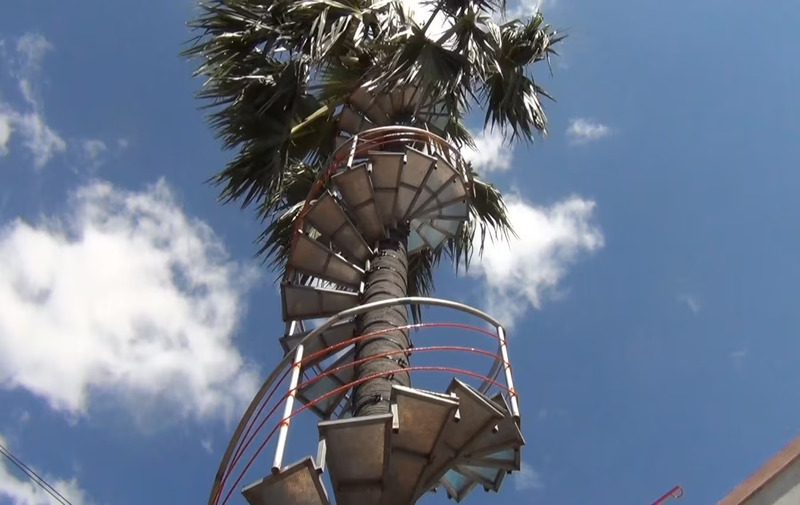
Faced with a growing shortage of skilled palm climbers, Dinakaraj has designed an ingenious solution—a spiral iron staircase wrapped around a towering 55-foot palmyra tree. The structure allows people to simply walk to the top of the tree instead of climbing it the traditional way, making the harvesting of fresh palm nectar, locally known as pathaneer or padaneer, significantly safer and easier.
For Dinakaraj, the staircase is far more than a clever invention. It is deeply personal. His family has been associated with the palmyra industry for generations. Like countless families across southern India, harvesting palm sap has long been both a livelihood and a cherished tradition.
Among those who devoted decades to the profession was his father, Yesudasan, now 70. Once an experienced palm climber, advancing age eventually forced him to stop scaling the towering trees that had sustained his family for years. Watching his father step away from the occupation planted a question in Dinakaraj's mind: Could there be a safer and easier way to reach the top of a palm tree?
That question eventually became an innovation.
According to a report in News18, the palmyra industry is grappling with a serious shortage of skilled climbers across many parts of Tamil Nadu. As experienced workers grow older, fewer young people are willing or trained to take up the physically demanding profession.
Determined to find a solution, Dinakaraj invested around ₹60,000 to build a sturdy spiral staircase using iron rods around a palmyra tree near his home.
The design resembles a residential spiral staircase, carefully winding around the tree's trunk until it reaches the top. The innovation has dramatically reduced the physical effort involved in harvesting palm sap while also lowering the risk of dangerous falls. According to Dinakaraj, elderly family members, women and even older children can now safely reach the top to collect fresh palm nectar.
While ₹60,000 may seem like a significant investment, Dinakaraj sees it as a long-term asset rather than an expense. He believes the regular sale of pathaneer will allow him to recover the entire cost within the first year. Since a healthy palmyra tree can remain productive for many years, he expects the staircase to continue delivering economic returns for at least the next 15 years.
Dinakaraj's spiral staircase preserves a centuries-old occupation while making it safer, more inclusive and economically viable for future generations. As traditional industries across India search for ways to adapt to modern challenges, this remarkable invention from a small village in Thoothukudi stands as proof that the most impactful ideas are often the simplest ones.
.jpeg)
I have a Masters in Literature and a knack for spotting the silver lining! When I’m not chasing good news, you’ll find me nurturing my farm or lost in a good book.