"Dream, Dream, Dream! Conduct these dreams into thoughts, and then transform them into action."
- Dr. A. P. J. Abdul Kalam
"Dream, Dream, Dream! Conduct these dreams into thoughts, and then transform them into action."
- Dr. A. P. J. Abdul Kalam
12 Jan 2026
India has launched Mission Sudarshan Chakra, an ambitious national defence programme designed to strengthen the country’s air defence architecture against emerging aerial threats, especially hostile drones. As unmanned aerial systems increasingly redefine modern warfare, this mission reflects a strategic shift in India’s defence posture from traditional, platform-centric air defence to an integrated, technology-driven, and layered protective shield. With sensitive borders, dense civilian populations, and critical infrastructure at risk, Mission Sudarshan Chakra is not just a military upgrade but a national security necessity.
In recent years, drones have transformed from hobbyist gadgets into powerful tools of warfare. They are relatively inexpensive, difficult to detect, and capable of surveillance, smuggling, and precision attacks. Conflicts across the world have demonstrated their disruptive potential. The Russia–Ukraine war has shown how drones can neutralise expensive military hardware, while closer to home, Indian security agencies have recorded a sharp increase in drone-based activities along the Pakistan border.
Attempts to use drones during operations such as Operation Sindoor highlighted vulnerabilities that conventional air defence systems were not fully designed to handle. For soldiers guarding remote border posts and civilians living near sensitive areas, drones represent an invisible threat—small machines that can cross borders silently, carry explosives, or relay intelligence. Mission Sudarshan Chakra emerges from this reality, aiming to close gaps in India’s defensive shield and ensure that the skies above the nation remain secure.
Mission Sudarshan Chakra is envisioned as a comprehensive, multi-layered air defence shield capable of countering a wide spectrum of aerial threats, including fighter aircraft, missiles, and unmanned aerial systems. With a target completion timeline extending to 2035, the program complements existing systems such as the Integrated Air Command and Control System by addressing evolving threat vectors rather than replacing current capabilities. The mission’s core philosophy is layered defence. Long-range systems will detect and intercept threats far from Indian airspace, while medium- and short-range systems will provide coverage closer to vital installations. At the lowest level, point-defence mechanisms will protect specific targets such as airbases, ammunition depots, power plants, and urban centres. This layered approach ensures redundancy, resilience, and rapid response in a fast-changing combat environment.
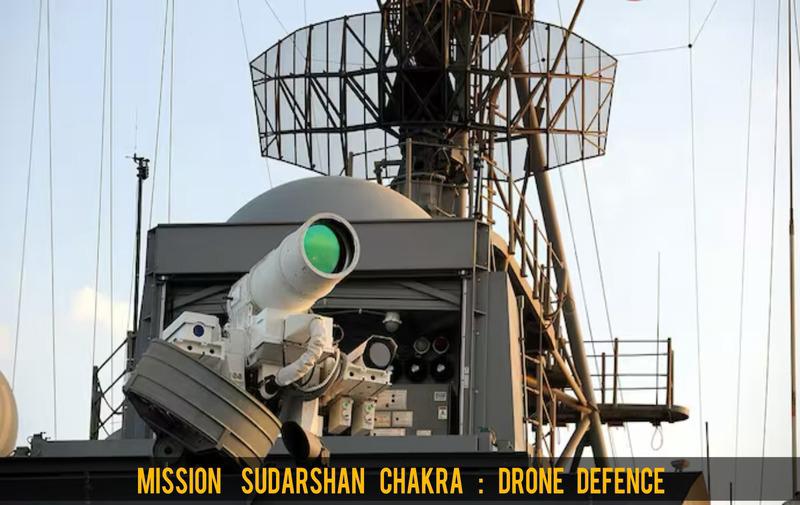
Modern drone warfare demands modern solutions. Mission Sudarshan Chakra places strong emphasis on advanced technologies, particularly electronic warfare and directed energy weapons. Counter-drone measures under the mission are designed around both soft-kill and hard-kill options. Soft-kill measures aim to neutralise drones without destroying them physically. These include electronic warfare techniques such as disrupting communication links between drones and their operators, as well as GNSS jamming to confuse navigation systems. Such methods are especially valuable in populated areas, where debris from destroyed drones could pose risks to civilians. By combining both approaches, India aims to create a flexible response framework that can adapt to different threat scenarios, from lone smuggling drones to coordinated swarm attacks.
Mission Sudarshan Chakra signals India’s recognition that future wars may not begin with fighter jets crossing borders but with silent drones probing weaknesses. By proactively building a multi-layered air defence shield and a dedicated counter-drone grid, India is preparing not just for today’s threats but for those that will emerge over the next decade. As adversarial neighbours continue to invest in unmanned systems, India’s response through Mission Sudarshan Chakra underscores a clear message that the nation is ready to defend its skies with intelligence, integration, and innovation. In doing so, it strengthens not only military preparedness but also the everyday security of its people, ensuring that technological progress serves the cause of peace and protection.

Writing about what truly matters, good news and stories to remind the world - it is brighter than we think.