"Dream, Dream, Dream! Conduct these dreams into thoughts, and then transform them into action."
- Dr. A. P. J. Abdul Kalam
"Dream, Dream, Dream! Conduct these dreams into thoughts, and then transform them into action."
- Dr. A. P. J. Abdul Kalam
22 May 2026
In one of the most extraordinary feats ever witnessed in mountaineering history, Rustam Nabiev has conquered the world’s highest peak using only the strength of his arms.
The Russian climber, who lost both his legs in a devastating military barracks collapse in 2015, successfully reached the summit of Mount Everest on May 20 during Nepal’s 2026 spring climbing season. Standing at a staggering 8,848.86 metres, Everest is considered one of the most dangerous and physically demanding mountains on Earth. Yet Nabiev achieved what many believed was impossible — climbing it without prosthetic legs.
His remarkable journey has stunned the mountaineering world and inspired millions across social media.
Nabiev’s story began with heartbreak. In 2015, while serving in the military, a barracks building collapsed as he slept inside. Several soldiers lost their lives in the tragedy, and Nabiev suffered catastrophic injuries that led to the amputation of both his legs.
For many, such a life-altering accident would have ended all dreams of adventure and physical endurance. But Nabiev refused to surrender to despair.
Over the years, he rebuilt his life through relentless determination, fitness training, and extreme sports, gradually proving that physical limitations do not define human potential.
This year, Nabiev set out for the ultimate challenge — Everest. He spent April and the first half of May in Nepal, carefully acclimatising to the harsh Himalayan environment while preparing for the dangerous ascent. His final summit push began on May 13, which also happened to be his 34th birthday.
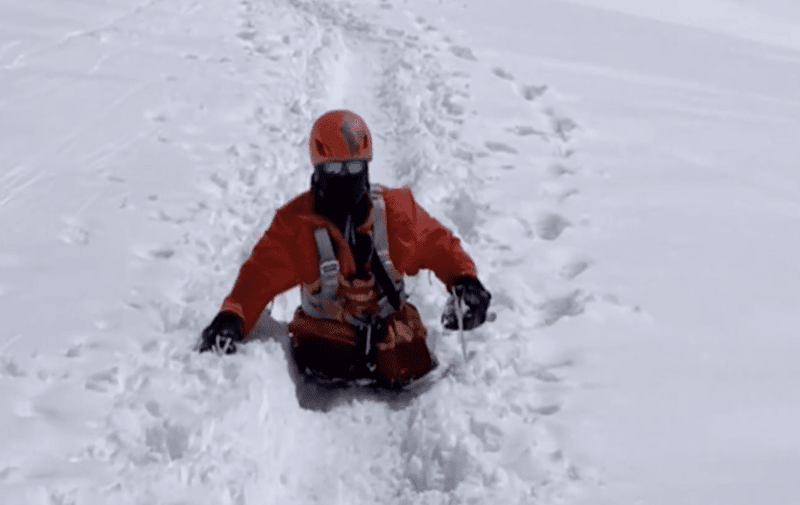
The climb tested him in unimaginable ways. Videos shared from the expedition showed Nabiev crawling across the terrifying ladders of the Khumbu Icefall using only his hands and upper body strength. The Khumbu Icefall is widely regarded as one of the deadliest sections of the Everest route, filled with deep crevasses, unstable ice towers, and constantly shifting terrain.
According to reports, it took him nearly 15 exhausting hours to cross the icefall and reach Camp I at around 6,065 metres. Yet he kept going. Navigating severe weather, freezing temperatures, and four high-altitude camps, Nabiev eventually reached the summit on May 20 at 8:16 AM Nepal time, making history in the process.
After reaching the top of the world, Nabiev shared an emotional message that quickly spread online.
“On May 20th, at 8:16 AM Nepal time, for the first time in the history of mountaineering, I, Rustam Nabiev, reached the summit of Everest using only my arms,” he wrote on Instagram. “I dedicate this ascent to everyone watching me now. With this act, I simply want to say one thing: as long as there’s life left in you, fight! Please fight to the end! It’s worth it!”
The heartfelt message connected with many on social media. People shared that his achievement was one of the most inspiring stories of human resilience they had ever seen.
Everest was not Nabiev’s first major mountain challenge. Following his accident, he first climbed Mount Elbrus, the highest mountain in both Russia and Europe. Later, in 2021, he travelled to Nepal and successfully summited Mount Manaslu, the world’s eighth-highest mountain.
But Everest remained his biggest dream. Today, that dream has become a historic reality. Nabiev’s achievement is far more than a mountaineering milestone. It is a powerful reminder that courage can rise above unimaginable pain and that the human spirit is capable of conquering even the world’s highest mountains.
.jpeg)
I have a Masters in Literature and a knack for spotting the silver lining! When I’m not chasing good news, you’ll find me nurturing my farm or lost in a good book.