"Dream, Dream, Dream! Conduct these dreams into thoughts, and then transform them into action."
- Dr. A. P. J. Abdul Kalam
"Dream, Dream, Dream! Conduct these dreams into thoughts, and then transform them into action."
- Dr. A. P. J. Abdul Kalam
30 Jul 2026
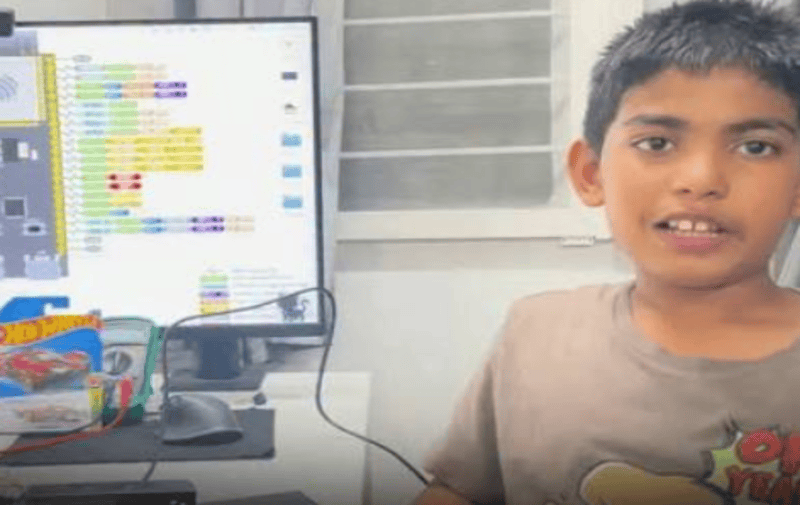
At an age when most children are captivated by bedtime stories, eight-year-old Laksh is busy creating the storyteller itself.
The young innovator has built a voice-controlled artificial intelligence storytelling device that runs entirely offline using an ESP32-S3 microcontroller costing around ₹760. Without relying on Wi-Fi, cloud computing or expensive APIs, the compact device generates original stories, narrates them aloud, displays simple animations and responds to spoken commands.
In a world increasingly dependent on cloud-based AI, Laksh's invention demonstrates that intelligent applications can also thrive on affordable hardware with no internet connection.
As per a report in India Today, the device is powered by an ESP32-S3 microcontroller, an INMP441 microphone, an I2S speaker and a MAX98357A amplifier. Together, they create a portable AI assistant that listens, thinks and tells stories—all without ever connecting to the internet.
Users simply speak commands such as "Make a funny story," and the AI instantly creates an original tale before reading it aloud. Additional voice commands like "play," "pause," "resume" and "next story" allow users to control the storytelling experience hands-free, while animations on the display bring every story to life.
Laksh developed the project by adapting TinyStories LLM for ESP32, an open-source language model created by developer slvDev. While the original model could generate stories offline, the young developer expanded its capabilities significantly.
He integrated voice interaction, playback controls and visual animations, transforming a simple language model into a fully interactive storytelling companion.
Since the original source code is publicly available on GitHub, other developers can also experiment with the technology, improve it and build new applications, highlighting the collaborative spirit of the open-source community.
Laksh follows a flexible online education model that allows him to explore and innovate. Instead of spending all his time in a conventional classroom, he learns through experiences, travel and independent projects.
This unique approach has also given him the opportunity to interact regularly with founders, entrepreneurs and professionals, exposing him to ideas that encourage problem-solving and creativity from a remarkably young age. His latest invention reflects the power of self-driven learning combined with curiosity and hands-on experimentation.
Laksh is already looking ahead. He believes the current limitation of his project lies in the quality of its text-to-speech system. Although the AI successfully generates and narrates stories, he aims to improve the naturalness of the spoken voice in future versions.
His determination to refine the technology shows that innovation is an ongoing journey rather than a finished product. The headlines celebrate an eight-year-old building an AI device. But the bigger story is the mindset behind it. While many people use artificial intelligence as consumers, Laksh chose to become its creator.
His project demonstrates how open-source software, affordable electronics and imagination can come together to produce meaningful innovation. It also highlights the growing potential of small language models that can run efficiently on compact devices without cloud infrastructure, making AI more accessible, affordable and useful across the world.
.jpeg)
I have a Masters in Literature and a knack for spotting the silver lining! When I’m not chasing good news, you’ll find me nurturing my farm or lost in a good book.