"Dream, Dream, Dream! Conduct these dreams into thoughts, and then transform them into action."
- Dr. A. P. J. Abdul Kalam
"Dream, Dream, Dream! Conduct these dreams into thoughts, and then transform them into action."
- Dr. A. P. J. Abdul Kalam
12 Jan 2026
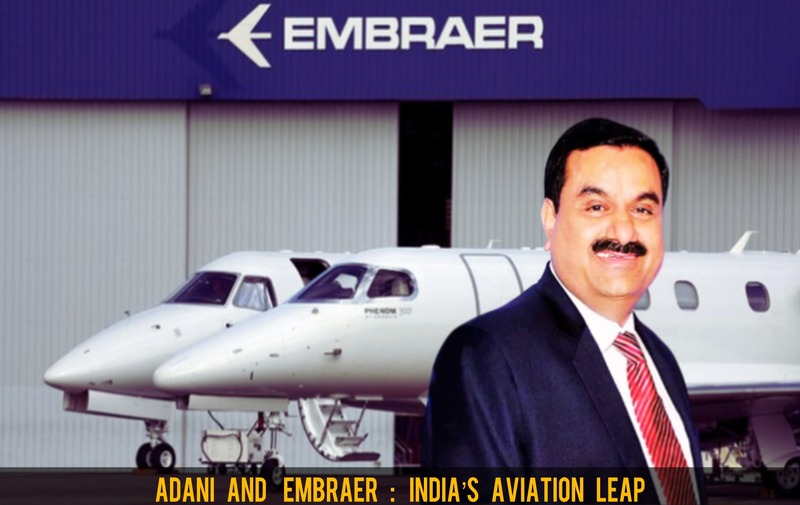
India’s aviation story is entering a historic new chapter. For the first time, regional passenger jets are set to be manufactured in the country, as the Adani Group partners with Brazil’s aerospace major Embraer. This collaboration is more than a business deal; it signals India’s ambition to move from being one of the world’s largest aircraft buyers to becoming a serious aircraft manufacturing hub. While details such as the site, investment size, and operational timeline of the proposed final assembly line (FAL) are yet to be disclosed, a formal announcement is expected later this month at the Hyderabad air show, a venue symbolic of India’s growing aerospace aspirations.
Embraer’s entry into manufacturing regional jets in India comes at a time when the country is the world’s fastest-growing aviation market. Indian airlines have more than 1,800 aircraft on order, with Air India Group, IndiGo and Akasa Air leading a massive fleet expansion to meet surging passenger demand. Regional connectivity, especially under schemes like UDAN, has created strong demand for short- and medium-haul aircraft, where Embraer has global expertise.
Embraer’s E-Jets are already familiar to India. Since 2005, the company’s aircraft have operated across multiple segments, including the Indian Air Force, government agencies, business jet operators and regional airline Star Air. With nearly 50 Embraer aircraft already flying in Indian skies, the company sees a natural opportunity to deepen its footprint by manufacturing locally and tapping into India’s scale, talent pool and cost advantages.
For the Adani Group, the Embraer partnership fits neatly into a broader aviation strategy. Over the past few years, Adani has emerged as India’s largest airport operator, but the group is now clearly moving beyond airport infrastructure. In December last year, Adani announced plans to foray into engine maintenance, repair and overhaul (MRO) as well as passenger-aircraft-to-freighter (P2F) conversion, reflecting a push to build a comprehensive aircraft services ecosystem.
Jeet Adani, Director of Adani Airport Holdings Ltd, recently explained that the group has distinctly separated its aviation verticals. One focuses on airport infrastructure, while the other concentrates on aircraft services, covering both civilian and defence use. By combining Indamer and Air Works, two established MRO players, Adani is creating what it calls a “single giant MRO company.” This integrated approach strengthens the case for a domestic aircraft assembly line, where manufacturing, maintenance and conversion capabilities exist within the same ecosystem.
The Indian government has been keen for global aerospace majors to set up commercial aircraft FALs in the country. Until now, Airbus and Boeing have largely focused on expanding their supplier base in India rather than assembling aircraft locally. With Embraer taking the lead, policymakers believe the time is right to test a new model. Several incentive mechanisms are under consideration to support the success of India’s first major commercial aircraft FAL. These include fiscal incentives for airlines ordering aircraft assembled in India, structured on a reducing basis as order volumes increase. For example, incentives could taper after every 50 aircraft ordered, encouraging early adoption while ensuring long-term sustainability. The government sees this as a catalytic step that could eventually nudge Airbus and Boeing to establish their own assembly lines in India.
The real significance of the Adani–Embraer partnership lies in ecosystem creation. Aircraft manufacturing is not just about putting together fuselages and wings; it requires a deep supply chain of component manufacturers, skilled engineers, technicians, quality inspectors and certification experts. India already supplies parts and engineering services to global aerospace majors, but a domestic FAL would anchor this supply chain within the country. This ecosystem approach also aligns with India’s defence and dual-use objectives. Regional jets and their derivatives can be adapted for surveillance, transport and special missions, offering strategic value alongside commercial benefits. Over time, local assembly can evolve into higher-value activities such as design, testing and indigenous aircraft development.
If successful, the Embraer FAL could alter how global aerospace companies view India. Instead of being only a market and supplier base, India could become a production hub serving Asia, Africa and the Middle East. The government believes that once a commercial aircraft assembly ecosystem proves viable, Airbus and Boeing may reconsider their India strategies and invest deeper than ever before. India’s aviation sector is at an inflection point, driven by booming passenger traffic and massive fleet expansion. The Adani–Embraer partnership arrives at precisely this moment, offering a glimpse of a future where India not only flies the world’s aircraft but also builds them. If executed well, this could be one of the most transformative Make in India stories of the decade.
The Adani–Embraer partnership is good news for India because it marks the country’s first step into manufacturing commercial passenger jets. It strengthens the Make in India mission by shifting India from being only a large aircraft buyer to a global production hub. The project will create high-skilled jobs, boost the aerospace supply chain and reduce dependence on imports. It also supports India’s fast-growing aviation market and regional connectivity needs. Most importantly, it sets the stage for global giants like Airbus and Boeing to consider assembling aircraft in India.

Romanticizing life and shaping stories from everything I see through my journalistic lens. Also, I love sports on the side.