"Dream, Dream, Dream! Conduct these dreams into thoughts, and then transform them into action."
- Dr. A. P. J. Abdul Kalam
"Dream, Dream, Dream! Conduct these dreams into thoughts, and then transform them into action."
- Dr. A. P. J. Abdul Kalam
18 Jun 2026
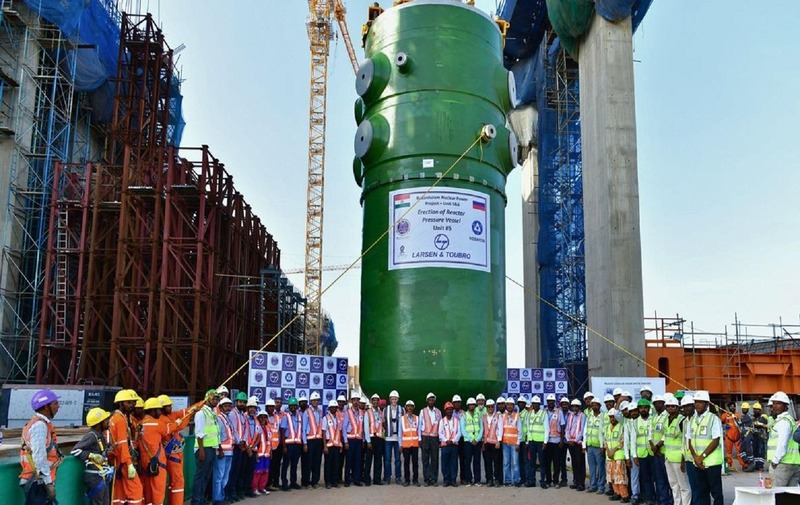
India’s ambitious nuclear energy expansion has crossed another major milestone. The Kudankulam Nuclear Power Plant (KKNPP) in Tamil Nadu has successfully installed the massive reactor pressure vessel (RPV) for Unit 5, marking a crucial step toward strengthening the nation’s clean energy capacity.
The installation, carried out after receiving approval from the Atomic Energy Regulatory Board (AERB), signals the transition of Unit 5 into its next phase of construction. Often called the “heart” of a nuclear reactor, the reactor pressure vessel houses the nuclear fuel and facilitates the controlled fission process that generates electricity.
Weighing around 320 tonnes, the gigantic vessel was manufactured by engineering major Larsen & Toubro and carefully positioned inside the reactor building. According to project officials, this precision operation represents one of the most significant stages in the development of a nuclear reactor.
The vessel’s installation allows engineers to proceed with the placement of other key components, including steam generators, main circulation pumps, pipelines, pressure compensators and emergency core cooling system tanks.
The process was completed using the “open top” method, where a heavy-duty crane lowered the massive structure into the building before the reactor dome is sealed. The same technique had earlier been employed for Units 3 and 4.
The Kudankulam Nuclear Power Plant currently operates two 1,000-megawatt reactors that have been supplying electricity for over a decade. Units 3, 4, 5 and 6 are at various stages of construction, with Units 3 and 4 nearing completion.
Once all six units become operational, the facility will boast an installed capacity of 6,000 MW, making it one of India’s largest nuclear energy hubs.
Adding to the long-term vision, a fourth phase comprising two advanced VVER-1200 reactors—Units 7 and 8—has also been proposed, promising to further elevate India’s nuclear power capabilities. By May 2024, Units 1 and 2 had already generated nearly 130 billion units of electricity. This achievement has helped avoid approximately 112 million tonnes of carbon dioxide emissions, highlighting nuclear power’s role in reducing dependence on fossil fuels and combating climate change.
The Kudankulam project stands as one of the most successful examples of long-standing cooperation between India and Russia. Built using Russian VVER technology, the project continues to advance through close collaboration between experts from both countries.
According to a report in World Nuclear News, Mikhail Novikov, Director of Projects in India at Atomstroyexport, has stated that Indian specialists are constructing and commissioning four power units based on the Russian design, with two more power units generating electricity for over 10 years.
With Unit 5’s “heart” now firmly in place, India’s march toward a powerful, low-carbon energy future has received another significant boost.
.jpeg)
I have a Masters in Literature and a knack for spotting the silver lining! When I’m not chasing good news, you’ll find me nurturing my farm or lost in a good book.