"Dream, Dream, Dream! Conduct these dreams into thoughts, and then transform them into action."
- Dr. A. P. J. Abdul Kalam
"Dream, Dream, Dream! Conduct these dreams into thoughts, and then transform them into action."
- Dr. A. P. J. Abdul Kalam
13 May 2026
Not every museum exhibit begins with a launchpad. Some begin quietly, in an ISRO control room, with a scientist focused on calculations, mission updates, and the pressure of making history.
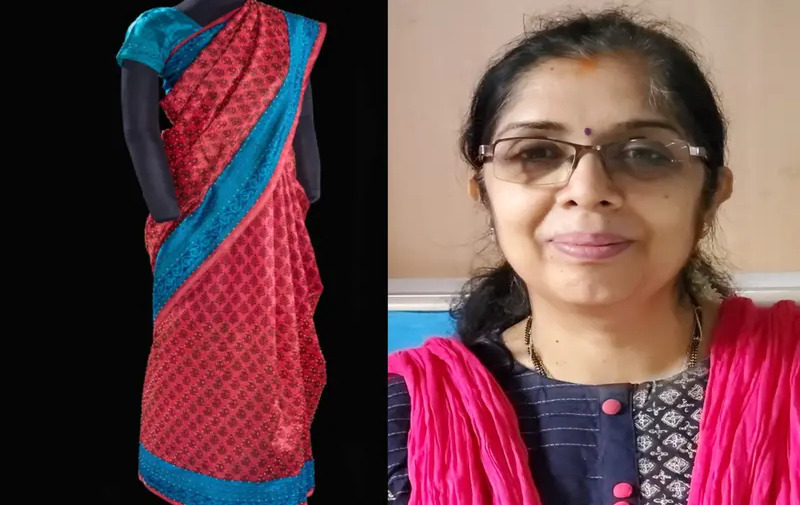
A saree worn by senior ISRO scientist Nandini Harinath has earned a place at the Smithsonian National Air and Space Museum, one of the world’s most respected museums dedicated to aviation and space exploration. The exhibit is not about fashion. It is about symbolism.
It represents the moment India’s ambitious Mars mission took a decisive leap toward history and the women scientists who stood at the center of that achievement.
The saree displayed at the Smithsonian is described as a vibrant red-and-blue drape with intricate patterns. It was the saree Harinath wore to work on the day ISRO’s spacecraft successfully left Earth’s orbit and began its 300-day journey to Mars.
That spacecraft was India’s legendary Mars Orbiter Mission, popularly known as Mangalyaan.
Launched in 2013 from the Satish Dhawan Space Centre, the mission stunned the world when India became the first Asian nation to reach Mars orbit and only the fourth country globally to do so. What made the mission even more remarkable was its efficiency. Built on a modest budget, Mangalyaan became a symbol of India’s scientific capability, innovation, and determination.
The Smithsonian museum shared a detailed note alongside the exhibit, calling Harinath one of India’s “Rocket Women.”
The description states that as the deputy operations director of the Mars Orbiter Mission, Harinath played a key role in mission planning and spacecraft operations.
The museum also highlighted how the spacecraft exceeded expectations. Originally designed for a mission life of six to ten months, Mangalyaan continued orbiting Mars for nearly eight years, documenting the planet’s atmosphere and surface.
The exhibit further recognizes how the sarees worn by women scientists during the mission became symbols of both national identity and India’s rise in space exploration. Over the years, images of women scientists in colorful sarees celebrating mission milestones inside ISRO control rooms became iconic across the world. Those photographs challenged outdated stereotypes about scientists and inspired countless young girls across India.
Born and brought up in India to a mathematics-teacher mother and an engineer father, Harinath built her career through years of dedication to science and engineering. Before joining ISRO, she completed her undergraduate and postgraduate studies in engineering. Over a career spanning more than two decades, she has contributed to over 14 ISRO missions.
Yet, Mangalyaan remains one of the defining chapters of her journey.
Reflecting on the mission’s impact, Harinath once recalled how the success of Mangalyaan captured the imagination of the public far beyond the scientific community. From schools to social media, people across the country celebrated the mission and the scientists behind it.
The recognition from global institutions, including NASA and now the Smithsonian, only strengthened the significance of India’s achievement.
The saree now displayed in the Smithsonian is no ordinary garment. It has become a reminder that history is often created not just through rockets and machines but through the people behind them—their perseverance, identity, and quiet determination.
For millions of Indians, especially young women aspiring to enter STEM fields, the exhibit sends a powerful message: India’s journey to Mars was not only about reaching another planet. It was also about breaking barriers here on Earth.
And now, stitched into the fabric of one saree, that story has become part of global space history.
.jpeg)
I have a Masters in Literature and a knack for spotting the silver lining! When I’m not chasing good news, you’ll find me nurturing my farm or lost in a good book.