"Dream, Dream, Dream! Conduct these dreams into thoughts, and then transform them into action."
- Dr. A. P. J. Abdul Kalam
"Dream, Dream, Dream! Conduct these dreams into thoughts, and then transform them into action."
- Dr. A. P. J. Abdul Kalam
24 Feb 2026
You must have heard about Mike Tyson, the heavyweight boxing legend known for his power and aggression. But this Tyson is different. This Tyson does not fight in a ring. He fights in dense forests, in silence, beside soldiers carrying rifles. And when bullets fly, he does not back down. Meet Tyson, a highly trained sniffer dog of the Indian Army’s 2 Para Special Forces, who was shot during an anti-terror operation in Jammu and Kashmir’s Kishtwar district yet continued advancing to help neutralize terrorists. His story is not just about bravery. It is about loyalty, discipline, and the unbreakable bond between a soldier and his unit.
The dense forests of Kishtwar are not ordinary terrain. Thick vegetation, rugged hills, and unpredictable visibility make it one of the most challenging operational zones in Jammu and Kashmir. It is in such environments that anti-terror operations demand extreme caution and precision. During a recent operation, intelligence inputs indicated the presence of heavily armed militants hiding in the area. The task of locating them fell not just on the soldiers but also on Tyson, a German Shepherd trained in advanced sniffing and tracking techniques. As troops from the Para Special Forces moved carefully through the forest, Tyson led the way. Using his sharp sense of smell and intense focus, he detected signs of militant presence. Every movement he made was calculated, every pause meaningful. In high-risk missions like these, military dogs are often the first line of detection, identifying threats long before human senses can.
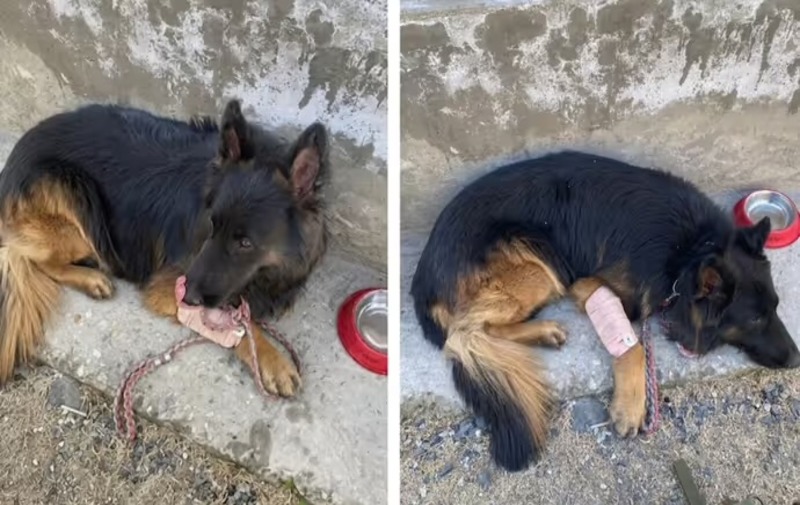
As Tyson approached a suspected hideout, gunfire suddenly erupted. The terrorists, aware of the advancing troops, opened fire directly toward the entry point. Tyson was hit in his front right leg. For most living beings, that moment would mean retreat. Pain, fear, and survival instinct would take over. But Tyson did not turn back. Despite being shot, he continued moving forward toward the door where the terrorists were hiding. His actions confirmed the militants’ exact location, giving the soldiers a tactical advantage at a critical moment. That confirmation allowed the Army to respond swiftly and decisively. In the intense exchange that followed, security forces eliminated all three terrorists, including a senior commander linked to the Pakistan-based terror group. Tyson’s determination, even while injured, played a key role in the success of the operation.
Army dogs are not just companions; they are highly trained combat assets. Units like the Indian Army’s Para Special Forces rely on canine soldiers for detecting explosives, locating hidden weapons, tracking suspects, and identifying ambush threats. German Shepherds, like Tyson, are commonly selected for such roles because of their intelligence, agility, loyalty, and ability to remain calm under pressure. Their training involves months of conditioning, simulation exercises, and exposure to gunfire and combat environments so they can function effectively during real operations. In counter-terror missions, a sniffer dog’s ability to identify hidden militants or explosive materials can save dozens of lives. Often, they are the first to enter confined spaces where threats are suspected. That first step is the most dangerous, and Tyson took it without hesitation.
Immediately after the encounter, Tyson was evacuated for medical treatment. He was taken to the Command Hospital in Udhampur, where doctors attended to his injury. According to officials, he is stable and responding well to care. For the soldiers who fought alongside him, Tyson is not just a trained animal. He is a teammate. A brother in uniform. Military dog handlers form deep emotional bonds with their canine partners. They train together, eat together, and operate in life-threatening situations together. When a dog like Tyson is injured, it is not seen as equipment damage. It is seen as a fellow soldier hurt in the line of duty. In the forests of Kishtwar, a German Shepherd showed the nation what true bravery looks like. And in doing so, Tyson proved that sometimes, the fiercest warriors do not roar—they simply move forward.

Writing about what truly matters, good news and stories to remind the world - it is brighter than we think.