"Dream, Dream, Dream! Conduct these dreams into thoughts, and then transform them into action."
- Dr. A. P. J. Abdul Kalam
"Dream, Dream, Dream! Conduct these dreams into thoughts, and then transform them into action."
- Dr. A. P. J. Abdul Kalam
13 Aug 2026
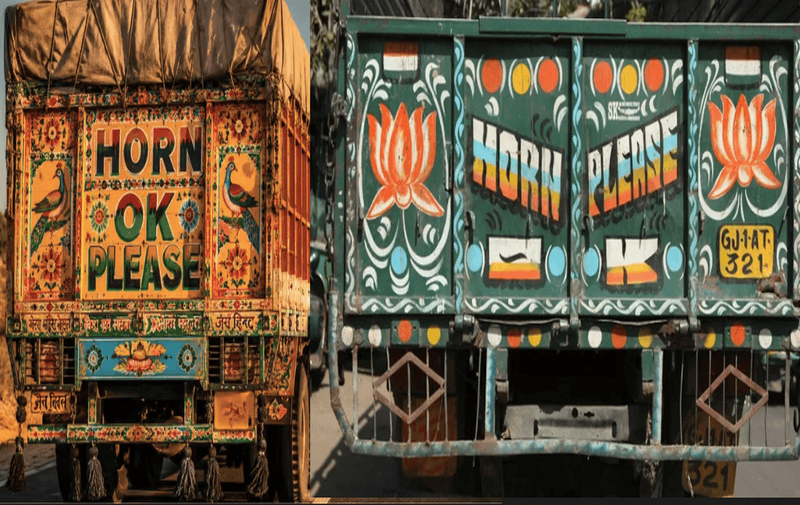
Spot a brightly painted Indian truck and there’s a good chance you’ll see the familiar words: “Horn OK Please.”
For generations, the phrase has been a quirky fixture on the backs of trucks, buses and taxis, usually surrounded by colourful motifs and elaborate South Asian truck art. But what does it actually mean?
Traditionally, the message was aimed at vehicles approaching from behind. If a driver wanted to overtake, they were encouraged to sound the horn and alert the vehicle ahead. It was a simple communication system in an era when roads were often narrower and overtaking required extra caution.
This is where the story gets intriguing. One popular explanation traces the phrase to World War II-era fuel shortages. According to the theory, when diesel was scarce, kerosene was sometimes used in trucks, leading to a warning supposedly reading “Horn Please, On Kerosene.”
There is no definitive proof that this was the phrase’s true origin, and the story remains largely anecdotal. Another colourful theory links the word “OK” to Tata’s early dominance of India’s truck market and an alleged connection to products made by the Tata group’s oil and soap businesses.
Neither explanation has been conclusively established.
The phrase, however, eventually found itself on the wrong side of India’s growing battle against unnecessary honking.
In 2015, the Maharashtra government banned “Horn OK Please” signage on commercial vehicles, arguing that it encouraged motorists to honk unnecessarily and contributed to noise pollution. The ban was welcomed by transport representatives who argued that the phrase had become outdated as India’s roads evolved.
With wider roads and multi-lane highways, drivers could increasingly rely on indicators, headlights and other road signals when overtaking rather than depending on a horn.
Whatever its true origins, “Horn OK Please” became deeply embedded in Indian visual culture. The words became part of the distinctive personality of Indian trucks, alongside painted flowers, birds, landscapes and messages ranging from philosophical to humorous.
Its cultural journey even reached Bollywood, with the 2009 comedy Horn OK Pleasss borrowing the iconic phrase for its title. Today, the words may be less welcome on commercial vehicles in some places, but they remain instantly recognisable.
A few words painted on the back of a truck became a slice of Indian road culture—and perhaps one of the country’s most memorable automotive phrases.
.jpeg)
I have a Masters in Literature and a knack for spotting the silver lining! When I’m not chasing good news, you’ll find me nurturing my farm or lost in a good book.