"Dream, Dream, Dream! Conduct these dreams into thoughts, and then transform them into action."
- Dr. A. P. J. Abdul Kalam
"Dream, Dream, Dream! Conduct these dreams into thoughts, and then transform them into action."
- Dr. A. P. J. Abdul Kalam
22 Jun 2026
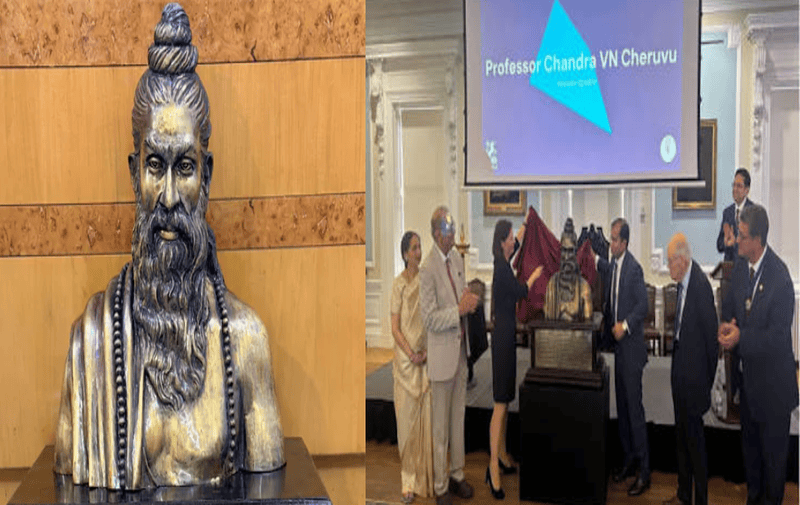
In a moment that bridges centuries of medical knowledge, a bronze statue of Maharishi Sushruta, revered as the Father of Surgery, has been unveiled at the Royal College of Surgeons of Edinburgh in Scotland.
Announced by the Consulate General of India in Scotland, the installation celebrates India’s rich medical heritage and highlights the historical ties between India and Scotland in the fields of medicine and surgery. The ceremony brought together distinguished surgeons, academics, medical professionals and dignitaries from both countries. The event also underscored the Royal College’s contribution to surgical education and training across the globe.
According to a report in News18, the initiative behind the statue came from Professor Chandra Cheruvu, a UK-based surgeon of Indian origin and a specialist in laparoscopic and upper gastrointestinal surgery at the University Hospital North Midlands.
The sculpture was donated by the Cheruvu Family Foundation, established by Professor Cheruvu and his family. Crafted by an artist from Tiruvannamalai in Tamil Nadu, the bronze statue now stands at one of the world’s most prestigious surgical institutions. The Consulate General of India expressed gratitude to Professor Cheruvu and the Royal College of Surgeons for making the initiative possible, describing it as a fitting tribute to India’s ancient scientific legacy.
Long before the advent of modern medicine, Maharishi Sushruta was laying the foundations of surgery. Believed to have lived around 600 BCE and traditionally associated with the ancient city of Varanasi, Maharishi Sushruta authored the Sushruta Samhita, one of the most important texts in the history of medicine.
The ancient Sanskrit treatise contains detailed descriptions of surgical procedures, medical instruments and techniques. Historians and medical scholars often regard his work as centuries ahead of its time. Many surgical instruments described in the text were inspired by shapes found in nature and the animal world.
The unveiling gains added significance because it took place at the Royal College of Surgeons of Edinburgh, considered the world’s oldest surgical institution.
Founded in 1505 and granted royal assent by King James IV of Scotland in 1506, the institution has preserved records dating back to 1581. Today, it remains one of the leading centres for surgical education and training worldwide.
The presence of Maharishi Sushruta’s statue at this historic venue symbolizes a meeting of ancient wisdom and modern science.
The installation is more than a tribute to a legendary physician. It is a recognition of the timeless value of knowledge and the enduring contributions of Indian civilisation to global medicine. More than 2,600 years after he practised in ancient India, Maharishi Sushruta’s legacy now stands immortalised in Scotland, inspiring generations of surgeons across the world.
.jpeg)
I have a Masters in Literature and a knack for spotting the silver lining! When I’m not chasing good news, you’ll find me nurturing my farm or lost in a good book.