"Dream, Dream, Dream! Conduct these dreams into thoughts, and then transform them into action."
- Dr. A. P. J. Abdul Kalam
"Dream, Dream, Dream! Conduct these dreams into thoughts, and then transform them into action."
- Dr. A. P. J. Abdul Kalam
30 Jan 2026
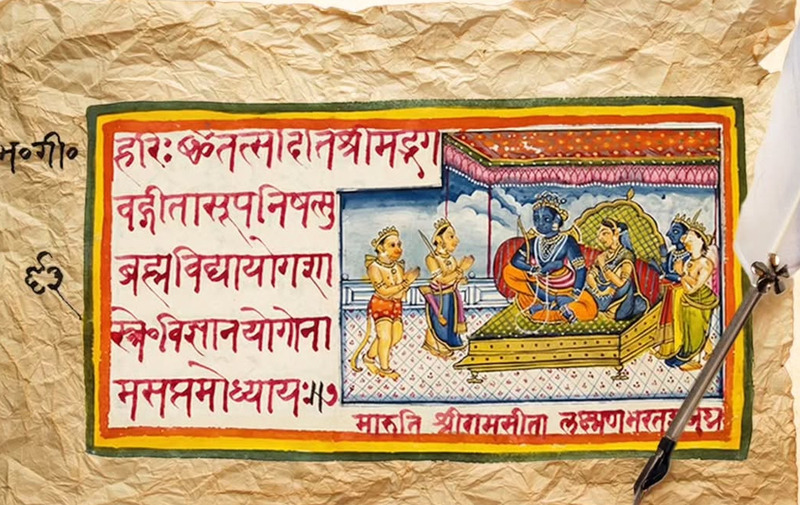
In a quiet room filled with palm-leaf manuscripts, the past is meeting the future. As the world races ahead with artificial intelligence trained on modern languages and internet data, India has taken a deeply rooted and ambitious step developing its first native Sanskrit Large Language Model (LLM) using more than 110,000 rare manuscripts. This is not merely a technological project; it is a civilisational moment, where centuries-old knowledge systems are being reimagined for the digital age.
Led by a unique collaboration between the 118-year-old Madras Sanskrit College, IIT Madras, and the Kuppuswami Sastri Research Institute in Chennai, the initiative seeks to build an AI that does not just read Sanskrit but truly understands it.
What makes this project extraordinary is the unlikely yet powerful partnership behind it. On one side stand traditional Sanskrit scholars, custodians of texts passed down through generations. On the other are engineers and computer scientists from IIT Madras, experts in algorithms, data and machine learning. Madras Sanskrit College, established in 1906, brings with it a living tradition of Sanskrit education. The Kuppuswami Sastri Research Institute contributes decades of research and preservation of classical texts. IIT Madras provides the technological backbone. Together, they represent a rare bridge between India’s intellectual past and its technological future.
Unlike most language models that rely on translation or surface-level pattern matching, this Sanskrit LLM is being built from the ground up. The goal is not to create another Optical Character Recognition tool or a simple translator, but an AI that understands the logical, grammatical and semantic depth of Sanskrit. Sanskrit is a highly structured language, governed by precise grammatical rules laid down by scholars like Panini over 2,000 years ago. Concepts such as Sandhi, where sounds merge and transform, and complex sentence constructions make the language challenging even for modern computers. This project aims to teach AI these rules intrinsically, allowing it to reason through Sanskrit rather than approximate it.
At the heart of the project lies a massive digitisation effort. Over 110,000 rare manuscripts, including palm-leaf texts and classical Shastras, are being converted into machine-readable digital formats. These texts span literature, philosophy, logic, mathematics, astronomy, medicine and metaphysics. Custom-built software has already digitised more than 70,000 Sanskrit books with an impressive 97 percent accuracy. But technology alone is not trusted blindly. Sanskrit scholars carefully verify, correct and curate the digitised texts before they are used to train the AI. This human-in-the-loop approach ensures that errors do not compound and that the AI learns from authentic, reliable sources.
This project represents a shift towards what researchers call “precision-first” language modelling. Instead of training AI on vast amounts of loosely structured data and letting it guess patterns, the Sanskrit LLM is being trained to respect structure, logic and rule-based reasoning. Sanskrit’s grammar is almost mathematical in nature, making it uniquely suited for such an approach. By embedding these rules into AI systems, researchers believe Sanskrit could become a computational language—a medium through which machines reason more accurately, consistently and transparently.
India’s first Sanskrit LLM is more than an AI experiment; it is a statement. It says that progress does not require forgetting the past and that ancient wisdom still has a role to play in shaping tomorrow’s technology. As palm-leaf manuscripts become lines of code, India is quietly redefining what the future of artificial intelligence can look like: rooted, rigorous and remarkably human.
Romanticizing life and shaping stories from everything I see through my journalistic lens. Also, I love sports on the side.