"Dream, Dream, Dream! Conduct these dreams into thoughts, and then transform them into action."
- Dr. A. P. J. Abdul Kalam
"Dream, Dream, Dream! Conduct these dreams into thoughts, and then transform them into action."
- Dr. A. P. J. Abdul Kalam
12 May 2026
In the lush green landscapes of Assam’s Bodoland region, where beekeeping has long been woven into tradition and daily life, a historic milestone has now put local honey on the global map.
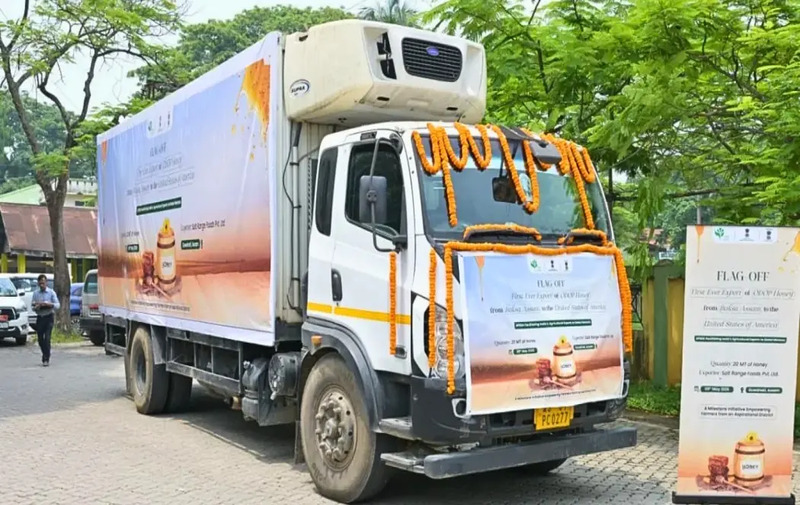
For the first time ever, 20 metric tonnes of honey from Baksa district have been exported to the United States, marking a major breakthrough for the state’s agricultural exports and rural economy.
The export was carried out under India’s One District One Product initiative with support from Agricultural and Processed Food Products Export Development Authority (APEDA). Flagged off on May 9, the shipment was exported by Salt Range Foods Pvt Ltd and is being celebrated as a defining moment for Assam’s farmers, especially the hundreds of small beekeepers who contributed to the consignment.
Behind this export success are nearly 500 local farmers and beekeepers from the Bodoland region whose honey has now reached international markets for the very first time.
For generations, indigenous communities, including the Bodo tribe, Karbi tribe, and Mishing tribe have practised honey collection not merely as a livelihood, but also as part of their food traditions, medicine, and culture.
Now, that age-old knowledge is creating global economic opportunities. According to the Commerce and Industry Ministry, farmers involved in the initiative are expected to receive nearly 43 per cent higher prices compared to regular local farm gate rates, a significant boost for rural households dependent on agriculture and forest-based livelihoods.
The development is being viewed as a model for how local products from remote regions can compete successfully in international markets.
Honey from Baksa district is known for its high quality, purity, and near-organic characteristics. Produced in eco-friendly and pesticide-free environments, the honey reflects the rich biodiversity of Assam’s forests and sustainable agricultural practices followed by local communities.
The district was identified under the ODOP programme due to its strong honey production potential and growing reputation for premium-quality natural honey. According to National Horticulture Board data, Assam produced around 1,650 metric tonnes of honey during the financial year 2023–24.
Major honey-producing districts include Baksa, Kokrajhar, Chirang, Udalguri, and Tamulpur within the Bodoland Territorial Region.
With increasing global demand for natural and sustainably sourced food products, Assam’s honey industry could now emerge as a major export sector for the Northeast.
To make the export possible, APEDA played a crucial role in strengthening infrastructure and ensuring that the honey met international quality and food safety standards.
The authority supported testing facilities and laboratory equipment at processing centres, helping exporters comply with strict global regulations.
Officials believe the initiative is not only about exporting honey, but also about integrating farmers from Aspirational Districts into global value chains and creating long-term market access. The ODOP initiative itself was designed to promote district-specific products, encourage value addition, strengthen local economies, and generate employment opportunities by connecting regional specialties with international buyers.
For Assam, this is more than just a shipment. It is a story of small farmers reaching global shelves, indigenous traditions gaining international recognition, and rural communities finding new pathways to prosperity.
From the forests of Baksa to supermarkets in the United States, this golden honey now carries with it the hopes of hundreds of families and the promise of a sweeter future for Assam’s rural economy.
.jpeg)
I have a Masters in Literature and a knack for spotting the silver lining! When I’m not chasing good news, you’ll find me nurturing my farm or lost in a good book.