"Dream, Dream, Dream! Conduct these dreams into thoughts, and then transform them into action."
- Dr. A. P. J. Abdul Kalam
"Dream, Dream, Dream! Conduct these dreams into thoughts, and then transform them into action."
- Dr. A. P. J. Abdul Kalam
3 Mar 2026
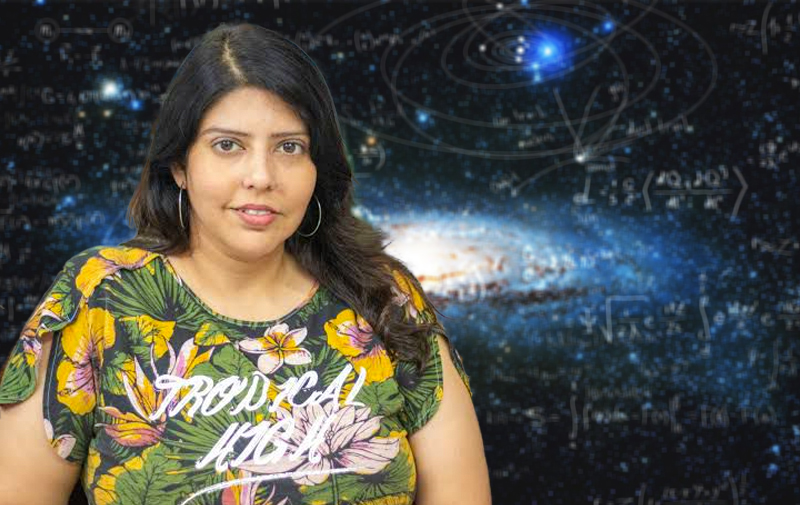
In a field where the universe is studied in silence and equations stretch across blackboards like constellations, a quiet yet powerful milestone has been achieved. Astrophysicist Debarati Chatterjee has become the first woman professor at the Inter-University Centre for Astronomy and Astrophysics (IUCAA) in Pune, a moment that is both historic and deeply inspiring. Her achievement is not just about a designation. It represents a shift in Indian science, where more women are stepping into leadership roles in cutting-edge research.
Prof. Debarati Chatterjee is a theoretical astrophysicist who works on some of the most mysterious objects in the universe—compact stars such as neutron stars and white dwarfs. These are not ordinary stars. They are the dense remains left behind after massive stellar explosions. A teaspoon of neutron star material would weigh billions of tonnes on Earth. Her expertise lies in creating both analytical and numerical models to understand how these stars behave. She studies them from two connected perspectives: the microscopic and the macroscopic. On the microscopic level, she works with concepts from nuclear physics, particle physics, and even superconductivity. On the macroscopic scale, she studies magnetic fields and Einstein’s theory of relativity. By combining these two levels consistently, she helps improve astrophysical simulations. This is crucial in the age of multi-messenger astronomy, where scientists study cosmic events not only through light but also through gravitational waves and other signals. Her work helps decode what these cosmic messages are really telling us.
The Inter-University Centre for Astronomy and Astrophysics is one of India’s leading research institutions in space science. It was set up by the University Grants Commission of India to promote astronomy and astrophysics research in universities across the country. Located on the University of Pune campus, IUCAA stands next to the National Centre for Radio Astrophysics, which operates the Giant Metrewave Radio Telescope, one of the world’s largest radio telescope arrays. The IUCAA campus itself is a blend of science and art, designed by renowned Indian architect Charles Correa. The buildings are structured to inspire collaboration, discussion, and quiet reflection, fitting for a place that studies the universe. Scientists at IUCAA work in diverse fields, including classical and quantum gravity, cosmology, gravitational waves, optical and radio astronomy, solar system physics, and advanced instrumentation. It is within this intellectually rich environment that Prof. Chatterjee now steps into her historic role.
One of the most fascinating aspects of Prof. Chatterjee’s work is how it connects theoretical physics to real astronomical observations. With the rise of gravitational wave detection and advanced telescopes, astronomers are receiving more data than ever before. But raw data alone does not reveal meaning. It requires strong theoretical frameworks to interpret it correctly. Her global models of compact stars aim to bridge this gap. By incorporating both nuclear interactions at the smallest scale and gravitational effects at the largest scale, she strengthens the scientific foundation behind astrophysical simulations. This improves our understanding of neutron star collisions, events that produce gravitational waves and heavy elements like gold and platinum.
IUCAA is not just about research; it is about nurturing talent across India. Through its Virtual Observatory project, run in collaboration with Persistent Systems in Pune, researchers and students gain access to raw observational data and advanced processing tools. This opens doors for young minds who may not have direct access to large telescopes. The centre also operates the Girawali Observatory, located near Junnar, about 80 kilometers from Pune. Its two-meter telescope, equipped with the IUCAA Faint Object Spectrograph and Camera (IFOSC), supports both research and training. Importantly, IUCAA reserves specific observation time for university students, ensuring that learning is not limited to elite institutions.
Prof. Chatterjee’s presence as a professor strengthens this academic ecosystem. For aspiring women scientists, seeing a woman in such a position transforms what once felt distant into something possible. As India expands its footprint in global astronomy, leadership diversity becomes essential. Different perspectives bring richer questions and deeper understanding. In studying neutron stars, objects born from explosive cosmic endings, Prof. Debarati Chatterjee is also shaping powerful new beginnings for Indian science. The universe is vast and silent. But sometimes, milestones like this echo louder than the most distant supernova.

Romanticizing life and shaping stories from everything I see through my journalistic lens. Also, I love sports on the side.