"Dream, Dream, Dream! Conduct these dreams into thoughts, and then transform them into action."
- Dr. A. P. J. Abdul Kalam
"Dream, Dream, Dream! Conduct these dreams into thoughts, and then transform them into action."
- Dr. A. P. J. Abdul Kalam
12 Mar 2026
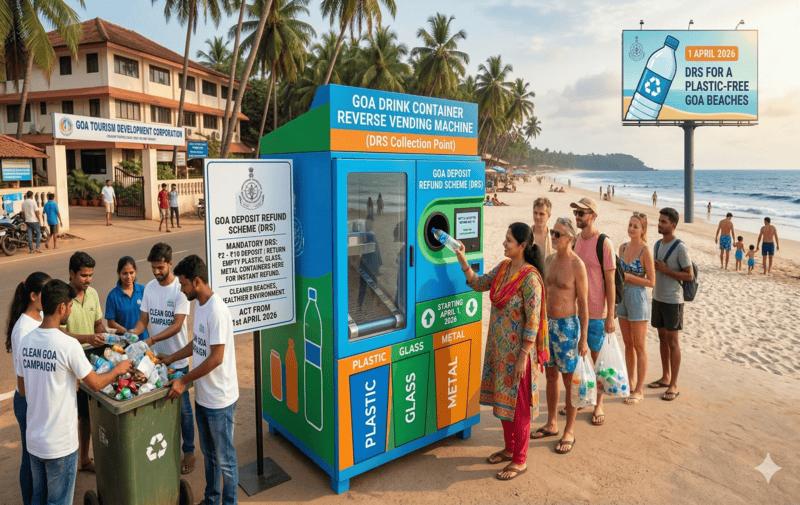
Imagine finishing a cold drink on a beach and knowing that the empty bottle in your hand still holds value. Soon, that will become reality in Goa. Starting April 1, 2026, the state will introduce a new environmental initiative called the Deposit Refund Scheme (DRS), a system designed to change how people see waste. Under this plan, every time someone buys a drink packaged in plastic bottles, glass bottles, or metal cans, they will pay a small additional amount, usually between ₹2 and ₹10 depending on the size of the container. But this money is not lost. It is simply a deposit waiting to be reclaimed.
When the empty bottle or can is returned to an authorized collection point or machine, the deposit comes back to the consumer. In simple words, the bottle that once looked like trash suddenly becomes something worth returning. The initiative will first focus mainly on beverage packaging, especially liquor bottles, which form a significant part of waste in tourist areas. Over time, the system may expand to include more types of packaging. With this small but clever change, Goa hopes to transform the everyday act of throwing away a bottle into an opportunity for responsible action.
The beauty of the Deposit Refund Scheme lies in its simplicity. When someone purchases a beverage, a “Green Deposit” will automatically be added to the product’s Maximum Retail Price (MRP). Think of it as a temporary payment that waits patiently to return to its owner. Across the state, more than 300 collection centres and reverse vending machines are expected to be set up so people can easily return their empty containers. The process is meant to be quick and hassle-free. A person can simply drop the empty bottle or can into a machine or scan a QR code at a return point to receive their refund.
The scheme covers commonly used beverage packaging materials such as plastic bottles, glass bottles, and metal cans. But the responsibility does not fall on consumers alone. Manufacturers will also participate by adding QR codes to products and registering their packaging so every returned container can be identified and tracked. This collaboration between consumers, producers, and authorities creates what experts call a circular system, where materials are reused again and again instead of being thrown away after a single use.
Few places in India capture the imagination like Goa. Its golden beaches, lively culture, and vibrant tourism attract millions of visitors every year. But popularity also brings a serious challenge - waste. With large numbers of tourists comes an equally large number of discarded bottles and cans. Many of these end up scattered across beaches, roadsides, and public spaces. Broken glass in particular has been a growing concern, sometimes causing injuries to people walking barefoot along the sand. The Deposit Refund Scheme is designed to tackle exactly this problem.
By placing a small monetary value on every bottle, the system encourages people to return containers instead of leaving them behind. What might once have been tossed aside now becomes something worth keeping until it reaches a return point. Over time, this simple incentive could lead to fewer bottles on beaches, safer public spaces, and cleaner tourist destinations. If successful, the initiative could not only reduce pollution but also strengthen Goa’s image as a place that values both tourism and environmental responsibility.
Like any new idea, the scheme has sparked both excitement and debate. While many environmental advocates see it as a powerful step toward better waste management, some concerns have also been raised. Small shop owners, for example, worry about where they will store returned bottles in crowded markets where space is already limited. Meanwhile, the Goa Women’s Forum has suggested that the policy should be reconsidered or modified, proposing alternative ways to handle waste. Despite these discussions, experts point out that deposit refund systems have been successfully used in many countries around the world.
Organizations such as the Association of Plastic Recyclers have often highlighted how these systems dramatically improve recycling rates because they motivate people directly. If Goa manages to implement the scheme effectively, it could become a powerful example for other Indian states struggling with plastic pollution and packaging waste. For students and young citizens, the lesson is equally important. Environmental change does not always begin with massive movements or complex technology. Sometimes it begins with something as simple as returning an empty bottle. And when thousands of people choose to do that small act together, the impact can be far bigger than anyone expects.

Writing about what truly matters, good news and stories to remind the world - it is brighter than we think.